ApoB Test: What Apolipoprotein B Reveals About Heart Risk and Biological Age
An ApoB test counts atherogenic particles, not cholesterol mass. How it differs from LDL-C and Lp(a), who should order it, and why Nuvo does not score it.
Written by the Nuvo Longevity editorial team at Firefly Labs LLC.
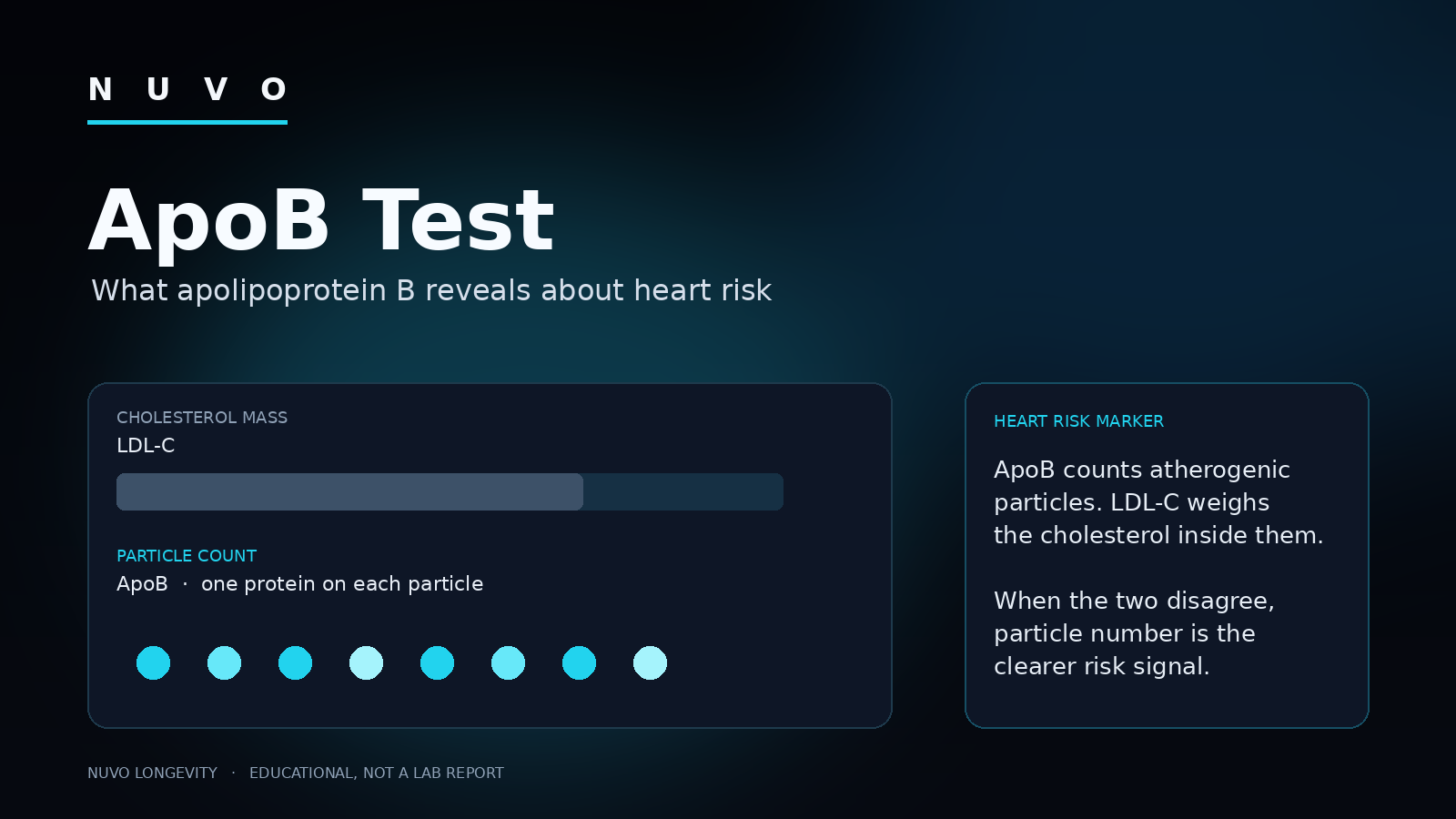
An ApoB test measures apolipoprotein B, the protein present as one molecule on each atherogenic lipoprotein particle — LDL, VLDL, IDL, and Lp(a). Because the cholesterol inside those particles varies, ApoB is a count of particles, and guidelines treat it as a clearer atherosclerotic-risk signal than LDL cholesterol when the two disagree. It does not calculate biological age: ApoB is not an input to the PhenoAge blood clock, and it is not one of the 21 biomarkers Nuvo uses for a daily score.
Written by the Nuvo Longevity editorial team at Firefly Labs LLC, the developer of Nuvo. Guideline targets and trial results below are taken from the 2019 ESC/EAS dyslipidaemia guideline, the 2018 AHA/ACC cholesterol guideline, the 2024 National Lipid Association expert consensus on ApoB, and the peer-reviewed papers cited in the sources. Cash prices were read from Labcorp OnDemand and Quest Health on 27 October 2026 and can change. This page is educational and is not medical advice. Lipid-lowering drugs are decisions for a licensed clinician.
What an ApoB test measures
Apolipoprotein B is the structural protein on lipoproteins that can enter the artery wall. Each LDL, VLDL, IDL, and Lp(a) particle carries one ApoB molecule, so the concentration in blood is a count of those particles. LDL cholesterol (LDL-C) is different: it is the mass of cholesterol packed inside LDL particles. Two people can share an LDL-C number and have very different particle counts if one person’s particles are cholesterol-rich and the other’s are cholesterol-poor.
Sniderman and colleagues, in a 2019 narrative review in JAMA Cardiology, put the mechanism in one line: cholesterol can enter the artery wall only inside ApoB particles, and the mass of cholesterol per particle is variable. Trapping of those particles, not the cholesterol number on the lab sheet by itself, is what starts and sustains atherosclerosis. Their conclusion is that ApoB unifies the information in the usual lipid markers for the risk that comes from ApoB lipoproteins. They also note two exceptions to the “all ApoB particles are equally atherogenic” simplification: abnormal chylomicron remnants in type III hyperlipoproteinemia, and Lp(a).
A separate genetic analysis points the same direction. Ference and colleagues (JAMA, 2019) compared triglyceride-lowering variants in the lipoprotein lipase gene with LDL-C-lowering variants in the LDL receptor gene across 654,783 people. Per 10 mg/dL lower ApoB, the two genetic scores lined up with a similar lower risk of coronary heart disease. After the analysis adjusted for ApoB, the associations of triglycerides and LDL-C with coronary disease were no longer evident. That is population genetics, not a personal diagnosis, and it is why particle number keeps showing up next to the standard panel.
ApoB vs LDL-C vs non-HDL-C vs Lp(a)
These four results are often drawn on the same morning and then treated as synonyms. They are not.
| Marker | What the number is | What it does not tell you | How major guidance uses it |
|---|---|---|---|
| ApoB | Concentration of ApoB protein. One molecule per atherogenic particle, so it tracks particle number (LDL, VLDL, IDL, and Lp(a)). | How much cholesterol is inside each particle, and how much of the count is Lp(a) rather than ordinary LDL. | 2019 ESC/EAS: secondary goals of <65, <80, and <100 mg/dL for very-high, high, and moderate risk. 2024 NLA: thresholds of 60, 70, and 90 mg/dL to consider intensifying therapy at very-high, high, and borderline-to-intermediate risk. 2018 AHA/ACC: ApoB ≥130 mg/dL is a risk-enhancing factor, not a treatment goal. |
| LDL-C | Cholesterol mass inside LDL particles, measured or calculated from the lipid panel. | Particle number when particles are cholesterol-poor or cholesterol-rich. Cholesterol carried in VLDL and remnant particles. | Primary treatment target in both the 2018 AHA/ACC guideline and the 2019 ESC/EAS guideline. Goals depend on risk (for example, ESC very-high risk: at least a 50% reduction and <55 mg/dL). |
| Non-HDL-C | Total cholesterol minus HDL cholesterol. Cholesterol mass in every ApoB-containing particle, including remnants. | Still a mass, not a particle count. Can disagree with ApoB. | 2019 ESC/EAS secondary goals of <85, <100, and <130 mg/dL for very-high, high, and moderate risk — about 30 mg/dL above the matching LDL-C goal. Useful when triglycerides are high. No extra test: it is arithmetic from a standard panel. |
| Lp(a) | A subclass of ApoB particles that also carry apolipoprotein(a). Reported in mg/dL or nmol/L. Those units are not interchangeable. | The rest of your ApoB particles. A normal ApoB does not rule out a high Lp(a). | 2019 ESC/EAS: measure at least once in adulthood. 2018 AHA/ACC: if measured, ≥50 mg/dL or ≥125 nmol/L is a risk-enhancing factor, especially with a family history of premature disease. Mostly inherited; diet and statins do not meaningfully lower it. |
Non-HDL cholesterol is the practical bridge. You can calculate it from any standard lipid panel, and it captures remnant cholesterol that LDL-C leaves out. The 2019 ESC/EAS dyslipidaemia guideline still prefers ApoB over non-HDL-C in people with high triglycerides, diabetes, obesity, or very low LDL-C, because those are the settings where cholesterol mass and particle number most often split.
Reference range vs a risk-based goal
A laboratory reference interval is a population cutoff printed by that lab. It is not a treatment goal, and it is not the same number from one lab to the next. Do not treat the edge of the “normal” bar as optimal.
Three published frameworks are in common use, and they answer different questions:
- 2018 AHA/ACC cholesterol guideline. In the top-line recommendations, apolipoprotein B ≥130 mg/dL is a risk-enhancing factor when it is measured, alongside Lp(a), hs-CRP, and others. The measurement section says a level above 130 mg/dL corresponds to an LDL-C of about 160 mg/dL or higher, and that a relative reason to measure ApoB is triglycerides ≥200 mg/dL. This is a flag for the statin discussion in primary prevention, not a target to treat toward. Source: Grundy et al., Circulation, 2018 guideline.
- 2019 ESC/EAS guideline. ApoB secondary goals are <65 mg/dL (very-high risk), <80 mg/dL (high risk), and <100 mg/dL (moderate risk). The guideline is explicit that these secondary goals were inferred rather than proven as independent trial endpoints, and that LDL-C remains the primary target. ApoB analysis is recommended for risk assessment particularly in people with high triglycerides, diabetes, obesity or metabolic syndrome, or very low LDL-C. It can be used as an alternative to LDL-C, and may be preferred over non-HDL-C in those groups.
- 2024 National Lipid Association expert consensus. Soffer and colleagues argue for using ApoB together with a standard lipid panel both before treatment and on treatment, because LDL-C and ApoB (and LDL-C and non-HDL-C) often disagree in an individual even when they correlate across a population. When they disagree, risk tracks ApoB or non-HDL-C more closely. For considering intensification of lipid-lowering therapy, the consensus suggests ApoB thresholds of 60 mg/dL (very high risk), 70 mg/dL (high risk), and 90 mg/dL (borderline to intermediate risk). Those are expert-consensus thresholds for a treatment conversation, not a universal “optimal” for every adult.
There is no single ApoB number that guidelines call optimal for everyone. A result of 95 mg/dL can be acceptable context for one risk category and a reason to intensify therapy in another. The report’s reference range will not make that distinction for you.
Who should test, and how often
ApoB is a blood test, not a wearable metric. You order it when particle number would change a decision that LDL-C alone might get wrong.
The groups called out most often:
- High triglycerides, diabetes, obesity, or metabolic syndrome — the ESC list, and the setting where the 2018 guideline says ApoB measurement has an advantage (triglycerides ≥200 mg/dL is the relative indication in that document).
- Very low LDL-C on treatment, where calculated LDL-C is less reliable and a particle count shows whether atherogenic particles actually came down.
- A family history of premature atherosclerotic disease. That history is also a reason to measure Lp(a), which ApoB does not replace.
- Someone whose LDL-C looks “at goal” but who still has insulin resistance, high triglycerides, or a low HDL. Discordance is the use case, not a routine add-on for its own sake.
How often depends on whether treatment is changing.
The 2018 AHA/ACC guideline says to assess adherence and response with a repeat lipid measurement 4 to 12 weeks after a statin is started or the dose is adjusted, then every 3 to 12 months as needed. If you and your clinician are following ApoB, draw it on that same cadence rather than inventing a separate calendar. If you are not on lipid-lowering therapy and the result sits comfortably for your risk, the guidelines do not mandate a quarterly ApoB. Repeating a focused panel on a schedule you can keep is a monitoring choice; our quarterly biomarker routine covers how to build that habit without turning every marker into a weekly test.
Lp(a) is the exception to “repeat with the lipid panel.” The 2019 ESC/EAS guideline says Lp(a) measurement should be considered at least once in each adult’s lifetime, to find people with very high inherited levels. The 2018 EAS/EFLM consensus on atherogenic lipoproteins (Langlois et al.) says Lp(a) should not be part of every repeated lipid profile, because the level varies little across life, unless a treatment known to change it has been started. One lifetime Lp(a), plus ApoB when particle number is the question, is the pattern those documents describe.
How to order an ApoB test
Two routes are ordinary. Neither is a diagnosis.
Through your own clinician. ApoB can be added to a fasting or nonfasting lipid order. The 2018 guideline allows either for treatment monitoring and notes that ApoB measurement can mean extra cost, and that not every laboratory’s assay is equally solid. Coverage depends on the plan. Ask for ApoB by name, and ask whether Lp(a) belongs on the same draw if you have never had one.
Direct-to-consumer labs. A consumer site pairs a blood draw with a physician authorization so you do not arrive with your own prescription. Availability and the cash price depend on the company and your state. Two public list prices we checked on 27 October 2026:
- Labcorp OnDemand’s standalone ApoB test (SKU 167015) showed a list price of $69.00 and a displayed promotional price of $51.75. The same page says “no special preparation needed” in the test details and, in the FAQ, fasting for 12–14 hours. Follow the instructions on the order you actually receive.
- Quest Health’s Advanced Heart Health Test Panel (with ApoB) was listed at $215.00 plus a $6.00 physician service fee. That is not a standalone ApoB price. The panel also includes a lipid panel, Lp(a), and hs-CRP, among other markers.
A clinician-ordered test billed to insurance is a third number, and we are not quoting it. Prices, promotions, and draw fees change. Confirm the total at checkout.
For how ApoB sits inside a broader longevity panel — next to HbA1c, hs-CRP, and the rest of a blood draw that is built to look at aging rather than only acute disease — see which blood panels tell you the most about rate of aging.
Lp(a) is inside the ApoB count, and still needs its own test
Each Lp(a) particle contributes one ApoB. A very high Lp(a) can therefore push ApoB up. The reverse is not true: ApoB cannot tell you what share of the count is Lp(a), and a comfortable ApoB does not clear a high Lp(a). Sniderman’s 2019 review treats Lp(a) as an exception to the idea that every ApoB particle carries the same risk per particle.
Lp(a) level is mostly inherited. The usual diet changes and statin therapy do not lower it in a useful way. Some PCSK9 antibodies lower Lp(a) modestly while they lower LDL-C a lot; that is not the same as a therapy chosen to treat Lp(a). If a parent or sibling had a heart attack young, the once-in-adulthood Lp(a) is the test to add, even if ApoB is already on the form.
What can lower ApoB
Anything that reduces the number of ApoB particles can move the test. Cholesterol mass and particle number do not always fall by the same percent, which is why a clinician sometimes repeats ApoB after LDL-C looks improved. The steps below are the ones with a paper trail. They are not a protocol, and they are not a promise about biological age.
Diet, viscous fiber, and weight
The 2018 guideline’s first recommendation is a heart-healthy eating pattern across life, before and alongside any drug. For LDL cholesterol specifically, replacing saturated fat with unsaturated fat is the dietary change with the longest trail. Viscous (soluble) fiber has a smaller, measured effect on cholesterol mass. Brown and colleagues (American Journal of Clinical Nutrition, 1999) pooled 67 controlled trials and found that 2–10 g/day of soluble fiber was tied to small decreases in total and LDL cholesterol — about 0.057 mmol/L (roughly 2 mg/dL) of LDL cholesterol per gram of soluble fiber — with no significant change in HDL or triglycerides. Their own example: 3 g of soluble fiber from oats lowered total and LDL cholesterol by about 0.13 mmol/L. That paper measured cholesterol, not ApoB. It is fair to call the fiber effect real and small, and inaccurate to treat a bowl of oatmeal as a substitute for a risk-based goal.
The National Lipid Association’s nutrition perspective (Kirkpatrick et al., Journal of Clinical Lipidology, 2023) reviews nutrition interventions for adults with dyslipidemia. Weight loss in people with excess weight tends to improve triglycerides and the metabolic setting where ApoB and LDL-C disagree. We are not quoting a percent drop in ApoB from a given number of pounds; that depends on where you started.
Exercise
Aerobic training is a weak lever on LDL-C and ApoB next to diet quality or a statin, and a stronger lever on triglycerides, fitness, resting heart rate, and VO2 max. Use it because cardiovascular fitness predicts mortality on its own — see what Apple Watch cardio fitness means for biological age — not because a month of zone 2 will reproduce a drug effect on particle number. If exercise is your only change and ApoB stays high for your risk category, that result is still a clinician conversation.
Statins, ezetimibe, and PCSK9 inhibitors
These are prescription decisions. This section describes trial evidence. It is not a dose, a product recommendation, or an instruction to start or stop a drug.
When a clinician decides medication is warranted, a statin is the usual first drug. The 2018 guideline frames high-intensity statin therapy as an LDL-C reduction of about 50% or more in secondary prevention and in severe hypercholesterolemia. Statins clear ApoB particles by increasing LDL-receptor activity. The 2024 NLA consensus notes that ApoB can still disagree with LDL-C on treatment, so the particle count is worth rechecking when the treatment decision is borderline.
Ezetimibe blocks cholesterol absorption in the gut and is an add-on, not a first step for most people. In IMPROVE-IT (Cannon et al., New England Journal of Medicine, 2015), adding ezetimibe to simvastatin in people recently hospitalized with acute coronary syndrome produced a lower time-weighted average LDL-C (53.7 mg/dL versus 69.5 mg/dL on simvastatin alone) and a modest further reduction in cardiovascular events over a median of six years. The 2018 guideline says it is reasonable to add ezetimibe when a person at very high risk stays at or above 70 mg/dL LDL-C on a maximally tolerated statin.
PCSK9 inhibitors are monoclonal antibodies, given by injection, that keep LDL receptors available to clear ApoB particles. In FOURIER (Sabatine et al., New England Journal of Medicine, 2017), evolocumab on top of statin therapy lowered LDL-C by 59% at 48 weeks, from a median of 92 mg/dL to 30 mg/dL, and reduced cardiovascular events in people who already had atherosclerotic disease. The 2018 guideline discusses a PCSK9 inhibitor after maximally tolerated statin plus ezetimibe in very-high-risk patients whose LDL-C remains ≥70 mg/dL, and it flags cost and the limits of what was known about long-term safety at the time. Those trial abstracts report LDL-C and events. They are the evidence a clinician uses; they are not a shopping list.
Bring the ApoB result, the LDL-C, triglycerides, Lp(a) if you have it, and your own risk history to that visit. Do not adjust a statin, ezetimibe, or a PCSK9 inhibitor from an article.
ApoB and biological age are different questions
Biological age is an estimate of risk and physiology relative to birthday age. The blood clock most often cited, phenotypic age, was built by Levine and colleagues (Aging, 2018) from nine chemistry markers: albumin, creatinine, glucose, C-reactive protein, lymphocyte percentage, mean cell volume, red cell distribution width, alkaline phosphatase, and white blood cell count. ApoB is not one of them. A lower ApoB does not automatically make a PhenoAge number younger, and a young PhenoAge does not tell you your ApoB.
What ApoB reveals about aging is narrower and more useful: atherogenic particle burden is a cardiovascular mechanism that those clocks do not capture. You can be “normal” on a standard metabolic panel and still carry a high ApoB. That is the gap a longevity-oriented blood panel is trying to close, and it is separate from the question of whether last night’s sleep moved a daily score.
HbA1c is the blood marker that does sit in both conversations. It is a three-month glucose average, it is one of Nuvo’s lab inputs, and chronically high glucose is one of the metabolic settings where ApoB and LDL-C tend to disagree. Tracking HbA1c does not substitute for an ApoB test. It tells you whether the metabolic background around that lipid result is moving.
What to track between ApoB draws
Nuvo Longevity is an iPhone and Apple Watch app from Firefly Labs LLC (App Store: Nuvo: Longevity Coach, id 6762535065). It reads Apple Health through HealthKit, optionally uses lab results you enter for the markers it supports, and computes a daily biological age with on-device AI. No account is required. Apple’s App Store privacy label is “Data Not Collected.” After a 7-day free trial, Nuvo Premium is $4.99/month or $24.99/year.
ApoB is not one of Nuvo’s 21 biomarkers. The published set is five blood markers — HbA1c, fasting glucose, HDL cholesterol, CRP, and creatinine — plus wearable signals such as VO2 max, resting heart rate, heart-rate variability, sleep, and heart-rate recovery. The full list, and why each one was chosen, is in what 21 longevity biomarkers Nuvo tracks. Nuvo does not order an ApoB test, does not score ApoB, and does not replace the lab result or a clinician’s reading of it.
The practical split is time scale. ApoB moves over weeks to months when diet, weight, or a prescribed drug changes particle number. The daily score moves when sleep, resting heart rate, HRV, and workouts change, and when you update a supported lab such as HDL, CRP, or HbA1c. Keep the ApoB report next to that picture so a single lipid draw is not the only feedback you have. HDL on the five-marker list is the lipid result Nuvo does take; it is not a stand-in for ApoB or for Lp(a).
Download app. Pricing detail is on the pricing page. For how biological age differs from the birthday on your license, see biological age vs chronological age.
Sources
- Sniderman AD, Thanassoulis G, Glavinovic T, et al. Apolipoprotein B particles and cardiovascular disease: a narrative review. JAMA Cardiology. 2019;4(12):1287-1295. DOI: 10.1001/jamacardio.2019.3780.
- Mach F, Baigent C, Catapano AL, et al. 2019 ESC/EAS guidelines for the management of dyslipidaemias. European Heart Journal. 2020;41(1):111-188. DOI: 10.1093/eurheartj/ehz455.
- Grundy SM, Stone NJ, Bailey AL, et al. 2018 AHA/ACC/AACVPR/AAPA/ABC/ACPM/ADA/AGS/APhA/ASPC/NLA/PCNA guideline on the management of blood cholesterol. Circulation. 2019;139:e1082-e1143.
- Soffer DE, Marston NA, Maki KC, et al. Role of apolipoprotein B in the clinical management of cardiovascular risk in adults: an expert clinical consensus from the National Lipid Association. Journal of Clinical Lipidology. 2024. NLA page: lipid.org. PMC: PMC11734832.
- Ference BA, Kastelein JJP, Ray KK, et al. Association of triglyceride-lowering LPL variants and LDL-C-lowering LDLR variants with risk of coronary heart disease. JAMA. 2019;321(4):364-373.
- Langlois MR, Chapman MJ, Cobbaert C, et al. Quantifying atherogenic lipoproteins: a consensus statement from EAS and EFLM. Clinical Chemistry. 2018;64(7):1006-1033.
- Brown L, Rosner B, Willett WW, Sacks FM. Cholesterol-lowering effects of dietary fiber: a meta-analysis. American Journal of Clinical Nutrition. 1999;69(1):30-42.
- Kirkpatrick CF, Sikand G, Petersen KS, et al. Nutrition interventions for adults with dyslipidemia: a clinical perspective from the National Lipid Association. Journal of Clinical Lipidology. 2023;17(4):428-451.
- Cannon CP, Blazing MA, Giugliano RP, et al. Ezetimibe added to statin therapy after acute coronary syndromes (IMPROVE-IT). New England Journal of Medicine. 2015;372(25):2387-2397.
- Sabatine MS, Giugliano RP, Keech AC, et al. Evolocumab and clinical outcomes in patients with cardiovascular disease (FOURIER). New England Journal of Medicine. 2017;376(18):1713-1722.
- Levine ME, Lu AT, Quach A, et al. An epigenetic biomarker of aging for lifespan and healthspan. Aging. 2018;10(4):573-591.
- Prices checked 27 October 2026: Labcorp OnDemand ApoB test; Quest Health Advanced Heart Health Test Panel (with ApoB).
Frequently Asked Questions
What is an ApoB test?
An ApoB test measures apolipoprotein B in blood. Each atherogenic lipoprotein particle carries one ApoB molecule, so the result counts LDL, VLDL, IDL, and Lp(a) particles rather than weighing the cholesterol inside them. Sniderman et al. (JAMA Cardiology, 2019) describe that particle count as a clearer picture of atherogenic risk than LDL cholesterol or non-HDL cholesterol when the numbers disagree.
How is ApoB different from LDL cholesterol?
LDL-C is cholesterol mass inside LDL particles. ApoB is the number of atherogenic particles. They often move together and still disagree in people with diabetes, high triglycerides, obesity, or very low LDL-C. Non-HDL-C (total cholesterol minus HDL) captures cholesterol in all ApoB particles but is still a mass, not a count. The 2019 ESC/EAS guideline says ApoB may be preferred over non-HDL-C in those discordant settings.
What ApoB level is optimal?
There is no single optimal value. A lab reference interval is a population cutoff, not a goal. The 2019 ESC/EAS secondary goals are under 65, 80, and 100 mg/dL for very-high, high, and moderate risk. The 2024 National Lipid Association consensus suggests 60, 70, and 90 mg/dL as thresholds for considering more intensive lipid-lowering therapy at very-high, high, and borderline-to-intermediate risk. The 2018 AHA/ACC guideline treats ApoB at or above 130 mg/dL as a risk-enhancing factor, not as a treatment target. Which number applies depends on your risk, and that is a clinician’s call.
Who should get an ApoB test, and how often?
The 2019 ESC/EAS guideline recommends ApoB for risk assessment particularly in people with high triglycerides, diabetes, obesity or metabolic syndrome, or very low LDL-C. The 2018 AHA/ACC guideline cites triglycerides at or above 200 mg/dL as a relative reason to measure it. On treatment, that same guideline repeats a lipid measurement 4 to 12 weeks after a statin is started or adjusted, then every 3 to 12 months as needed. Draw ApoB on that schedule if it is the marker you are following. It is not a daily test.
Does an ApoB test replace an Lp(a) test?
No. Lp(a) particles are included in the ApoB count, but ApoB does not report the Lp(a) level, and the units (mg/dL versus nmol/L) are not interchangeable. The 2019 ESC/EAS guideline says Lp(a) should be considered at least once in adulthood. A normal ApoB does not rule out a high Lp(a). Diet and statins do not meaningfully lower Lp(a).
Can diet, fiber, weight loss, or exercise lower ApoB?
They can help, and the size of the effect is often modest next to drug therapy when the number is far above a risk-based goal. Replacing saturated fat with unsaturated fat is the core dietary step in the cholesterol guidelines. A 1999 meta-analysis (Brown et al.) found small LDL-cholesterol reductions from 2–10 g/day of soluble fiber; that paper did not measure ApoB. Exercise does more for fitness, triglycerides, and wearable signals than for ApoB particle number. None of these replaces a prescribed lipid-lowering drug when one is indicated.
Do statins, ezetimibe, or PCSK9 inhibitors lower ApoB?
They lower atherogenic particles by mechanisms a clinician matches to your risk, and this is not a dosing guide. Statins are the usual first drug when medication is indicated. In IMPROVE-IT, adding ezetimibe to statin therapy lowered average LDL-C from 69.5 to 53.7 mg/dL and modestly reduced events. In FOURIER, the PCSK9 inhibitor evolocumab on top of a statin lowered LDL-C by 59% and reduced events in people with existing atherosclerotic disease. Those trials report LDL-C. ApoB generally falls when LDL receptors clear particles, and it can still disagree with LDL-C on treatment. Do not start, stop, or combine these drugs based on an article.
Does Nuvo track ApoB?
No. Nuvo’s 21 biomarkers are five blood markers — HbA1c, fasting glucose, HDL cholesterol, CRP, and creatinine — plus wearable signals from Apple Health, including VO2 max, resting heart rate, HRV, sleep, and heart-rate recovery. ApoB is not in that set. Nuvo is an iPhone and Apple Watch app that computes a daily biological age on device, with no account required and an App Store privacy label of Data Not Collected. Use it to follow the markers it supports between ApoB lab draws. It does not order or score an ApoB test.
Is this medical advice?
No. This page is educational and is not medical advice, a diagnosis, or a prescription. ApoB goals depend on overall cardiovascular risk. Statins, ezetimibe, and PCSK9 inhibitors require a licensed clinician. Nuvo’s daily biological age is not a clinical assay and is not a substitute for that review.