Apple Watch Health Tracking: Which Metrics Feed Into a Biological Age Score
Your Apple Watch tracks HRV, resting heart rate, VO2 max, sleep quality, and more. Here's which of those signals actually feed into a biological age calculation, how they interact with blood biomarkers, and what it takes to turn raw wearable data into a score you can act on.
Written by the Nuvo Longevity editorial team at Firefly Labs LLC.
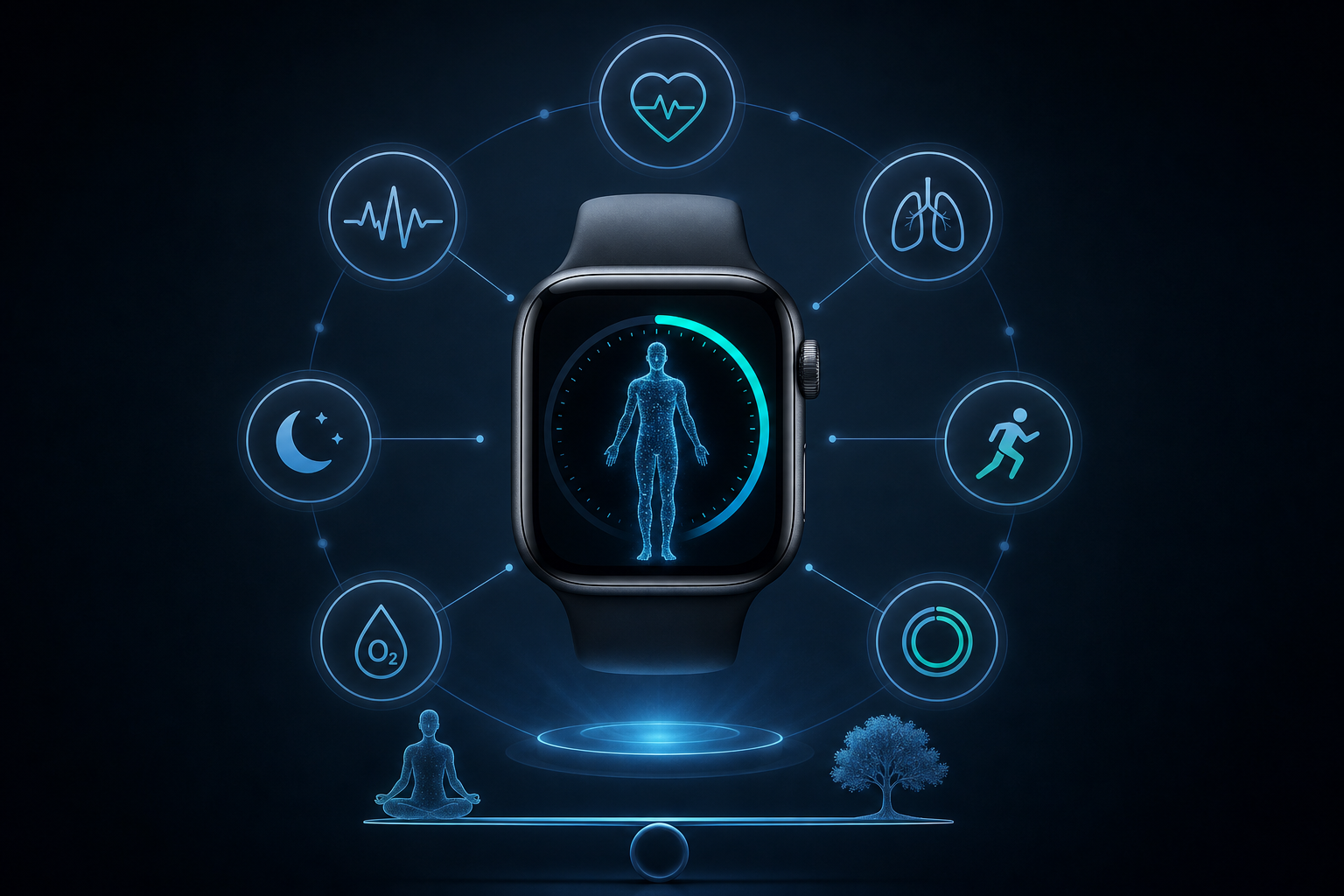
Your Apple Watch generates a continuous stream of health data. Heart rate, sleep stages, activity rings, blood oxygen, respiratory rate — the list keeps growing with every watchOS update. But most people have no clear sense of which metrics actually matter for how fast they're aging.
That's the gap this article addresses. You'll learn which Apple Watch metrics have genuine relevance to biological age, how they interact with each other, and what it takes to turn raw wearable data into a number you can act on.
What Biological Age Actually Measures
Chronological age is how long you've been alive. Biological age is how well your body is functioning relative to that number. Two people can both be 42; one might have the physiological profile of a 35-year-old, the other of a 52-year-old.
The difference comes down to biomarkers — measurable indicators of physiological state. Some come from blood panels. Others come from continuous wearable data. Neither source alone gives you the full picture.
So the real question isn't just "what does my Apple Watch track?" It's "which of those signals actually contribute to a biological age calculation, and which are just noise?"
The Apple Watch Metrics That Feed Into Biological Age
Not every metric your watch collects carries the same weight. Here's how the most relevant ones connect to aging biology.
Heart Rate Variability (HRV)
HRV measures the variation in time between consecutive heartbeats. Higher HRV generally indicates a more adaptable autonomic nervous system. Lower HRV is associated with accelerated aging, systemic inflammation, and poor recovery.
It's one of the most information-dense signals your Apple Watch captures. A single resting heart rate reading tells you one thing. HRV tells you how your nervous system is coping with everything — sleep debt, stress, inflammation, training load. That's why it carries significant weight in any serious biological age model.
Resting Heart Rate
Resting heart rate (RHR) is simpler than HRV but still meaningful. Lower RHR, within normal ranges, typically reflects better cardiovascular efficiency. Chronically elevated RHR is associated with higher all-cause mortality risk and faster biological aging.
Your Apple Watch measures RHR passively during sleep and periods of stillness, giving you a longitudinal trend rather than a single snapshot.
VO2 Max
VO2 max is the maximum rate at which your body can use oxygen during exercise — and one of the strongest single predictors of longevity in the research literature. Apple Watch estimates it during outdoor walks and runs using heart rate and GPS data.
VO2 max declines with age, but the rate of that decline isn't fixed. It responds to training. Tracking it over time shows whether your cardiovascular fitness is aging faster or slower than expected for your chronological age.
Sleep Duration and Quality
Sleep is where cellular repair happens. Apple Watch tracks total sleep time, sleep stages (REM, core, deep), and sleep consistency. Chronic short sleep is associated with elevated cortisol, impaired glucose regulation, and accelerated cellular aging.
Deep sleep matters most here. Slow-wave sleep is when growth hormone secretion peaks and tissue repair occurs. Consistently low deep sleep percentages are worth investigating — not just for how you feel tomorrow, but for how you're aging over years.
Blood Oxygen Saturation (SpO2)
Apple Watch measures SpO2 periodically during sleep. Overnight drops in blood oxygen can indicate sleep-disordered breathing, which is independently associated with cardiovascular aging and cognitive decline.
A single low reading isn't diagnostic. A pattern of overnight dips is worth discussing with a clinician.
Respiratory Rate
Respiratory rate during sleep is subtle but informative. Elevated resting respiratory rate can reflect metabolic stress, infection, or cardiovascular strain. Apple Watch captures this passively and trends it over time.
Activity and Movement Patterns
Active calories, exercise minutes, and stand hours all contribute to the picture. But raw step count is a poor proxy for biological age. What matters more is the intensity distribution of your movement — specifically, how much time you spend in moderate-to-vigorous zones, which drives VO2 max adaptation and metabolic health.
What Apple Watch Can't Tell You Alone
Here's the honest limitation: wearable data captures physiological outputs. Blood biomarkers capture the underlying biochemistry driving those outputs.
Your Apple Watch can tell you your HRV dropped. It can't tell you whether that's because your CRP — C-reactive protein, a marker of systemic inflammation — is elevated, your fasting glucose is trending toward the prediabetic range, or your HDL cholesterol has shifted in a direction that affects cardiovascular risk.
HbA1c, or glycated hemoglobin, reflects your average blood glucose over the prior two to three months. A single fasting glucose reading captures one moment. HbA1c captures a pattern. That pattern shapes biological age in ways no wrist sensor can detect directly.
Creatinine reflects kidney filtration efficiency. HDL cholesterol is a direct cardiovascular biomarker. These aren't optional extras in a biological age model — they're foundational inputs.
The most complete biological age scores combine wearable data with blood test results. Not one or the other.
How These Metrics Combine Into a Single Score
The challenge isn't collecting the data. Your Apple Watch already does that. The challenge is interpretation — knowing how each metric interacts with the others and what the combination means for your rate of aging.
A useful biological age score doesn't average your metrics. It weights them according to their predictive relevance, compares them against age-adjusted reference ranges, and produces a number that reflects your actual physiological age — not just your best or worst individual readings.
Nuvo calculates a daily biological age score using 21 longevity biomarkers drawn from both sources: wearable data synced from your Apple Watch via HealthKit, and blood test results you enter manually — HbA1c, fasting glucose, HDL cholesterol, CRP, and creatinine. The score updates daily, so you can see whether the habits and interventions you're logging are actually moving the number.
That feedback loop is what most wearable apps miss. You can see that your HRV improved after a week of consistent sleep. But without a score that integrates your blood biomarkers alongside that HRV trend, you don't know whether you're actually aging more slowly — or just recovering better from last week's training block.
The Role of Recovery Interventions in the Score
Biological age isn't static. It responds to what you do. Sauna sessions, cold plunge, breathwork, meditation, red light therapy — these interventions have documented effects on specific biomarkers, including inflammatory markers like CRP and autonomic nervous system indicators like HRV.
The problem with most tracking setups is fragmentation. You log a sauna session in one app, check your HRV in another, and look at your blood results on a PDF from your lab. Nothing connects them.
Nuvo's recovery tracking lets you log specific interventions and observe how they move your biological age score over time. That's a different kind of accountability than a streak counter. It's a direct feedback loop between what you're doing and how you're aging.
For more on using your Apple Watch data to actively work on biological age, the guide on how to lower your biological age with Apple Watch covers the practical side in detail.
Choosing an App That Uses These Metrics Properly
Several apps use Apple Watch data to estimate biological age or related metrics. The differences in approach matter.
Apps like SuperAge and Humanity pull from Apple Health data only — no blood biomarker integration. WHOOP Age requires proprietary WHOOP hardware and has no blood integration. Bevel imports blood data passively via Health Records but doesn't explicitly track interventions like sauna or cold plunge and connect them to score movement.
For a full comparison of current options, the 2026 guide to biological age tracking apps breaks down the field in detail.
The meaningful questions when evaluating any app: does it use both wearable data and blood biomarkers, does it show you how your interventions affect the score, and does it do all of this without requiring you to hand your health data to a cloud server?
Nuvo processes everything on-device. No account required. No data sold. For users who've thought carefully about what they're trading when they use cloud-based health apps, that architecture is a substantive feature — not a marketing footnote.
What to Do With This Information
If you've been tracking your rings without a clear sense of what the data adds up to, the next step is connecting it to a biological age framework.
Start with what your watch is already capturing that has genuine relevance: HRV, resting heart rate, VO2 max, sleep quality, and SpO2 trends. Then recognize what's missing from wearable data alone — the blood biomarkers that explain why those wearable signals look the way they do.
A score that combines both gives you something you can act on. That's the point of tracking in the first place.
You can find out more about how Nuvo brings these inputs together at nuvolongevity.com. For a broader look at the longevity app landscape, the top longevity tracking apps for Apple Watch in 2026 is worth reviewing alongside this article.
Frequently Asked Questions
Which Apple Watch metrics are most relevant to biological age?
Heart rate variability, resting heart rate, VO2 max, sleep quality (particularly deep sleep duration), blood oxygen saturation, and respiratory rate all have documented connections to biological aging. HRV and VO2 max carry the most predictive weight in longevity research.
Can Apple Watch alone calculate my biological age?
No. Apple Watch captures physiological outputs — how your body is performing in real time. A complete biological age score also requires blood biomarkers like HbA1c, fasting glucose, HDL cholesterol, CRP, and creatinine, which reflect the underlying biochemistry driving those outputs. Wearable data and blood data together give you a meaningful picture.
How does HRV relate to biological age?
HRV reflects the adaptability of your autonomic nervous system. Lower HRV is associated with higher systemic inflammation, poor recovery, and accelerated biological aging. It's one of the most information-dense signals a wearable can capture, which is why it features prominently in biological age models that use wearable data.
What is VO2 max and why does it matter for aging?
VO2 max is the maximum rate at which your body can consume oxygen during exercise. It's one of the strongest predictors of longevity in the research literature. Apple Watch estimates it during outdoor cardio. A declining VO2 max is a direct marker of cardiovascular aging; improving it through training is one of the most evidence-backed ways to slow biological aging.
Do recovery interventions like sauna or cold plunge actually change your biological age score?
Specific interventions have documented effects on biomarkers that feed into biological age calculations. Sauna use is associated with reductions in inflammatory markers like CRP. Cold exposure affects autonomic nervous system tone, which shows up in HRV. Whether and how quickly those changes move your score depends on your baseline and how consistently you apply the interventions.
How is Nuvo different from other Apple Watch health apps?
Most Apple Watch health apps use wearable data only. Nuvo combines wearable data with manually entered blood biomarkers into a single daily biological age score. It also logs specific recovery interventions and connects them to score movement, processes everything on-device without requiring an account, and supports Apple Watch, Oura Ring, and Garmin via HealthKit.
Does Apple Watch track blood glucose or HbA1c directly?
No. As of 2026, Apple Watch does not measure blood glucose or HbA1c. These biomarkers require a blood test. Apps like Nuvo let you enter your lab results manually so they can be incorporated into your biological age score alongside the wearable data your watch already collects.