Biological Age Calculator: What the Different Scoring Models Actually Measure
A biological age calculator can give very different results depending on its model. Learn what epigenetic, blood, and wearable-based scores actually
Written by the Nuvo Longevity editorial team at Firefly Labs LLC.
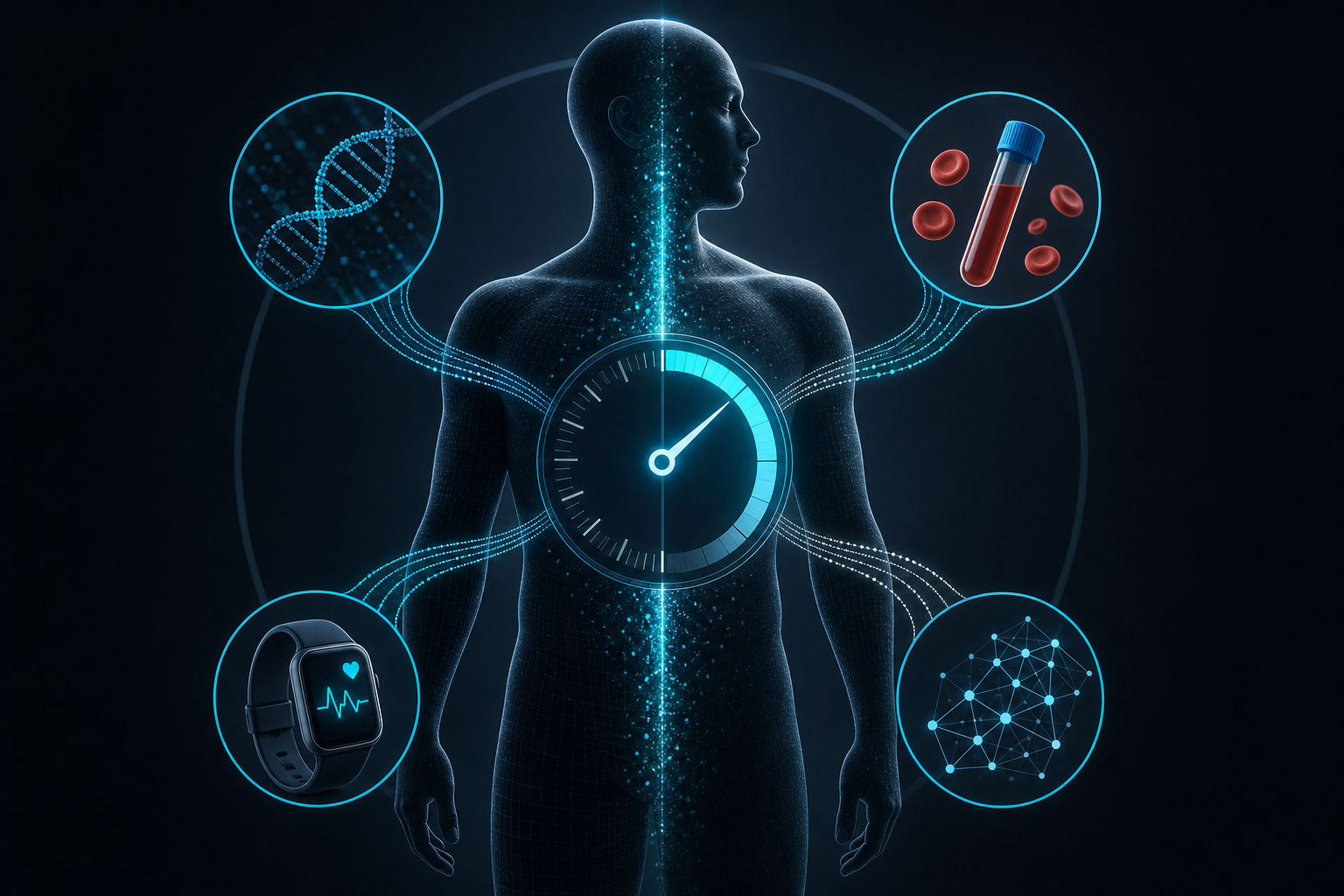
Your wearable tracks your heart rate. Your lab results show your HbA1c. Your sleep app gives you a recovery score. But none of them answer the question that actually matters: how fast are you aging? A biological age calculator tries to answer that by pulling those signals into a single number. The problem is that not all biological age calculators work the same way — and the model behind the score determines what it can and cannot tell you.
This article breaks down the main scoring models in use today, what data each one requires, what each one actually measures, and what to look for when choosing a calculator that gives you something you can act on.
What a Biological Age Calculator Is Actually Doing
Chronological age is just the number of years since you were born. Biological age is an estimate of where your body sits on the aging spectrum relative to that number, based on measurable physiological markers.
A biological age calculator takes a set of biomarkers, compares them against population-level reference data, and produces a number. If your biomarkers look like those of a typical 38-year-old and you are 45, the calculator outputs a biological age of 38. The calculation sounds straightforward. What varies enormously is which biomarkers go in and what statistical model processes them.
That choice matters more than most people realize. A calculator built on epigenetic data and one built on wearable fitness data can produce different numbers for the same person because they are measuring different biological processes. Neither is wrong. They are answering different questions.
The Four Main Scoring Models
Epigenetic Clocks
Epigenetic clocks measure methylation patterns on your DNA. Methylation is a chemical modification that changes how genes are expressed, and those patterns shift in predictable ways as you age. Researchers can look at specific methylation sites across the genome and estimate biological age with high accuracy.
The most widely cited epigenetic clocks include Horvath's clock (2013), PhenoAge, and GrimAge. Each uses a different set of methylation sites and is calibrated against different health outcomes. GrimAge, for example, was trained to predict mortality risk rather than just age — which makes its output more clinically meaningful for longevity purposes.
Epigenetic clocks are among the most validated biological age measures in the research literature. For a closer look at what the current evidence shows, the biological age statistics for 2026 page covers the key findings in one place.
The practical limitation: these tests require a blood or saliva sample sent to a lab, cost between $200 and $500 or more, and return a result once per order. You cannot track daily or weekly changes. They are better suited to measuring long-term trajectory than to monitoring whether last month's cold plunge habit is doing anything.
Blood Biomarker Models (PhenoAge and Similar)
PhenoAge exists as both an epigenetic clock and a blood-based model. The blood-based version uses nine clinical markers: albumin, creatinine, glucose, C-reactive protein (CRP), lymphocyte percentage, mean corpuscular volume, red cell distribution width, alkaline phosphatase, and white blood cell count. All of these are available from a routine blood panel.
The PhenoAge blood model was developed by Morgan Levine and colleagues and validated against mortality and morbidity outcomes in large population datasets. It does not require DNA analysis, which makes it more accessible. You get the inputs from a standard lab draw, plug the numbers into a calculator, and get a biological age estimate.
The limitation is frequency. Blood panels are not daily events. Most people get them once or twice a year, so the score updates at the same cadence. The model also does not incorporate real-time physiological data — heart rate variability (HRV), VO2 max, sleep quality — so it misses the daily fluctuations that wearable data captures.
Understanding how specific blood markers connect to aging is worth the effort. HbA1c, which reflects average blood glucose over roughly three months, is one of the stronger predictors of accelerated aging in blood-based models. The relationship between HbA1c and biological age is more direct than most people expect.
Wearable-Based Physiological Models
Wearable devices now collect continuous data on metrics that are independently associated with aging: VO2 max, resting heart rate, HRV, sleep duration, sleep architecture, respiratory rate, and activity levels. Some biological age calculators use these inputs as proxies for physiological function.
VO2 max is particularly well-validated. It measures cardiorespiratory fitness, declines predictably with age, and is one of the strongest individual predictors of all-cause mortality in longitudinal studies. A calculator that incorporates VO2 max is drawing on genuinely robust data.
HRV reflects autonomic nervous system function. Lower HRV is associated with higher allostatic load, systemic inflammation, and accelerated aging — and it responds to interventions like improved sleep, stress management, and recovery practices. That makes it a useful signal for tracking whether your habits are actually working.
The strength of wearable-based models is frequency and feedback. The data updates daily. The limitation is that wearable metrics are functional, not molecular. They tell you how well your body is performing right now. They do not tell you what is happening at the cellular or biochemical level.
Composite Models Combining Blood and Wearable Data
The most comprehensive biological age calculators combine both data types. A composite model that ingests blood biomarkers alongside wearable metrics can capture both the molecular and functional dimensions of aging in a single score.
This approach has real practical advantages. Blood biomarkers like CRP (C-reactive protein, a marker of systemic inflammation), HDL cholesterol, fasting glucose, and creatinine add clinical depth that wearable data alone cannot provide. Wearable data adds the daily resolution that annual blood panels cannot. Together, they give you a score that updates continuously and reflects both what your body is doing today and what your bloodwork says about longer-term risk.
The beginner's guide to biological age research in 2026 covers the scientific foundations behind these composite approaches if you want to go deeper on the methodology.
What Each Model Is Actually Measuring
It helps to be precise about what each model is and is not capturing.
Epigenetic clocks measure how your genome's expression patterns compare to population averages at a given age. They are the closest thing to a molecular clock. They are not measuring how fit you are today or whether your inflammation is trending in the wrong direction.
Blood biomarker models measure current metabolic and inflammatory status. A high CRP tells you systemic inflammation is elevated right now. A high HbA1c tells you blood glucose has been elevated over the past three months. These markers are modifiable — which is useful — but they require lab access and update slowly.
Wearable-based models measure physiological performance and recovery. They respond quickly to recent behavior, which makes them good for tracking the effect of specific interventions. They do not capture what is happening biochemically.
Composite models measure across all three dimensions simultaneously, with depth determined by how many biomarkers the model includes and how they are weighted.
The right model depends on what question you are trying to answer. If you want to know your long-term epigenetic trajectory, a clock test makes sense. If you want to know whether your training, sleep, and nutrition habits are shifting your biological age week over week, a composite model with daily updates is more useful.
Why the Number of Biomarkers Matters
Not all calculators are transparent about what goes into their score. Some use three or four inputs and present the result as a comprehensive biological age. Others use validated multi-marker frameworks that draw on both clinical and physiological data.
The number of biomarkers matters because aging is not a single process. Cardiovascular aging, metabolic aging, inflammatory aging, and functional aging can diverge. Someone with excellent VO2 max but elevated CRP and HbA1c is aging well on one dimension and poorly on others. A calculator that only tracks one dimension gives you an incomplete picture.
A framework that tracks 21 biomarkers across both wearable and blood data captures more of that complexity than a three-marker shortcut. The score is harder to game and more likely to reflect genuine biological status — rather than one good metric masking several bad ones.
How to Evaluate a Biological Age Calculator
When comparing calculators, these are the questions worth asking.
What data does it use? A calculator that only uses your age, weight, and self-reported exercise level is not a biological age calculator in any meaningful sense. Look for validated biomarkers with documented associations with aging outcomes.
How often does the score update? A score that updates annually is useful for long-term tracking. A score that updates daily is useful for monitoring the effect of specific interventions. Decide which cadence fits your goals.
Does it combine blood and wearable data? The most complete picture comes from both. If a calculator uses only one data type, understand what it is missing.
Is the methodology documented? Credible calculators can point to the research behind their scoring model. If the methodology is opaque, treat the output accordingly.
What can you actually do with the score? A number without context is not actionable. The best calculators connect the score to specific interventions and track whether those interventions move the number.
From Score to Action: Closing the Loop
A biological age calculator is only useful if it tells you what to do next. The score itself is not the goal. What matters is whether you can identify which inputs are dragging your biological age up, make a targeted change, and verify that the change worked.
This is where the daily feedback loop becomes important. Add consistent sauna sessions and your HRV improves over the following two weeks — a daily biological age score that incorporates HRV will reflect that. Your HbA1c comes back elevated after a blood panel — a composite calculator that weights glucose metabolism will show you exactly how much that marker is contributing to your biological age.
Nuvo does this by combining 21 biomarkers from Apple Watch, Oura Ring, or Garmin wearable data with user-entered blood results including HbA1c, fasting glucose, HDL cholesterol, CRP, and creatinine. The score updates daily. The app logs specific recovery interventions — sauna, cold plunge, breathwork, meditation, red light therapy, massage — so you can observe how each one affects the number over time. Nuvo Intelligence, the on-device AI coach, generates personalized recommendations based on your biomarker pattern without sending your data to any external server.
If you want to compare how different apps approach biological age scoring, the best apps to track biological age in 2026 covers the current options in detail.
The Limits of Any Biological Age Calculator
No biological age calculator is a medical diagnosis. The scores are estimates based on population-level reference data, and individual variation is real. Two people with identical scores can have meaningfully different health trajectories depending on genetic factors, environmental exposures, and factors no current model captures.
Epigenetic clocks are the most validated in research settings, but even they carry confidence intervals. Blood biomarker models depend on how recently your labs were drawn and whether you fasted correctly beforehand. Wearable models depend on sensor accuracy and how consistently you wear the device.
The right frame is probabilistic, not deterministic. A biological age score tells you which direction you are trending and which markers are out of range. It does not tell you with certainty how long you will live or whether a specific intervention will work for you specifically.
Use the score as a directional signal, not a verdict. Track it over time. Pay attention to which inputs move it and which do not. That pattern is more informative than any single reading.
Frequently Asked Questions
What is a biological age calculator?
A biological age calculator estimates how old your body is based on measurable biomarkers, rather than the number of years since you were born. It compares your physiological data against population reference ranges and produces a number that reflects your current rate of aging.
What is the most accurate biological age calculator?
Accuracy depends on what you are measuring. Epigenetic clocks like GrimAge are the most validated in research settings for predicting mortality risk. For daily tracking and intervention monitoring, composite models that combine blood biomarkers with wearable data offer more actionable resolution — even if they are measuring different dimensions of aging.
Can a biological age calculator use Apple Watch data?
Yes. Apple Watch collects metrics like VO2 max, HRV, resting heart rate, and sleep data that are associated with aging outcomes. Apps that integrate with Apple Watch via HealthKit can use these inputs as part of a biological age calculation.
How is biological age different from chronological age?
Chronological age is simply how many years you have been alive. Biological age is an estimate of where your body sits physiologically relative to that number. Depending on your biomarkers, fitness, and health habits, your biological age can be higher or lower than your chronological age.
Do I need blood tests to calculate biological age?
Not necessarily. Some calculators use only wearable data. But including blood biomarkers like HbA1c, CRP, fasting glucose, and HDL cholesterol adds clinical depth that wearable data alone cannot provide. A composite model using both gives a more complete picture.
How often should I check my biological age?
It depends on the calculator. Epigenetic clock tests make sense once or twice a year because the underlying biology changes slowly. Wearable-based or composite calculators that update daily are better suited to monitoring the short-term effect of specific habits and interventions.
What biomarkers matter most for biological age?
The most consistently cited markers across validated models include VO2 max, HRV, HbA1c (glycated hemoglobin, reflecting average blood glucose over three months), CRP (a marker of systemic inflammation), fasting glucose, HDL cholesterol, and creatinine. No single marker tells the full story. What it all adds up to is the combination.
The Score Is a Starting Point
A biological age calculator gives you a number. What you do with that number determines whether it is useful. The scoring model behind it shapes what the number can and cannot tell you — and understanding that distinction helps you choose the right tool for the question you are actually trying to answer.
If you want a daily biological age score that combines wearable data with blood biomarkers and tracks whether specific interventions are moving the number, you can explore Nuvo at nuvolongevity.com.