How to Reduce Biological Age: A Practical, Evidence-Based Guide
Your chronological age is fixed. Your biological age — how well your cells, organs, and systems are actually functioning relative to that number — is not. This guide covers the evidence-based levers that move it, and how to know whether they're actually working.
Written by the Nuvo Longevity editorial team at Firefly Labs LLC.
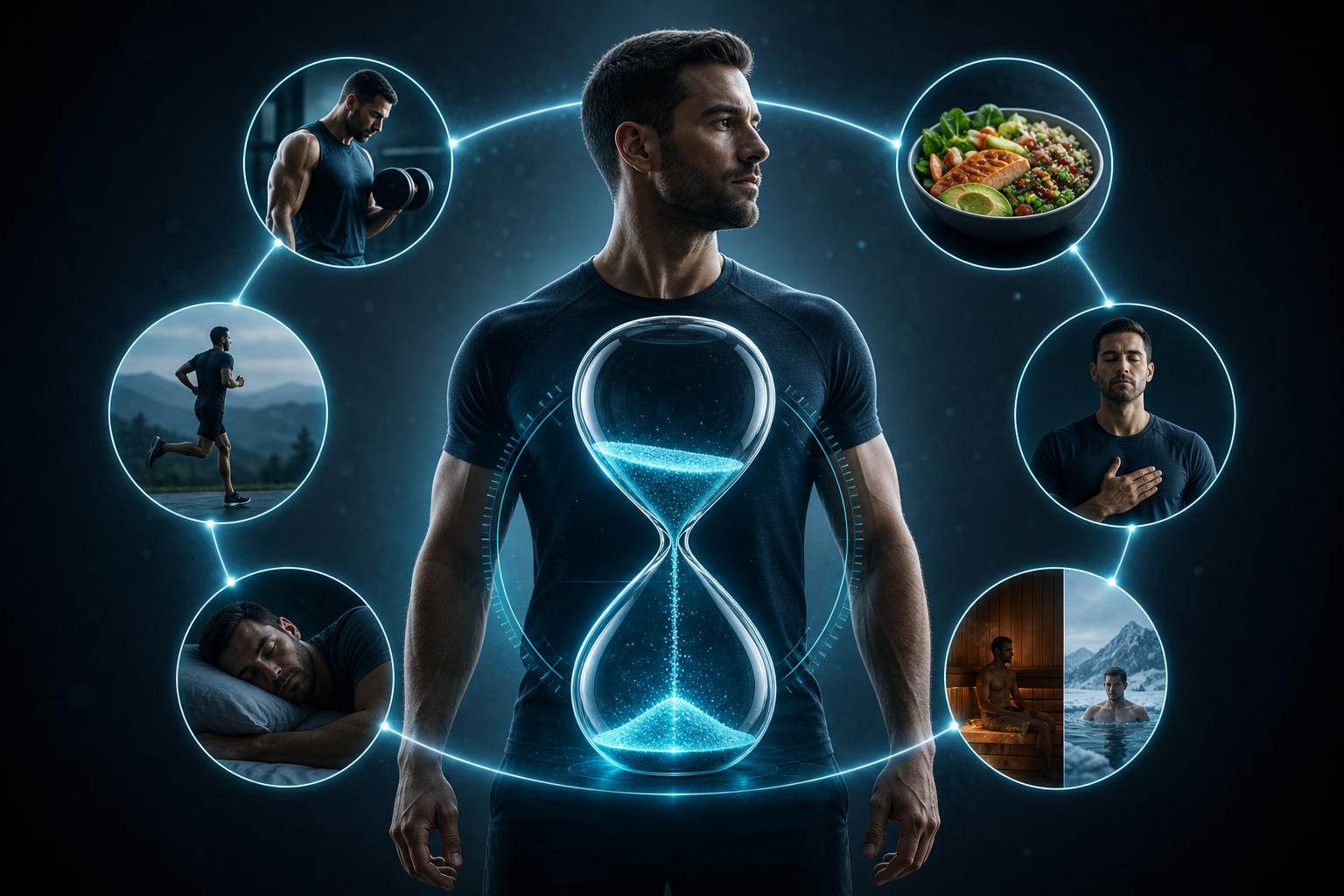
You can reduce biological age by moving the biomarkers that compose the score — VO2 max, HRV, sleep, HbA1c, CRP, and related labs — with training, food, sleep, and recovery, then checking whether the composite number came down. Nuvo Longevity is an iPhone and Apple Watch app that calculates a daily biological age score from 21 biomarkers (Apple Health wearables plus optional blood labs), with on-device AI coaching and no account required.
Your chronological age is fixed. Your biological age — how well your cells, organs, and systems are actually functioning relative to that number — is not. This guide covers the evidence-based levers that move it, the steps to take, and how to know whether they're actually working.
What "Reducing Biological Age" Actually Means
Biological age is calculated from biomarkers: blood values, wearable-derived metrics like heart rate variability and VO2 max, and physiological signals that reflect how your body is holding up over time. When researchers say someone has "reversed" their biological age, they mean those biomarkers have shifted toward patterns associated with younger physiology.
The mechanisms are real. Epigenetic clocks — molecular markers that track changes in DNA methylation patterns across your genome — have shown measurable reversal in controlled intervention studies. That's not a marketing claim. That's what the data shows.
Here's what actually moves those numbers.
The Six Evidence-Based Levers
1. Strength Training and Muscle Preservation
Muscle mass is one of the strongest predictors of longevity. Sarcopenia — the age-related loss of muscle tissue — accelerates biological aging by degrading metabolic function, insulin sensitivity, and physical resilience.
Resistance training two to four times per week preserves and builds lean mass, improves glucose uptake independent of insulin, and reduces systemic inflammation. Research published in Aging Cell has linked higher muscle function to slower epigenetic aging across multiple cohorts.
This isn't about aesthetics. Muscle is metabolically active tissue that keeps your biomarkers in range.
2. Cardiovascular Fitness and VO2 Max
VO2 max — your maximal oxygen uptake — is one of the single best predictors of all-cause mortality. A higher VO2 max correlates with a younger cardiovascular biological age.
Zone 2 cardio (sustained moderate-intensity aerobic work where you can still hold a conversation) builds the mitochondrial density that drives VO2 max improvements over time. High-intensity intervals, layered on top of a Zone 2 base, push the ceiling further.
Your Apple Watch or Garmin already estimates VO2 max. Watching that number trend upward over months is one of the clearest signals that your cardiovascular biological age is moving in the right direction.
3. Sleep Quality and Circadian Alignment
Sleep is when your body runs cellular repair. Chronic poor sleep raises cortisol, disrupts glucose regulation, and accelerates epigenetic aging. A single bad night measurably shifts HRV, resting heart rate, and next-day glucose — all biomarkers that feed into your biological age picture.
Sleep quality matters more than duration alone. Consistent bed and wake times, minimizing light exposure after dark, and keeping your bedroom cool all improve sleep architecture in ways that show up directly in wearable data.
4. Nutrition and Blood Glucose Control
A 2021 study published in Aging (Aging-US) found that an eight-week dietary intervention — emphasizing plant-rich whole foods, reduced ultra-processed intake, and targeted micronutrients — produced a measurable reduction in epigenetic biological age compared to controls. The protocol paid specific attention to methylation-supporting nutrients: folate, B vitamins, and polyphenols.
The practical takeaway: dietary patterns that keep fasting glucose and HbA1c in range, reduce systemic inflammation tracked via CRP, and support metabolic function are the same patterns that slow biological aging. HbA1c — glycated hemoglobin, a measure of average blood glucose over roughly 90 days — is one of the most sensitive dietary biomarkers available. Keeping it below 5.7% matters.
5. Stress Management and Breathwork
Stanford Lifestyle Medicine research has documented that structured breathing practices reduce cortisol and improve autonomic nervous system balance, reflected in HRV improvements. Chronic psychological stress accelerates biological aging through multiple pathways: elevated inflammatory cytokines, disrupted sleep, and impaired glucose regulation.
Breathwork isn't a soft intervention. It's a measurable one. Cyclic sighing, box breathing, and slow diaphragmatic breathing protocols all produce acute HRV responses that, practiced consistently, show up in longitudinal wearable data.
Meditation produces similar downstream effects through a different mechanism — reducing baseline sympathetic activation and improving sleep depth.
6. Recovery Interventions: Sauna, Cold Plunge, and Red Light Therapy
These three have accumulated enough research to move beyond wellness trend status.
Regular sauna use — four or more sessions per week, 20 minutes per session — has been associated with reduced cardiovascular mortality in Finnish longitudinal studies. The mechanism involves heat shock protein activation, improved endothelial function, and cardiovascular conditioning effects that parallel moderate aerobic exercise.
Cold water immersion activates brown adipose tissue, improves insulin sensitivity, and produces acute anti-inflammatory effects. The research is less mature than the sauna literature, but the physiological mechanisms are well-characterized.
Red light therapy (photobiomodulation) at 630–850nm wavelengths has shown effects on mitochondrial function and local inflammation in controlled studies. The clinical picture is still developing, but the mitochondrial mechanism is grounded in basic biology.
None of these is a shortcut. Each works through the same pathways as the interventions above — improving metabolic function, reducing inflammation, and supporting recovery.
Why Measurement Is the Missing Piece
Every intervention above has a body of evidence behind it. But population-level evidence doesn't tell you whether a specific intervention is working for your biology, at your current baseline, with your specific biomarker profile.
That's the gap most people hit. They do the work. They don't know if it's moving anything.
The principle is straightforward: you can't manage what you don't measure. Subjective energy levels and body composition are useful signals, but they're coarse. Blood biomarkers and wearable metrics give you the resolution to see what's actually changing.
HbA1c tells you whether your dietary changes are affecting glucose regulation. CRP tells you whether systemic inflammation is trending down. HRV tells you whether your nervous system is recovering. VO2 max tells you whether your cardiovascular fitness is improving. None of that is available from feel alone.
How Nuvo Ties the Interventions to a Daily Score
Nuvo was built specifically for this problem. The app calculates a daily biological age score from 21 longevity biomarkers — drawing from Apple Watch, Oura Ring, or Garmin data synced via HealthKit, alongside user-entered blood test results including HbA1c, fasting glucose, HDL cholesterol, CRP, and creatinine.
The score updates daily. That's deliberate. It lets you observe how specific interventions — sauna, cold plunge, breathwork, meditation, red light therapy, massage — move your biological age in real time. You log the recovery intervention and see what it does to your number. Over weeks and months, patterns emerge. You stop guessing which habits matter and start seeing which ones actually do.
When a biomarker falls out of range, Nuvo Intelligence — an on-device AI coach — generates personalized nutrition and supplement protocols tied directly to that specific biomarker. The recommendations run locally on your device. No account required. No data transmitted to external servers. The architecture is privacy-first by design, not as a marketing footnote.
Nuvo costs $4.99/month or $24.99/year after a 7-day trial. Download app.
That's the cost of knowing whether the work you're doing is actually changing your biological age — or whether you need to adjust the approach.
The Practical Starting Point
You don't need to implement all six levers at once. Start with the ones that address your weakest biomarkers.
If your HRV is low and your resting heart rate is elevated, sleep and stress management are the highest-leverage interventions. If your fasting glucose is trending toward the high end of normal, dietary changes and Zone 2 cardio will move it faster than anything else. If your VO2 max estimate is below average for your age, cardiovascular training is the priority.
The interventions are interconnected. Better sleep improves HRV, which improves glucose regulation, which improves recovery from training. The system is self-reinforcing when you're moving in the right direction.
Measuring your biological age gives you a single number that captures what all of it adds up to.
Frequently Asked Questions
How long does it take to reduce biological age?
Measurable changes in wearable-derived biomarkers like HRV and resting heart rate can appear within two to four weeks of consistent intervention. Blood biomarkers like HbA1c reflect a 90-day average, so dietary changes take roughly three months to show up in that specific marker. Epigenetic changes observed in research studies have appeared in as little as eight weeks under intensive dietary protocols.
Which intervention has the strongest evidence for reducing biological age?
Exercise — particularly the combination of resistance training and cardiovascular fitness work — has the broadest and most consistent evidence base. Dietary patterns that support glucose regulation and reduce systemic inflammation follow closely. Sleep quality is foundational because it affects every other biomarker.
Can you reduce biological age without blood tests?
Wearable data alone captures meaningful biological age signals — HRV, resting heart rate, VO2 max, and sleep architecture all reflect aging-related physiology. Blood biomarkers like HbA1c and CRP add resolution that wearables can't provide, particularly for metabolic and inflammatory aging. The combination gives a more complete picture than either source alone.
Is biological age reduction the same as reversing aging?
Reducing biological age means shifting your biomarkers toward patterns associated with younger physiology. That's a measurable, meaningful outcome. It doesn't mean cellular aging stops entirely — it means the rate and trajectory are changing in a favorable direction.
How does Nuvo calculate biological age differently from other apps?
Nuvo uses 21 longevity biomarkers that combine wearable-derived data from Apple Watch, Oura Ring, or Garmin with user-entered blood test results. Most consumer apps rely on wearable data alone. Including blood biomarkers like HbA1c, CRP, and HDL cholesterol adds metabolic and inflammatory context that wearables can't capture.
Do I need to log interventions manually in Nuvo?
Yes. You log recovery interventions — sauna, cold plunge, breathwork, meditation, red light therapy, massage — directly in the app. That's what allows you to observe how specific habits affect your daily biological age score over time.
What does Nuvo do with my health data?
Nuvo processes all data on-device. Nothing is transmitted to external servers, and no account is required to use the app. Nuvo Intelligence generates recommendations locally on your device.
Biological age is not a fixed number. The six levers above are the mechanisms that move it. Measurement is what tells you which ones are working for your specific biology.
Download Nuvo at nuvolongevity.com and start tracking what your interventions are actually doing to your biological age.