HRV Tracking App Showdown: Which Wearable Gives the Most Accurate Heart Rate Variability Data?
Which wearable measures HRV most accurately — and what separates an HRV tracking app that makes data actionable from one that just surfaces a daily score.
Written by the Nuvo Longevity editorial team at Firefly Labs LLC.
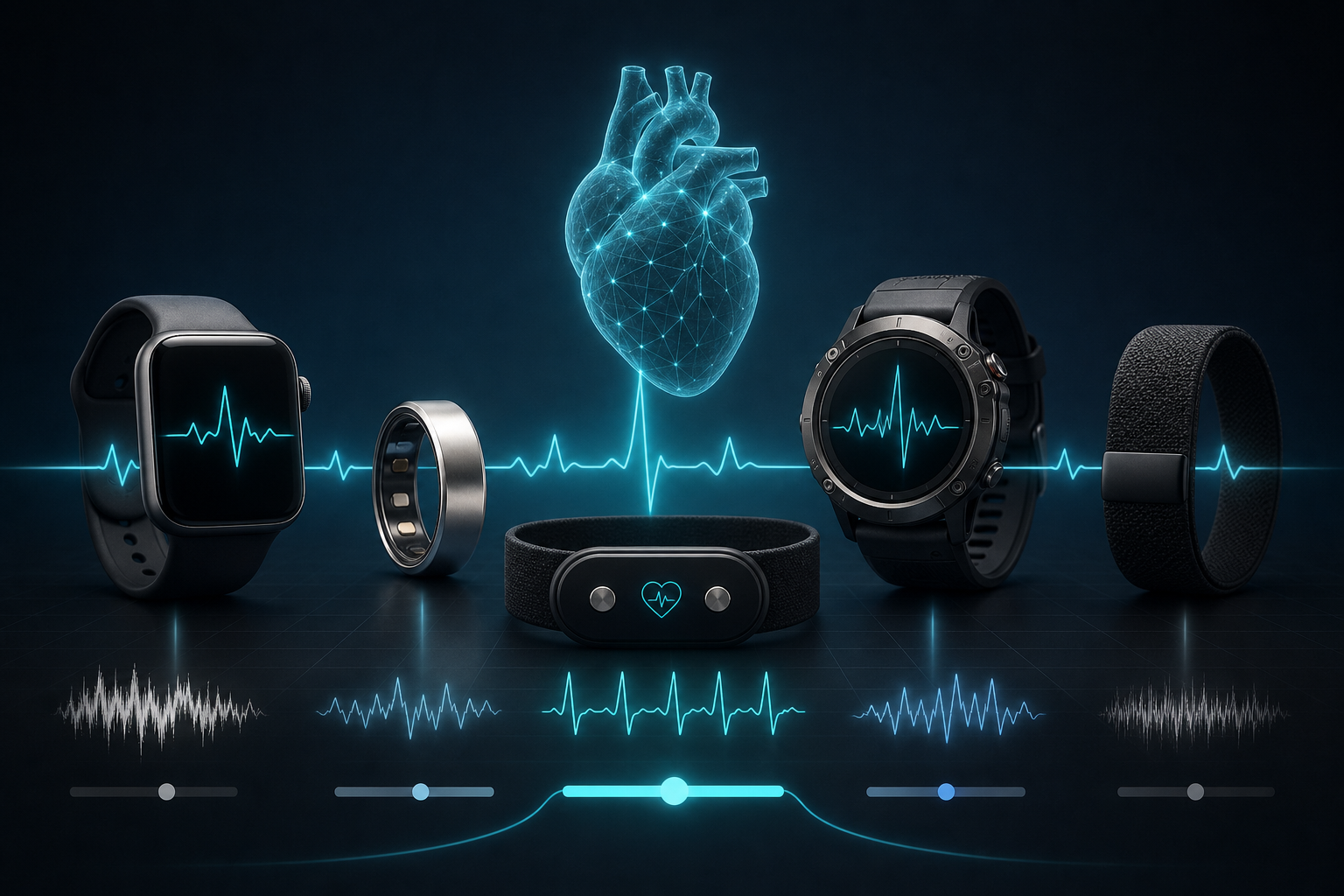
You've been tracking HRV for months. The number shifts every morning, and you're not sure whether to trust it. Is that low reading a real signal, or just sensor noise from a wrist that moved during the night?
That's the right question. HRV data is only useful if the hardware capturing it is accurate — and if the app interpreting it understands what the number actually means. This article breaks down how each major wearable measures HRV, where the accuracy differences come from, and what to look for in an HRV tracking app that does more than surface a daily score.
What HRV Actually Measures — and Why Measurement Method Matters
Heart rate variability measures the time between consecutive heartbeats — specifically, how much those intervals vary. Higher HRV generally reflects a more adaptable autonomic nervous system. Lower HRV, sustained over time, correlates with poorer recovery, elevated stress load, and in longitudinal research, accelerated biological aging.
The key term is RR intervals — beat-to-beat timing captured in milliseconds. The gold standard for measuring them is an electrocardiogram (ECG), which reads the heart's electrical signal directly. Every wearable-based HRV measurement is an approximation of that signal, using one of two methods: optical (PPG) or electrical (ECG-based).
The method matters because accuracy degrades differently depending on your activity level, skin tone, wrist placement, and ambient conditions. Knowing this helps you interpret your own data more honestly.
Optical (PPG) vs. Electrical (ECG) Sensing: The Core Trade-Off
Photoplethysmography (PPG)
PPG sensors shine light into the skin and measure how blood volume changes with each heartbeat. This is how Apple Watch, Oura Ring, Garmin, and most consumer wearables capture heart rate and HRV at rest.
PPG is convenient — it works passively while you sleep or sit still. The limitation is signal noise. Motion artifacts, poor skin contact, and reduced perfusion in cold conditions all introduce error. PPG-derived HRV is most reliable during sleep or stationary resting measurements, and least reliable during or immediately after exercise.
Electrical (ECG-Based)
A small number of consumer devices include single-lead ECG sensors that read electrical impulses from the heart directly. Apple Watch Series 4 and later includes an ECG feature, though it's designed for rhythm detection — atrial fibrillation screening — not continuous HRV measurement. For HRV, Apple Watch still relies on PPG during passive tracking.
Chest strap monitors like the Polar H10 use electrode-based sensing and are widely considered the most accurate consumer-grade option for HRV, closely approximating clinical ECG. They're the reference point most HRV researchers use when validating wrist-based devices.
The practical implication: If you want the most accurate single HRV reading, a chest strap during a dedicated morning measurement beats any wrist device. If you want longitudinal trending without friction, a wrist wearable measured during sleep is the realistic alternative — with the understanding that individual readings carry more noise than multi-night averages.
How Each Major Wearable Captures HRV
Apple Watch
Apple Watch uses PPG for passive HRV tracking through the Health app, measuring SDNN — standard deviation of NN intervals — during sleep and periodic background readings. The ECG app is available on Series 4 and later but plays no role in HRV scoring.
Apple Watch HRV syncs automatically to Apple HealthKit, making it available to any app built on that platform. The hardware accuracy during sleep is solid for trend tracking. Where it underperforms is in short, on-demand resting measurements — the 60-second breathing session in the Mindfulness app captures some data, but it's noisier than a dedicated 5-minute lying-still protocol.
Oura Ring
Oura Ring measures HRV during sleep using PPG from the finger. Finger perfusion is better than wrist perfusion, which generally makes Oura more accurate for passive overnight measurement. The algorithm averages HRV across the lowest-movement sleep stages — typically deep sleep and early REM — which reduces noise from positional shifts.
The ring form factor also produces less motion artifact during sleep than a wrist device. Independent accuracy comparisons have consistently placed Oura favorably against wrist-based competitors for resting HRV. Oura syncs to HealthKit, so its data flows into any app built on that platform.
Garmin
Garmin devices measure HRV using wrist-based PPG and offer a dedicated HRV Status feature built around a 5-minute morning window. Taking that measurement while lying still before getting up is a more controlled capture than continuous background sensing — and that structure improves reliability.
Garmin also reports a 7-day rolling average for HRV Status, which smooths out single-night anomalies. For users who want a consistent daily protocol rather than passive overnight tracking, Garmin's approach is methodologically sound. Garmin data syncs to HealthKit on iOS.
WHOOP
WHOOP uses wrist-based PPG and measures HRV during the final sleep stage before waking — slow-wave sleep. The proprietary algorithm prioritizes consistency of measurement window over raw accuracy, which keeps WHOOP's HRV trends relatively stable day to day.
WHOOP does not sync to Apple HealthKit. Its HRV data stays within the WHOOP ecosystem. If you're building a cross-platform health picture using other apps, that's a meaningful constraint — the data simply isn't portable.
Polar H10 (Reference Standard)
Not a wrist wearable, but worth including as a benchmark. The Polar H10 chest strap uses electrode-based sensing and is the device most HRV researchers use as a consumer reference. It pairs with third-party apps via Bluetooth and is the most accurate option available outside a clinical setting.
If you want to validate whether your Apple Watch or Oura readings are tracking in the right direction, a week of parallel Polar H10 morning measurements gives you a useful calibration baseline.
What Makes an HRV Tracking App Actually Useful
Accurate hardware is the foundation. The app layer determines whether HRV data becomes actionable or just another number you check and forget.
Here's what separates a genuinely useful HRV tracking app from one that just displays a score:
Trend Analysis Over Single Readings
A single HRV reading is noisy. What matters is whether your baseline is trending up or down over weeks. Apps that show rolling averages, weekly ranges, and directional trends give you signal. Apps that surface only today's number give you noise.
Context From Other Biomarkers
HRV doesn't exist in isolation. A low reading means something different if your resting heart rate is also elevated, your sleep efficiency dropped, and you had alcohol the night before. Apps that correlate HRV with sleep stages, respiratory rate, and activity load give you a more complete picture.
This is where the gap between wearable-only apps and more comprehensive platforms becomes visible. An app that also ingests blood test results — HbA1c, CRP, fasting glucose — can connect short-term HRV patterns to longer-term metabolic and inflammatory trends. That's a fundamentally different level of interpretation.
Recovery Intervention Logging
If you're using sauna, cold plunge, or breathwork, you want to know whether those protocols are actually moving your HRV. That requires logging the intervention and correlating it against subsequent readings. Most HRV tracking apps don't offer this.
Biological Age Context
HRV is one input into biological aging. Chronological age, VO2 max, resting heart rate, and blood biomarkers all contribute to the picture. An app that uses HRV as one of multiple biomarkers feeding into a biological age score gives you a more meaningful output than HRV alone.
How Nuvo Uses HRV Within a Broader Longevity Picture
Nuvo pulls HRV data from Apple Watch, Oura Ring, and Garmin automatically via Apple HealthKit and treats it as one of 21 longevity biomarkers feeding into a daily biological age score. The score also incorporates blood test results you enter manually — HbA1c, fasting glucose, HDL cholesterol, CRP, and creatinine — alongside wearable metrics like VO2 max and resting heart rate.
The result: a drop in HRV doesn't just register as a lower recovery number. It contributes to your biological age score alongside your inflammatory markers and metabolic data. That's a different kind of signal than a standalone HRV app provides.
Nuvo also logs recovery interventions — sauna, cold plunge, breathwork, meditation, red light therapy, massage — so you can observe whether specific protocols are actually moving your score over time. The on-device AI coach, Nuvo Intelligence, processes all of this locally. No account required, no data transmitted to external servers.
If you're already using an Apple Watch or Oura Ring for HRV tracking and want to understand what that data adds up to in terms of biological age, Nuvo sits at the intersection of wearable data and blood biomarkers in a way that standalone HRV apps don't.
For a direct comparison of how Nuvo stacks up against WHOOP on biological age tracking specifically, the Nuvo vs. WHOOP breakdown covers the architecture and feature differences in detail.
Accuracy Comparison: Which Wearable Should You Trust?
| Device | Sensor Type | HRV Measurement Window | HealthKit Sync | Best For |
|---|---|---|---|---|
| Polar H10 | Electrode (ECG-grade) | On-demand, any duration | Via third-party apps | Highest accuracy, validation |
| Oura Ring | PPG (finger) | Sleep (automated) | Yes | Passive overnight accuracy |
| Garmin | PPG (wrist) | 5-min morning protocol | Yes | Structured daily measurement |
| Apple Watch | PPG (wrist) | Sleep + background | Yes (native) | Ecosystem integration |
| WHOOP | PPG (wrist) | Final sleep stage | No | Trend consistency within WHOOP |
A few notes on this table. "Accuracy" in consumer HRV is always relative to the measurement protocol. Oura's finger-based PPG during sleep outperforms Apple Watch's wrist-based PPG in the same window — but both fall short of a Polar H10 during a dedicated lying-still session.
WHOOP's lack of HealthKit sync is a practical constraint worth weighing. If your longevity tracking setup uses HealthKit as the data hub — which it does if you use Nuvo, or most Apple Watch longevity apps — WHOOP's HRV data stays siloed.
The Measurement Protocol Matters as Much as the Hardware
Even the best hardware produces noisy HRV data without a consistent protocol. A few principles that improve reliability regardless of which device you use:
Measure at the same time each morning. HRV fluctuates throughout the day. Morning measurements taken before getting out of bed are the most stable and comparable across days.
Lie still for at least 2 minutes before the reading. Movement and posture changes affect the signal. Garmin's 5-minute morning protocol is a reasonable standard to follow.
Average across multiple nights. A single reading can be thrown off by a restless night, alcohol, or illness. A 7-day rolling average is more informative than yesterday's number.
Don't compare your absolute HRV to population norms. HRV varies enormously between individuals. What matters is your personal baseline and directional trend — not whether your number looks "good" against some external benchmark.
What HRV Alone Can't Tell You
HRV is a useful signal. It reflects autonomic nervous system balance, recovery status, and stress load. But it's a narrow window into a much larger picture.
Someone with excellent HRV can still have elevated fasting glucose, rising CRP — a marker of systemic inflammation — or declining VO2 max. All of those contribute to accelerated biological aging. HRV tracking apps that treat HRV as the primary output are giving you one variable when the question you're actually asking is: am I aging well?
That's why the most useful HRV tracking app for longevity purposes treats HRV as an input, not an output. The output is biological age. The inputs are HRV, sleep, resting heart rate, VO2 max, and the blood biomarkers that wearables can't capture at all.
If you want to understand where HRV fits within that broader picture, the best apps to track biological age comparison covers how different platforms weight wearable versus blood data in their scoring models.
FAQs
What is the most accurate consumer wearable for HRV measurement?
The Polar H10 chest strap is the most accurate consumer option, closely approximating clinical ECG. Among wrist and ring wearables, Oura Ring's finger-based PPG during sleep generally outperforms wrist-based devices for passive overnight HRV measurement. Apple Watch and Garmin are reliable for trend tracking when used with consistent morning protocols.
Does Apple Watch measure HRV accurately?
Apple Watch measures HRV using PPG during sleep and periodic background readings. It's accurate enough for trend tracking over weeks, but individual readings carry more noise than a chest strap or finger-based sensor. For the most reliable Apple Watch HRV data, focus on multi-night averages rather than single-day readings.
Why does my HRV vary so much from day to day?
HRV is highly sensitive to alcohol, sleep quality, training load, illness, stress, and even hydration. Single-day variation is normal. What matters is whether your 7-day or 30-day baseline is stable or trending in a clear direction. Apps that show rolling averages are more useful than those that surface only today's reading.
Does WHOOP sync HRV data to Apple HealthKit?
No. WHOOP does not sync HRV or other health data to Apple HealthKit. That means WHOOP's HRV data can't be read by third-party apps that use HealthKit as a data source, including most longevity and biological age apps on iOS.
What's the difference between SDNN and RMSSD for HRV?
SDNN — standard deviation of NN intervals — captures overall HRV across a measurement window and reflects both sympathetic and parasympathetic nervous system activity. RMSSD — root mean square of successive differences — focuses on beat-to-beat variation and is more closely tied to parasympathetic (rest-and-digest) activity. Apple Health reports SDNN. Most HRV-focused apps and research use RMSSD for short-term recovery assessment. Both are valid; they measure slightly different aspects of autonomic function.
Can HRV predict biological age?
HRV correlates with biological aging — lower baseline HRV over time is associated with accelerated aging in longitudinal research. But HRV alone is not a complete biological age measure. A meaningful biological age score also requires metabolic markers like HbA1c and fasting glucose, inflammatory markers like CRP, cardiovascular fitness data like VO2 max, and other biomarkers that wearables can't capture directly.
Should I use a dedicated HRV app or a broader longevity tracking app?
It depends on the question you're trying to answer. If you want to optimize recovery for athletic performance, a dedicated HRV app with trend analysis and training load context works well. If your goal is understanding how your daily habits and blood biomarkers are affecting how you're aging, a platform that treats HRV as one input into a biological age score gives you a more complete answer.
The Bottom Line
HRV data is only as useful as the measurement method behind it and the context around it. Oura Ring and Garmin offer the most reliable passive measurement among common wrist and ring wearables. Apple Watch is solid for trend tracking within the HealthKit ecosystem. WHOOP's data stays siloed. The Polar H10 remains the accuracy benchmark if you want to validate your wearable readings.
But the deeper question isn't which device measures HRV most precisely. It's whether your HRV tracking app connects that data to something meaningful — your recovery, your interventions, your blood biomarkers, and ultimately, whether you're aging faster or slower than your chronological age suggests.
That's the question worth optimizing for. Learn more at nuvolongevity.com.