Longevity Coach App for iPhone: What to Look For
Five criteria for evaluating a longevity coach app for iPhone: wearable and Apple Health integration, blood biomarker depth, on-device privacy, actionable daily coaching, and transparent pricing.
Written by the Nuvo Longevity editorial team at Firefly Labs LLC.
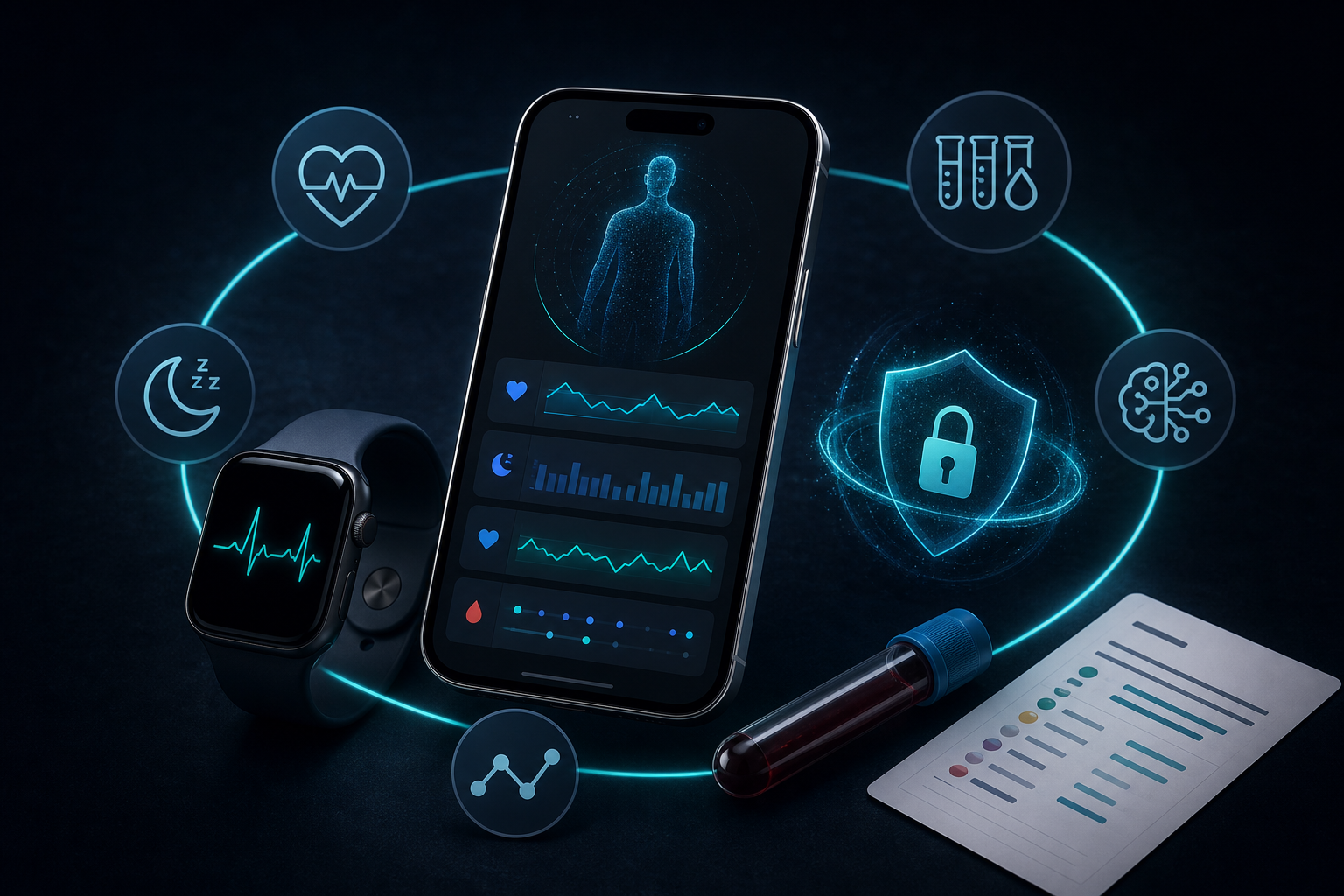
Most iPhone users interested in longevity coaching have no shortage of options. The harder problem is knowing which apps are actually doing something useful with your data — and which ones are wrapping a basic step counter in biological age branding.
This guide covers five criteria that separate a genuinely useful longevity coach app for iPhone from one that just looks the part. Use it as a checklist before you download anything.
Why This Category Is Harder to Evaluate Than It Looks
Longevity apps have multiplied fast. You'll find AI chat coaches (Vora, The Longevity AI), comprehensive biological age trackers (Nuvo, Humanity), and general wellness platforms (Wellness Project, Ray) that have bolted on longevity-adjacent features. They all use similar language. They all claim to personalize recommendations.
The differences show up in the details: what data they actually read, how deeply they process it, where that processing happens, and whether the output is something you can act on tomorrow morning or just a number to screenshot.
Five questions worth asking before committing to any of them.
1. How Deep Is the Apple Health and Wearable Integration?
HealthKit is the foundation. Every serious longevity app on iPhone should pull from it. The question is what they do with that data once they have it.
A surface-level integration reads step count, active calories, and maybe resting heart rate. That's fine for a fitness app. It's not enough for biological age modeling.
Look for apps that read a broader signal set: heart rate variability (HRV), sleep architecture including REM and deep sleep stages, blood oxygen saturation, respiratory rate, and continuous heart rate. Tracked longitudinally, these markers carry meaningful aging signal. A single night's HRV reading tells you little. Months of it tells you a lot.
Also check which wearables the app supports beyond Apple Watch. Oura Ring and Garmin devices generate high-quality sleep and recovery data that many users prefer. An app locked to Apple Watch limits your options if your hardware ever changes.
Nuvo syncs Apple Watch, Oura Ring, and Garmin data through HealthKit, pulling the wearable inputs needed to calculate its 21-biomarker biological age score. That breadth matters if you want the score to reflect your actual physiology rather than a subset of it.
2. Does the App Support Blood Biomarker Input?
This is where most apps fall short — and it's the single biggest gap between a longevity coach and a fitness tracker with a new label.
Wearable data captures real-time physiology. Blood biomarkers capture what's happening at a metabolic and inflammatory level, which no wearable can see directly. HbA1c (glycated hemoglobin, a 90-day average of blood glucose control), fasting glucose, HDL cholesterol, C-reactive protein (CRP, a marker of systemic inflammation), and creatinine (a kidney function indicator) each carry independent aging signal that no watch can infer from your wrist.
An app that ignores blood data is working with one hand tied behind its back. It can tell you how last night's sleep affected your HRV. It cannot tell you whether your metabolic health is accelerating your aging.
When evaluating any longevity coach app for iPhone, check specifically:
- Which blood markers can you enter manually?
- Does the app connect to lab providers, or is it manual entry only?
- How does it weight blood data relative to wearable data in its score?
- Does it flag out-of-range values and explain what they mean?
The more clearly an app answers these questions, the more seriously it's taking the biomarker side of the equation.
3. Where Does the AI Processing Actually Happen?
This question matters more than most people realize, and it's almost never answered clearly in App Store listings.
When an app sends your health data to a cloud server to run its AI model, that data exists on someone else's infrastructure. It can be stored, analyzed, used to train future models, or potentially sold. Privacy policies are long and they change. The only way to guarantee your biological age data stays yours is for the processing to happen on your device.
On-device AI — sometimes called local inference — runs the model entirely within your iPhone. No data leaves the device. No account is required to generate recommendations. The app can't sell what it never receives.
This is a meaningful architectural choice, not a marketing footnote. It requires building the model to run efficiently on device hardware rather than offloading computation to a server. Few apps have done it.
Nuvo processes all recommendations through Nuvo Intelligence, its on-device AI coach, with encrypted local processing. No data is transmitted to external servers, and no account is required. For anyone who has thought carefully about what it means to share longitudinal health data with a third party, that distinction is worth weighing seriously.
4. Does the App Give You an Actionable Daily Plan, or Just a Score?
A biological age score is only useful if it connects to something you can change.
Some apps calculate a score and stop there. You get a number, maybe a trend line, and a vague suggestion to sleep more. That's informative in the same way a cholesterol printout is informative: technically accurate, practically incomplete.
A genuine longevity coach should do three things with your score.
First, it should tell you which specific biomarkers are pulling your score in the wrong direction. Not "your recovery is suboptimal" — but "your HRV has dropped 18% over the past two weeks and your CRP is elevated, which together suggest systemic inflammation is affecting your recovery."
Second, it should connect those biomarkers to specific interventions. Recovery modalities like sauna, cold plunge, breathwork, meditation, red light therapy, and massage each have distinct physiological effects. An app worth using should log these interventions and show you, over time, which ones are actually moving your score.
Third, it should generate nutrition and supplement protocols tied to out-of-range biomarkers — not generic wellness advice. "Take omega-3s" is generic. "Your CRP is elevated and your omega-3 intake appears low based on your logged nutrition, which may be contributing to the inflammatory signal in your score" is something you can act on.
When evaluating any app in this category, look past the score visualization and ask: what does this tell me to do differently tomorrow?
5. Is Pricing Transparent and Proportionate?
Longevity apps span a wide range. Some are free with paywalled features. Some charge monthly. Some are expensive enough that the pricing page is conspicuously absent from the website.
Opacity on pricing is worth noting. If an app won't tell you what it costs before you download it, that's a deliberate product decision — and it usually means the price is designed to feel more reasonable after you've already invested time in setup.
For any app you're seriously considering, confirm:
- Is there a free tier, and what does it actually include?
- Is billing monthly or annual, and what's the per-month cost either way?
- Is there a trial period long enough to see whether the score moves?
For Nuvo's current pricing and plan details, check nuvolongevity.com directly, as plans are updated periodically.
Putting the Criteria Together
A quick reference for evaluating any longevity coach app for iPhone:
Apple Health / wearable integration: HRV, sleep stages, SpO2, respiratory rate; multi-device support (Apple Watch, Oura Ring, Garmin).
Blood biomarker support: Manual entry for HbA1c, fasting glucose, HDL cholesterol, CRP, and creatinine at minimum.
Privacy and AI processing: On-device processing; no account required; clear data policy.
Actionability: Specific biomarker feedback, intervention logging, and personalized protocols.
Pricing transparency: Clearly stated before download; trial period available.
No app in this category is perfect across all five. But these criteria let you identify where each one is making tradeoffs — and whether those tradeoffs align with what you actually need.
If your priority is a privacy-first app that combines wearable data with blood biomarkers and ties a daily score to specific, actionable recommendations, Nuvo was built around exactly that combination. You can explore how it works at nuvolongevity.com.
Frequently Asked Questions
What makes a longevity coach app different from a regular fitness app?
A fitness app tracks activity and recovery. A longevity coach app models biological aging by combining wearable data with blood biomarkers, then connects that score to specific interventions you can change. The goal isn't fitness performance — it's the rate at which your body is aging.
Do I need an Apple Watch to use a longevity coach app on iPhone?
Not always. Some apps accept manual data entry or connect to other wearables via HealthKit. That said, continuous wearable data — HRV, sleep, heart rate — significantly improves the accuracy of any biological age model, so some form of wearable is strongly recommended.
What blood biomarkers should a longevity app support?
At minimum: HbA1c, fasting glucose, HDL cholesterol, C-reactive protein (CRP), and creatinine. These markers cover metabolic health, systemic inflammation, and kidney function — each carrying independent aging signal that wearable data cannot capture.
Is on-device AI processing actually more private than cloud-based processing?
Yes. When an app runs its AI model on your device, your health data never leaves your iPhone. Cloud-based processing requires transmitting your data to external servers, where it can be stored, analyzed, or potentially shared. On-device processing eliminates that exposure entirely.
How do I know if a longevity app's recommendations are personalized or just generic?
Genuine personalization ties recommendations to your specific out-of-range biomarkers. If an app gives the same nutrition or supplement advice regardless of your blood data, it's not personalizing — it's templating. Look for apps that explain which specific marker is driving each recommendation.
Can a longevity coach app replace a doctor or registered dietitian?
No. These apps are tools for tracking and pattern recognition, not clinical diagnosis or medical treatment. Use them to understand trends in your own data and to have better-informed conversations with your healthcare provider — not as a substitute for professional medical advice.
How long does it take to see meaningful changes in a biological age score?
Most meaningful movement requires at least four to eight weeks of consistent data and behavioral change. Blood biomarkers like HbA1c reflect a 90-day average, so metabolic improvements take time to register. Wearable-based markers like HRV can shift faster in response to sleep and recovery changes.