Oura Ring Review 2026: How Well Does It Track What Actually Matters for Longevity?
This Oura Ring review examines how well its HRV, sleep, and readiness data connects to the biomarkers that actually predict longevity.
Written by the Nuvo Longevity editorial team at Firefly Labs LLC.
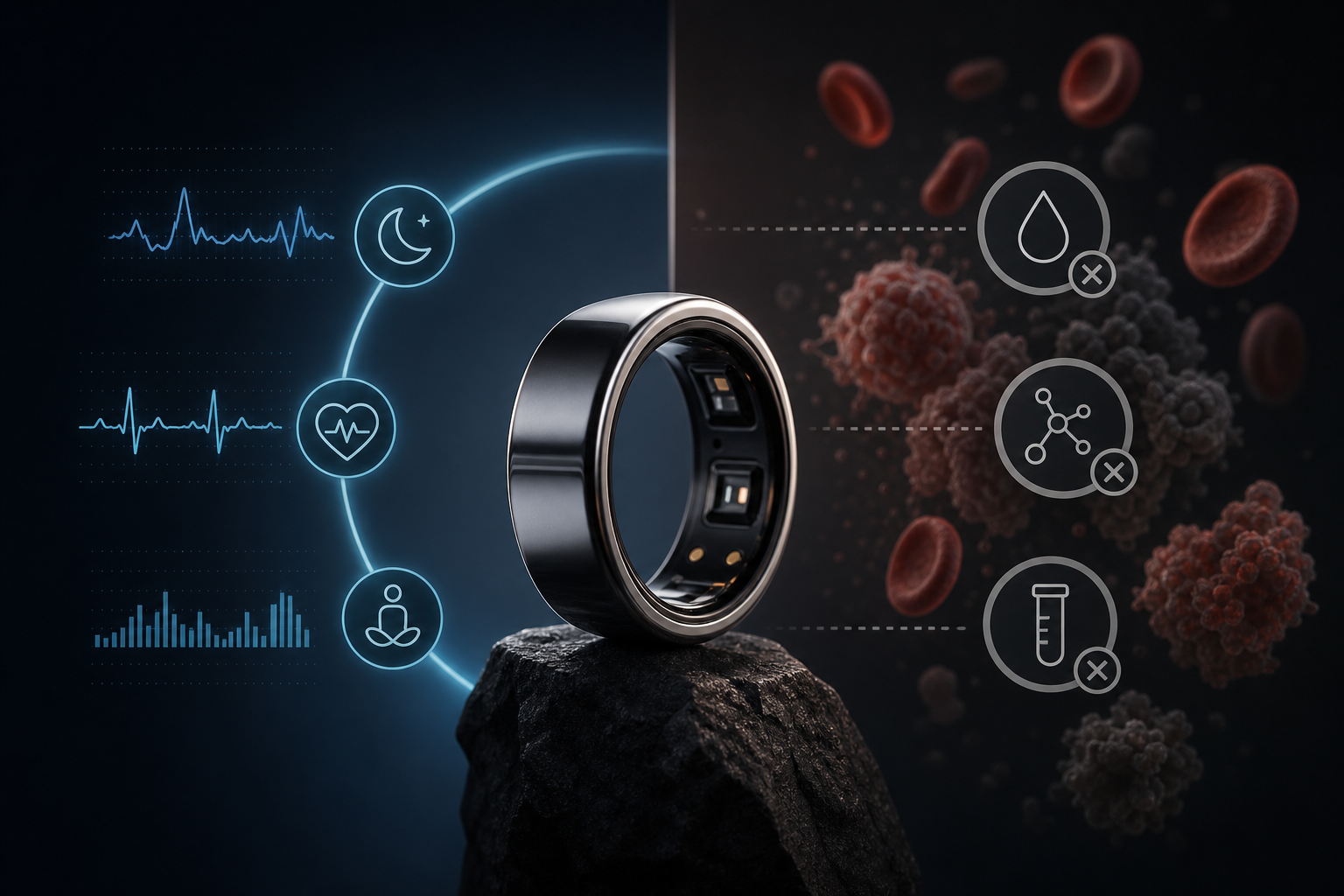
The Oura Ring has earned its place on the fingers of founders, athletes, and serious sleep trackers. But if your goal is understanding how you're actually aging — not just how you recovered from last Tuesday — the more useful question is whether the data it collects connects to the biomarkers that predict longevity. This review looks at exactly that: what the ring measures well, where it falls short for longevity tracking, and what it takes to turn raw ring data into something you can act on.
What the Oura Ring Actually Measures
The Oura Ring Gen 3 tracks heart rate variability (HRV), resting heart rate, skin temperature, respiratory rate, blood oxygen saturation (SpO2), and sleep architecture — REM, deep, and light stages. It also logs steps, activity, and caloric burn.
These aren't trivial measurements. HRV is one of the more meaningful longevity-adjacent signals a wearable can capture. It reflects autonomic nervous system balance, and chronically low HRV correlates with accelerated biological aging. Skin temperature trending is useful for detecting illness, hormonal shifts, and recovery status. Sleep staging, imperfect on any finger or wrist device, still gives you a reasonable picture of sleep quality over time.
The ring produces three daily scores — Readiness, Sleep, and Activity — each aggregating the underlying signals into a number between 0 and 100.
Where the Hardware Performs Well
Form factor matters for data quality. The finger produces a cleaner photoplethysmography (PPG) signal than the wrist, which means HRV and heart rate readings from the Oura Ring are generally more accurate than those from wrist-based wearables, especially under movement conditions. For overnight tracking, where the ring stays still, that advantage is most pronounced.
Sleep staging accuracy is reasonable. No consumer wearable matches a polysomnography lab, but Oura's staging correlates well enough with clinical measures to be useful for tracking trends across weeks and months. Trends are what matter for longevity. Not any single night.
Skin temperature trending is a genuine differentiator. Absolute temperature is less useful than deviation from your personal baseline, and Oura's algorithm handles this well. It's one of the few consumer devices that makes this data actionable rather than decorative.
Where the Hardware Has Limits
SpO2 monitoring is passive and averaged overnight rather than continuous. If you need event-level oxygen desaturation data, the ring captures it broadly — not with the granularity of a dedicated sleep study device.
VO2 max estimation exists in the Oura ecosystem but is less developed than on Apple Watch or Garmin, both of which use GPS-paired cardio data to sharpen the estimate. This matters. VO2 max is one of the strongest single predictors of longevity, and a noisier estimate means a less reliable signal.
There's also no ECG capability. For cardiovascular longevity tracking, the absence of atrial fibrillation detection is a real gap compared to Apple Watch Series 9 and later.
The Readiness Score: Useful, But Not a Biological Age
Readiness is Oura's flagship output. It aggregates HRV, resting heart rate, sleep quality, temperature deviation, and recent activity load into a daily number. For recovery management, it works. It tells you whether your body handled yesterday's stress well.
What it doesn't tell you is how you're aging. Readiness is a snapshot of today's recovery state. Biological age is a longitudinal picture of whether your physiology is older or younger than your birth certificate says. Related concepts — but not the same measurement.
A 45-year-old with a Readiness score of 85 might still carry a biological age of 52 if their HbA1c is elevated, their CRP is chronically high, and their fasting glucose has been trending upward for two years. The ring can't see any of that.
What Readiness Gets Right
The scores do reflect meaningful physiology. When HRV drops and resting heart rate rises after a hard training block, travel, or illness, Readiness captures that accurately. Using it to modulate training intensity or decide whether to push a hard session is a legitimate application.
The trend data is where Readiness becomes genuinely interesting for longevity purposes. If your 90-day average is declining without an obvious cause, that's a signal worth investigating with a blood panel. The ring surfaces the symptom. Blood work identifies the mechanism.
What the Oura Ring Cannot Tell You About Longevity
This is the core gap, and it's worth being direct.
Meaningful longevity tracking requires biomarkers the ring simply cannot measure. HbA1c — which reflects average blood glucose over roughly three months — is one of the most predictive markers of accelerated aging and metabolic disease. The ring has no access to it. Fasting glucose, HDL cholesterol, C-reactive protein (CRP, a marker of systemic inflammation), and creatinine (kidney function) are all absent from any consumer wearable sensor currently available.
These aren't minor omissions. CRP is a direct signal of the chronic low-grade inflammation that drives accelerated biological aging. You can have excellent HRV and deep sleep while your CRP sits at 4 mg/L, quietly indicating an inflammatory state your ring will never detect.
The Oura app also doesn't produce a biological age score. It doesn't attempt to tell you whether your physiology is aging faster or slower than your chronological age. That's a deliberate product choice, not a technical limitation — but it means the ring alone cannot answer the question most longevity-focused users are actually asking.
How Oura Ring Data Becomes More Useful for Longevity
The ring's data doesn't have to exist in isolation. Via Apple HealthKit, Oura syncs HRV, sleep, heart rate, and activity data into the Apple Health ecosystem, where it becomes available to apps built on top of that foundation.
This is where the picture changes for users serious about biological age.
Apps like Nuvo Longevity pull Oura Ring data through HealthKit and combine it with user-entered blood test results — HbA1c, fasting glucose, HDL cholesterol, CRP, creatinine — to calculate a daily biological age score from 21 longevity biomarkers. The HRV and sleep data your ring captures every night becomes one input in a broader model that also accounts for the blood markers your ring can't see.
That's the difference between a recovery tool and a longevity tracking system. The ring provides the daily wearable signal. Blood data provides the metabolic and inflammatory context. Together, they produce something the ring alone cannot: a single picture of how you're actually aging.
For a broader look at how different apps handle this kind of integration, the top longevity tracking apps for Apple Watch in 2026 covers the field in more detail.
Oura Ring vs. Apple Watch for Longevity Tracking
This comparison comes up constantly. The honest answer is that they're optimized for different things.
Apple Watch has a stronger VO2 max estimation algorithm, ECG capability, and a larger app ecosystem built natively on watchOS. It's the better choice if you want a wrist-based device with the broadest longevity app compatibility.
The Oura Ring produces cleaner HRV data during sleep, has better passive wear compliance — most people wear a ring 24/7 more consistently than a watch — and runs longer between charges. For sleep and recovery data specifically, many users find the ring more consistent.
You don't have to choose. Both sync to Apple HealthKit, and both can feed into the same downstream analysis. If you already own an Apple Watch, the Oura Ring adds complementary data rather than replacing what you have.
The Intervention Tracking Gap
One thing the Oura Ring app doesn't do well is close the feedback loop between specific interventions and your physiological data.
You can see that your HRV was higher on a given morning. You can't easily see whether that's because you did a sauna session two nights ago, started magnesium three weeks ago, or cut alcohol for the past ten days. The app doesn't log interventions in a way that lets you correlate them with your scores over time.
For users running structured longevity protocols, this gap matters. If you're doing cold plunges, breathwork, or red light therapy, you want to know whether those practices are actually moving your numbers. The ring captures the downstream signal. It doesn't help you attribute it.
Apps that log specific interventions alongside wearable data — and track how those interventions correlate with biological age movement over time — address this directly. It's one reason Oura Ring users who are serious about longevity often pair the ring with a dedicated analysis layer rather than relying on the Oura app alone.
Oura Ring and Privacy
The Oura Ring stores data in Oura's cloud. The app requires an account. Data is processed on Oura's servers, not on your device.
For most users, this is a non-issue. For the growing segment of health-conscious users who care specifically about where their physiological data lives, it's worth knowing. Oura's privacy policy permits data use for product improvement and, in aggregated or de-identified form, for research partnerships.
This is the standard model for consumer health apps — not unusual. But if you're entering sensitive health data, including blood results and detailed sleep patterns, understanding the data architecture of every tool in your stack is reasonable due diligence.
On-device processing — where all computation happens locally and nothing leaves your device — is an alternative architecture some apps have adopted. For users who treat health data privacy as a first-order concern, that distinction is substantive.
Who Should Buy the Oura Ring in 2026
The Oura Ring is well-designed hardware that does a specific set of things well. If you want accurate overnight HRV and sleep data in a form factor you'll actually wear consistently, it's one of the better options available.
If your goal is longevity tracking in a complete sense, the ring is a useful input — not a complete solution. It captures the wearable side of the equation. It doesn't capture metabolic health, inflammatory status, or kidney and liver function. It doesn't produce a biological age score. It doesn't tell you whether your interventions are working at a systemic level.
The ring works best as part of a stack: hardware that collects clean physiological data, paired with an analysis layer that connects that data to blood biomarkers and produces something you can actually act on. Used that way, it's a genuinely valuable tool for people who take longevity seriously.
Used alone, it tells you how you recovered. It doesn't tell you how you're aging.
FAQs
Does the Oura Ring measure biological age?
No. The Oura Ring does not calculate or display a biological age score. It produces Readiness, Sleep, and Activity scores based on wearable sensor data. Biological age calculation requires blood biomarkers — HbA1c, CRP, fasting glucose — which no wearable sensor currently measures. Some apps that integrate with Oura Ring data via HealthKit do calculate biological age by combining wearable data with user-entered blood results.
How accurate is Oura Ring HRV compared to other wearables?
The Oura Ring captures HRV from the finger, which generally produces a cleaner PPG signal than wrist-based devices during sleep. For overnight HRV tracking specifically, it's considered one of the more accurate consumer options. During movement, accuracy differences between devices narrow considerably. No consumer wearable matches clinical-grade HRV measurement equipment.
Can the Oura Ring sync with Apple Health?
Yes. The Oura Ring syncs HRV, sleep stages, heart rate, skin temperature, and activity data to Apple HealthKit, making it available to any iOS app that reads from Apple Health — including longevity tracking apps that combine wearable data with blood biomarkers.
What does the Oura Ring Readiness score actually measure?
Readiness aggregates HRV balance, resting heart rate, sleep quality and duration, body temperature deviation, and recent activity load. It reflects your current recovery state relative to your personal baseline. A high Readiness score means your body handled recent stress well. It's a recovery metric, not a longevity metric.
Is the Oura Ring worth it if you already have an Apple Watch?
For most users, the two devices are complementary rather than redundant. Apple Watch provides stronger VO2 max estimation, ECG, and a broader native app ecosystem. The Oura Ring provides cleaner overnight HRV and sleep data and higher passive wear compliance. Both sync to Apple Health, so data from both can feed into the same downstream analysis.
Does the Oura Ring store data in the cloud?
Yes. Oura processes and stores data on its servers and requires an account. This is standard architecture for most consumer health wearables. Users who prioritize health data privacy should review Oura's privacy policy and consider whether the apps they pair with the ring offer on-device processing as an alternative.
What blood biomarkers matter most for longevity that the Oura Ring can't track?
The most longevity-relevant blood markers include HbA1c (average blood glucose over three months), fasting glucose, HDL cholesterol, C-reactive protein (systemic inflammation), and creatinine (kidney function). These are strong predictors of biological aging and metabolic health. No current consumer wearable measures them directly. They require periodic blood testing, and their value increases significantly when analyzed alongside wearable data over time.
The Oura Ring captures real, useful data. The question is always what you do with it. If you want to connect that data to blood biomarkers and get a daily picture of how you're actually aging, Nuvo Longevity is built to do exactly that — pulling Oura Ring data through HealthKit and combining it with 21 longevity biomarkers, including your blood results, into a single daily score.