Recovery Readiness Score: What It Means and How to Improve It
A recovery readiness score combines HRV, sleep, resting heart rate, and training load into a single daily number. Here's how WHOOP, Oura, and Garmin calculate it differently — and what the evidence actually supports for improving yours.
Written by the Nuvo Longevity editorial team at Firefly Labs LLC.
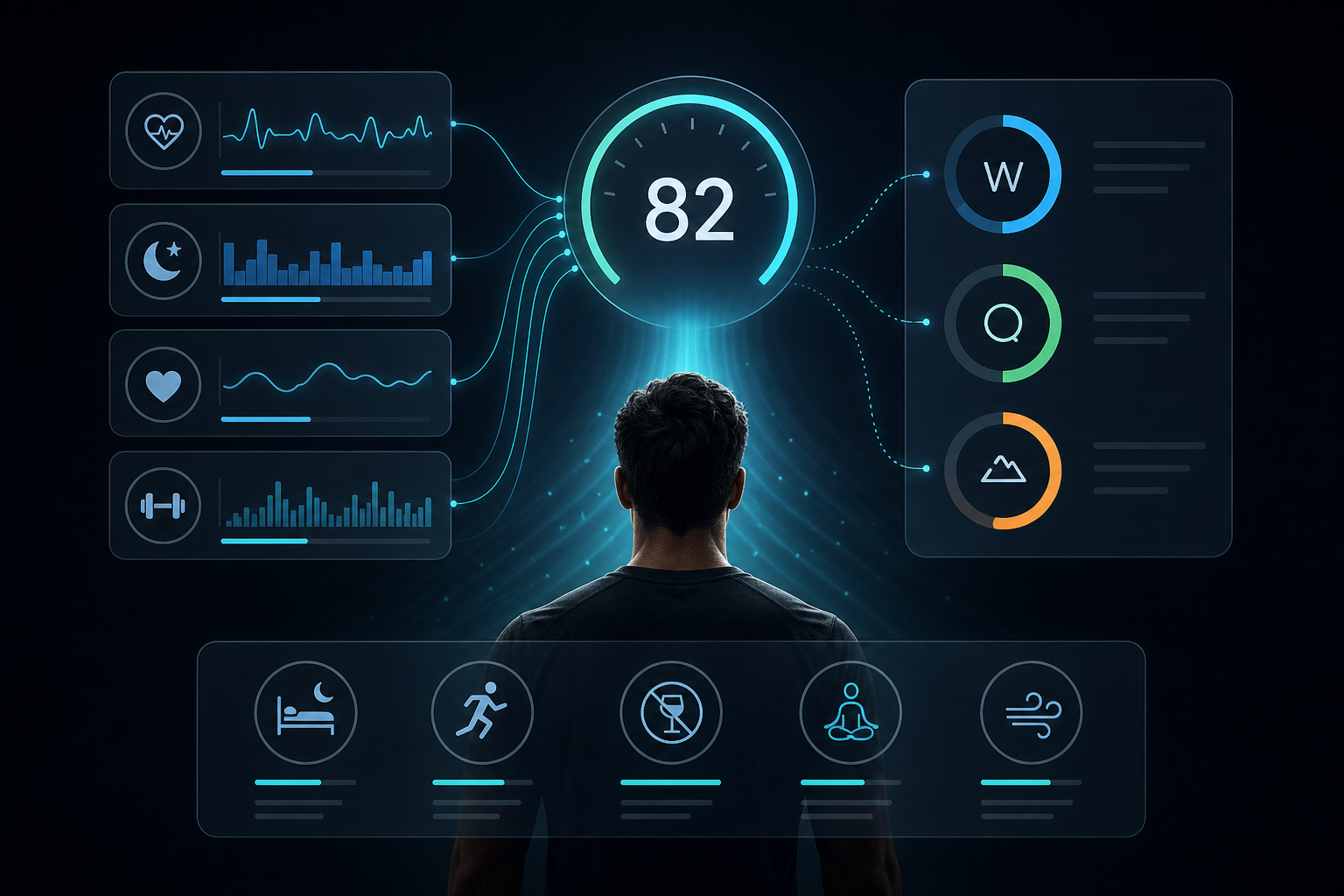
Your wearable gave you a number this morning. Maybe it was green. Maybe it wasn't. But do you actually know what it calculated — and whether it's telling you something worth acting on?
A recovery readiness score is a composite metric that estimates how prepared your body is for physical or cognitive stress on a given day. It draws on physiological signals collected overnight: primarily heart rate variability (HRV), resting heart rate (RHR), sleep quality and duration, and accumulated training load. This article breaks down how that calculation works, how WHOOP, Oura, and Garmin each approach it differently, and what the evidence actually supports for improving it.
What Goes Into a Recovery Readiness Score
Four inputs do most of the work.
Heart rate variability is the primary signal. HRV measures the variation in time between consecutive heartbeats, expressed in milliseconds. Higher HRV generally reflects a more adaptable autonomic nervous system — your body is ready to respond. A suppressed HRV signals accumulated stress, whether from training, poor sleep, illness, or psychological load.
Resting heart rate adds a slower-moving signal. An RHR elevated above your personal baseline often indicates incomplete recovery. It responds to alcohol, illness, heat stress, and overtraining.
Sleep contributes both duration and architecture. Deep sleep and REM sleep drive physiological repair and hormonal regulation. Fragmented or shortened sleep reduces the overnight recovery window, even when HRV looks acceptable.
Training load contextualizes the other three. A suppressed HRV after a hard workout means something different than the same reading after a rest day. Most platforms track cumulative load across several days to distinguish productive stress from excessive stress.
None of these signals is sufficient on its own. The score combines them into a single number relative to your personal baseline — not a population average.
How WHOOP, Oura, and Garmin Calculate It Differently
The concept is consistent. The math is not.
WHOOP produces a Recovery score (0–100%) each morning using HRV, RHR, sleep performance, and respiratory rate, compared against your personal 30-day rolling baseline. HRV carries the most weight. WHOOP also tracks Strain — a 0–21 exertion score — to calibrate how much recovery you need relative to what you've accumulated.
Oura generates a Readiness score (0–100) that incorporates HRV balance, body temperature deviation, respiratory rate, activity balance, sleep balance, and previous day's activity. Oura's emphasis on skin temperature makes it a sensitive early signal for illness or hormonal shifts — something WHOOP doesn't surface directly.
Garmin uses Body Battery (0–100), which models energy reserves from HRV stress score, sleep, and activity. Newer Garmin devices also offer a separate HRV Status feature that tracks a 5-week baseline and flags whether your current reading is balanced, unbalanced, or low.
One important caveat: HRV values and readiness scores are not comparable across platforms. HRV researcher Marco Altini has written extensively on this — measurement methodology, sensor placement, and proprietary algorithms differ enough between devices that a 70 on Oura is not the same as a 70 on WHOOP. What matters is your trend within a single platform, not cross-device comparison.
What the Evidence Says About Improving Recovery Readiness
The research here is more settled than most wellness content suggests.
Sleep consistency matters more than duration alone. Irregular sleep timing disrupts circadian rhythm and suppresses HRV independent of total hours slept. Maintaining a consistent bedtime and wake time within a 30-minute window produces measurable HRV improvements over weeks.
Training load management is the most direct lever. HRV-guided training — adjusting workout intensity based on morning HRV rather than a fixed schedule — has shown improvements in both performance outcomes and recovery markers compared to fixed-load programs. The logic is straightforward: when HRV is suppressed, reduce intensity. When it's elevated or stable, push harder.
Alcohol reliably suppresses HRV. Even moderate consumption the night before produces measurable reductions in overnight HRV and elevates resting heart rate. The effect is dose-dependent and consistent across studies.
Psychological stress loads the same system as physical stress. The autonomic nervous system doesn't distinguish between a hard interval session and a difficult work week. Chronic psychological stress suppresses HRV and degrades readiness scores, which is why stress-reduction practices appear throughout the recovery literature alongside training protocols.
Sauna and cold exposure have documented acute effects on autonomic recovery. Post-exercise sauna sessions have been associated with improved HRV recovery in the hours following training. Cold water immersion reduces markers of muscle damage and perceived soreness, though its effect on HRV is more variable and appears context-dependent.
Where Most Recovery Scores Stop Short
Here's the gap most platforms don't address: they tell you your score, but not what moved it.
WHOOP, Oura, and Garmin all surface the output. They show you the number and its components. What they don't do is let you log specific recovery interventions and observe how those practices correlate with score changes over time. You know you slept 7.5 hours. You don't know whether yesterday's sauna session contributed to this morning's HRV improvement — or whether it was the breathwork before bed, or simply skipping alcohol.
That's a meaningful analytical gap.
How Nuvo's Recovery Readiness Feature Addresses This
Nuvo makes the intervention layer explicit and measurable.
The app lets you log specific recovery practices — sauna, cold plunge, breathwork, meditation, red light therapy, and massage — then tracks how your recovery readiness score moves in the days following each. Over time, you build a personal dataset: which interventions actually shift your score, and by how much, given your physiology.
This matters because individual response to recovery interventions varies more than most people expect. Some people see consistent HRV improvements after sauna. Others see more movement from breathwork or meditation. Without logging the intervention and observing the downstream effect, you're guessing.
Nuvo pulls wearable data from Apple Watch, Oura Ring, and Garmin via HealthKit, so the underlying physiological signals are the same ones driving your existing readiness score. The difference is the analytical layer on top: connecting what you did to what changed.
Recovery readiness also sits within a broader picture. Nuvo calculates a daily biological age score using 21 longevity biomarkers — including blood test results like HbA1c, fasting glucose, HDL cholesterol, CRP, and creatinine — so you're not just tracking day-to-day performance, you're tracking what your habits add up to over time. Nuvo Intelligence, an on-device AI coach, generates personalized recommendations locally without transmitting your data to external servers.
Nuvo is available at $2.08 per month on an annual plan or $4.99 per month monthly. Details at nuvolongevity.com.
Practical Steps to Improve Your Recovery Readiness Score
- Anchor your sleep timing. Same bedtime and wake time, including weekends. Consistency drives circadian alignment more reliably than chasing extra hours.
- Use HRV to guide training intensity. On days with suppressed HRV, reduce intensity or volume. The signal exists for a reason.
- Log your interventions. Whether you use Nuvo or a spreadsheet, tracking what you did and observing what followed is how you identify what actually works for your physiology.
- Limit alcohol, especially within four hours of sleep. The HRV suppression is reliable and measurable.
- Treat psychological stress as a training load. High-stress periods warrant the same recovery adjustments as heavy training weeks.
- Experiment with one intervention at a time. Adding sauna, cold plunge, and breathwork simultaneously makes it impossible to isolate what's working.
Frequently Asked Questions
What is a recovery readiness score?
A recovery readiness score is a composite daily metric estimating how prepared your body is for physical or cognitive stress. It typically combines heart rate variability, resting heart rate, sleep quality, and accumulated training load, compared against your personal baseline.
Is a recovery readiness score the same across WHOOP, Oura, and Garmin?
No. Each platform uses different sensors, measurement windows, and proprietary algorithms. A score of 70 on one device is not equivalent to 70 on another. Track trends within a single platform rather than comparing numbers across devices.
What is the most important factor in a recovery readiness score?
Heart rate variability carries the most weight in most algorithms. But HRV itself is shaped by sleep quality, training load, alcohol, psychological stress, and illness — so improving your score means addressing those upstream factors, not just watching the HRV number.
Can sauna or cold plunge improve recovery readiness?
Both have documented effects on recovery markers. Post-exercise sauna has been associated with improved autonomic recovery. Cold water immersion reduces perceived soreness and some markers of muscle damage. Individual response varies, which is why logging these interventions and observing your own score movement is more useful than relying on population averages.
How does Nuvo's recovery readiness feature differ from WHOOP or Oura?
Nuvo lets you log specific recovery interventions — sauna, cold plunge, breathwork, meditation, red light therapy, massage — and tracks how your recovery readiness score moves after each. Most platforms show you the score but don't connect it to the specific practices that may have influenced it.
How long does it take to improve a recovery readiness score?
Sleep consistency improvements can produce measurable HRV changes within two to four weeks. HRV-guided training adjustments tend to show clearer trends over six to eight weeks. Alcohol elimination typically shows effects within days.
Does recovery readiness affect biological age?
Chronic poor recovery — suppressed HRV, disrupted sleep, elevated resting heart rate — is associated with accelerated aging markers including elevated CRP (a systemic inflammation biomarker) and dysregulated blood glucose. Recovery readiness and biological age aren't the same metric, but the physiological inputs overlap significantly.
Recovery readiness scores give you a daily signal. What you do with that signal — and whether you can connect it to specific habits — determines whether the number stays informative or becomes noise. Start with sleep consistency and training load management. Then build the intervention log. The pattern will emerge.