Spermidine Supplement: The Research on Autophagy, Aging, and Daily Dosing
A spermidine supplement may support autophagy and slow cellular aging. Here is what the research actually shows on dosing, mechanisms, and daily use.
Written by the Nuvo Longevity editorial team at Firefly Labs LLC.
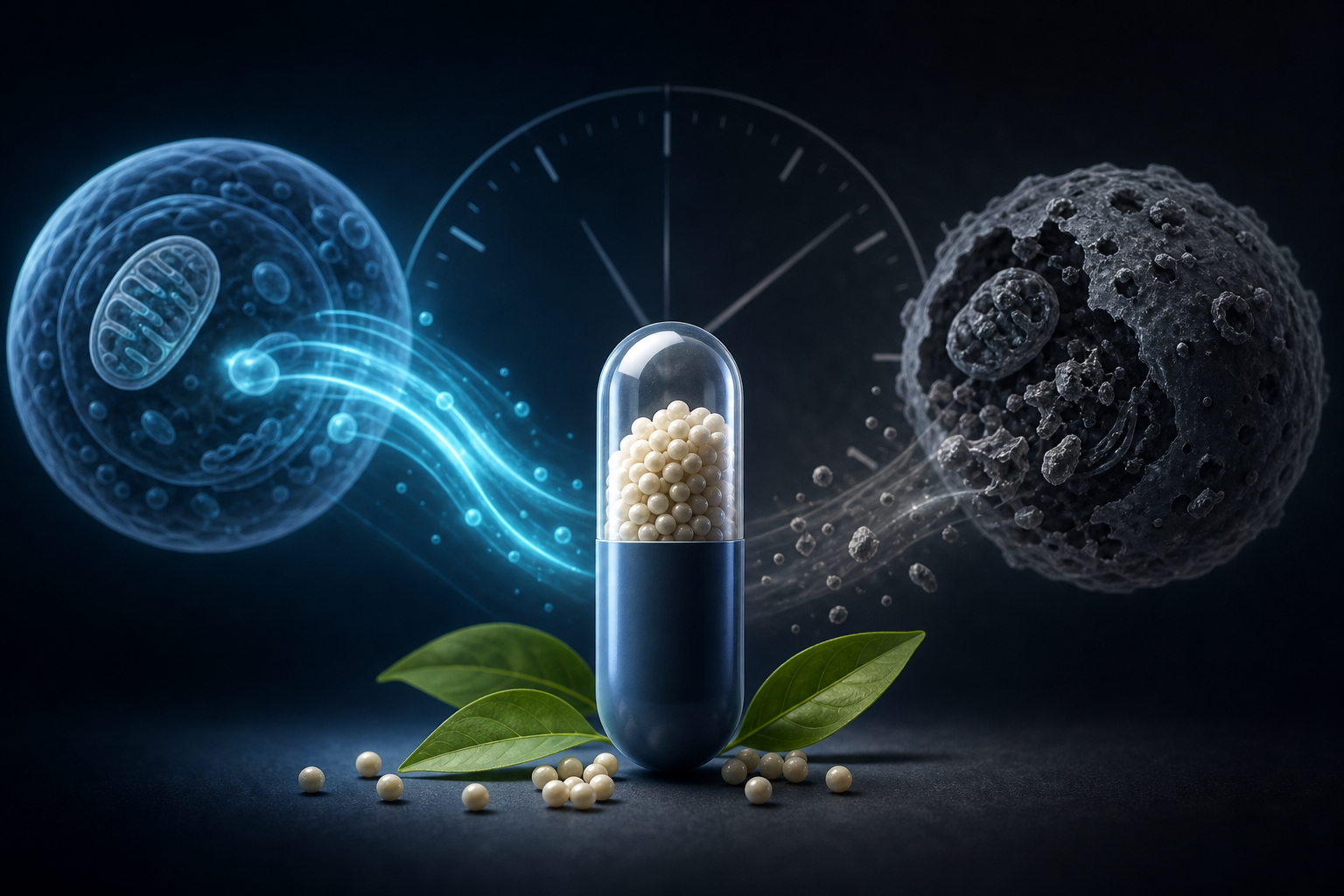
Spermidine has moved quickly from obscure biochemistry papers into mainstream longevity conversations. If you've been tracking your biological age or paying attention to what actually moves the needle on cellular aging, you've probably come across the name. But the gap between "I've heard of it" and "I understand what it does and whether I should take it" is wider than most articles admit.
This piece covers what spermidine is, what the research actually says about autophagy and aging, what doses appear in the literature, and what you need to know before adding it to a protocol.
What Spermidine Actually Is
Spermidine is a polyamine — a class of small molecules found in virtually every living cell. Your body produces it naturally, and you get it through food. Wheat germ is the richest dietary source, with aged cheese, mushrooms, soybeans, and legumes also contributing meaningful amounts.
The name comes from its original isolation site, which is exactly what you're thinking. That history doesn't matter here. What does matter is that polyamines regulate cell growth, gene expression, and protein synthesis — and spermidine specifically has emerged as a potent inducer of autophagy.
Autophagy, from the Greek for "self-eating," is the process by which cells break down and recycle damaged proteins and organelles. It's cellular quality control. When autophagy functions well, the cell clears out dysfunctional components before they accumulate and cause problems. When it declines — which it does with age — that debris builds up.
The Autophagy Connection: What the Research Shows
The link between spermidine and autophagy isn't speculative. It's been replicated across multiple model organisms and is mechanistically understood.
Spermidine inhibits an enzyme called EP300, a histone acetyltransferase. When EP300 is inhibited, autophagy-related genes are expressed more readily. The result is increased autophagic flux — cells clear damaged material more efficiently.
Evidence in Model Organisms
Studies in yeast, flies, worms, and mice have consistently shown that spermidine supplementation extends lifespan. In some mouse studies, it extended median lifespan by roughly 25%, with effects observed even when supplementation began in middle age. The animals also showed improved cardiac function and reduced inflammation markers.
These findings matter as proof of concept. They don't translate directly to humans, but they establish that the mechanism is real and that the effect size in animals is substantial enough to warrant serious investigation.
Human Observational Data
A large epidemiological study of roughly 800 participants in Austria found that higher dietary spermidine intake correlated with lower blood pressure and reduced cardiovascular mortality. The association held after adjusting for confounders. People in the highest tertile of spermidine consumption had meaningfully lower mortality risk than those in the lowest.
Observational data doesn't establish causation. Diet is complex, and people who eat more wheat germ and fermented foods may differ from those who don't in dozens of ways. But the direction of the finding is consistent with the mechanistic research.
The Memory and Cognitive Aging Signal
A randomized controlled trial published in 2018 tested spermidine supplementation in older adults with subjective cognitive decline. After three months, the supplemented group showed improvements in memory performance compared to placebo. The trial was small — roughly 30 participants per arm — but it was double-blind and placebo-controlled, which gives it more weight than observational work.
Cognitive aging and biological aging aren't the same thing, but they share upstream mechanisms. Reduced autophagy, mitochondrial dysfunction, and systemic inflammation drive both. A compound that addresses those mechanisms at the cellular level could plausibly affect multiple aging phenotypes.
Why Spermidine Levels Decline With Age
Endogenous spermidine production drops as you get older. Part of this is because the gut microbiome changes with age, and certain gut bacteria are significant polyamine producers. Part of it is that the enzymatic machinery for polyamine synthesis becomes less efficient over time.
The result is a progressive deficit. Cells that once cleared damaged proteins efficiently begin to accumulate cellular debris. This is one reason autophagy is described as a hallmark of aging — and one reason researchers are interested in whether supplementation can partially compensate.
Dietary intake varies enormously. Someone eating a Mediterranean-style diet with regular legumes, aged cheese, and whole grains may consume 10 to 15 mg of spermidine daily. Someone eating a highly processed diet may consume a fraction of that. Supplementation is partly an attempt to close that gap, and partly an attempt to exceed what diet alone can deliver.
Daily Dosing: What the Research Uses
This is where the evidence gets thinner, and honesty matters here.
Most human trials have used doses in the range of 1.2 mg to 5.7 mg of spermidine per day. The Austrian memory trial used a wheat germ extract standardized to 1.2 mg daily. Some more recent protocols have pushed higher — up to 5 mg or more — but large-scale dose-finding trials in humans haven't been completed.
What Supplement Labels Actually Contain
Spermidine supplements are typically sold as wheat germ extract standardized to a specific spermidine content. A product labeled "1 mg spermidine" should contain 1 mg per serving, but standardization quality varies between manufacturers. Third-party testing for actual spermidine content is not universal.
Some products use spermine, a related polyamine, or a blend of polyamines. These are not equivalent to spermidine, though they share some mechanisms. Read the label carefully.
Timing and Cycling
There's no strong human evidence on optimal timing. Some researchers speculate that taking spermidine in the morning, in a fasted or semi-fasted state, may enhance autophagic activity — since fasting itself induces autophagy. But this is mechanistic reasoning, not a tested protocol.
Cycling — taking periodic breaks from supplementation — is sometimes recommended by practitioners, but it isn't well-supported by human trials. The animal studies used continuous supplementation.
Spermidine and Biological Age: The Measurement Problem
Here's the practical challenge. You can take a spermidine supplement for 90 days and have no objective way to know whether it's doing anything unless you're tracking the right biomarkers.
Autophagy doesn't have a simple blood test. You can't order an "autophagy panel" at a standard lab. What you can track are downstream markers that autophagy influences: systemic inflammation (CRP is a reasonable proxy), metabolic markers like fasting glucose and HbA1c, and cardiovascular markers like blood pressure and resting heart rate.
This is where biological age tracking becomes relevant. A daily biological age score that incorporates CRP, HbA1c, fasting glucose, HDL cholesterol, and wearable data like HRV and resting heart rate gives you a composite signal that can shift in response to interventions over weeks and months. If spermidine is working, you'd expect to see improvement in the inflammatory and metabolic markers that feed into that score.
Nuvo is built for exactly this kind of longitudinal tracking. It calculates a daily biological age score from 21 biomarkers, combining user-entered blood results with Apple Watch, Oura Ring, or Garmin data. When you add a supplement to your protocol, you can observe whether the markers that supplement is supposed to influence are actually moving. That's not a guarantee of attribution — but it's far better than guessing.
Food Sources vs. Supplementation
If you're skeptical of supplementation, the dietary route is worth taking seriously. Wheat germ is the most concentrated food source, at roughly 243 mg of spermidine per 100 grams — though you're not eating 100 grams of wheat germ in a sitting. A tablespoon contains approximately 3 to 5 mg, which puts it in the range of what trials have used.
Other useful sources:
- Aged cheese (particularly cheddar and brie): 20 to 90 mg per 100g, depending on aging
- Mushrooms (especially shiitake and oyster): 10 to 30 mg per 100g
- Soybeans and legumes: 10 to 25 mg per 100g
- Broccoli and cauliflower: 5 to 15 mg per 100g
- Chicken liver: notably high among animal products
A diet deliberately designed around high-spermidine foods could realistically deliver 15 to 25 mg daily. Whether that's equivalent to supplementation at the same dose is unknown — bioavailability from food may differ from standardized extracts.
What Spermidine Doesn't Do
A few things worth stating plainly.
Spermidine is not a substitute for sleep, exercise, or metabolic health. Autophagy is induced powerfully by both exercise and fasting. If you're sedentary and sleeping poorly, a spermidine supplement is unlikely to compensate. The compound works within a biological context, and that context matters.
There's also no evidence that spermidine reverses existing cellular damage. It supports the clearance machinery — it doesn't undo accumulated dysfunction. Framing spermidine as a "rejuvenation" compound overstates what the research shows.
Finally, the long-term safety profile in humans isn't fully established. Polyamines are involved in cell proliferation, and there's a theoretical concern that high-dose supplementation could be problematic in certain contexts, including some cancers. This hasn't been documented as a harm at typical supplement doses, but it's a reason to be thoughtful rather than aggressive with dosing.
How Spermidine Fits Into a Longevity Protocol
Spermidine makes the most sense as one component of a protocol that already includes the basics: consistent sleep, regular aerobic and resistance exercise, metabolic health management, and periodic blood testing. It's not a standalone intervention.
If you're already doing those things and looking at what the evidence supports at the supplement level, spermidine has a stronger mechanistic and early-stage human evidence base than most compounds in the longevity category. That's a meaningful distinction.
The practical question is whether you can tell if it's working. This is where many longevity supplements fail their users — not because the science is weak, but because there's no feedback loop. You take something for three months and have no idea whether anything changed.
Building that feedback loop means tracking the right biomarkers over time. If you're already running periodic blood panels and wearing a device that captures HRV, resting heart rate, and sleep data, you have the inputs. The question is whether those inputs are being synthesized into something you can act on.
That's the problem biological age tracking is designed to solve. When your CRP drops after 60 days of spermidine supplementation, you want to see that reflected in a number you can track daily — not buried in a PDF from a lab.
Integrating Spermidine With Other Longevity Habits
Spermidine doesn't operate in isolation. Several other interventions share the autophagy pathway, and understanding the overlap helps you build a coherent protocol rather than a stack of redundant inputs.
Fasting and time-restricted eating are the most potent non-pharmacological autophagy inducers known. If you're already doing 16:8 intermittent fasting, you're already stimulating autophagy significantly. Spermidine may enhance or extend that effect, but the additive benefit over fasting alone is unclear.
Exercise — particularly high-intensity interval training and resistance training — also induces autophagy in muscle tissue. The combination of exercise and spermidine hasn't been tested directly in humans, but the mechanisms don't appear to conflict.
Other supplements with autophagy-adjacent mechanisms include rapamycin (a prescription mTOR inhibitor used off-label in longevity circles), urolithin A (produced from pomegranate by gut bacteria, with mitophagy-specific effects), and NMN/NR (NAD+ precursors that support mitochondrial function). Stacking all of these is common in longevity communities, but interaction effects are not well-studied.
If you're building a protocol that includes multiple interventions, the ability to observe which ones are actually moving your biomarkers becomes more important, not less. You can't attribute changes to a single compound if you change five things at once — but you can at least observe whether the composite is working.
For a broader look at which habits have the strongest evidence behind them, the 2026 trending longevity habits overview covers the current evidence landscape across exercise, sleep, and supplementation.
Practical Guidance Before You Start
A few things worth doing before adding a spermidine supplement:
Get baseline blood work. At minimum, CRP and fasting glucose. These are the markers most likely to show movement if spermidine is having an anti-inflammatory and metabolic effect. HbA1c — glycated hemoglobin, which reflects your average blood glucose over the past 90 days — gives you a useful baseline for tracking change over that same timeframe.
Choose a standardized extract. Look for wheat germ extract with a stated spermidine content, not a generic polyamine blend. Third-party testing certification (NSF, Informed Sport, or similar) adds confidence that the stated dose is accurate.
Start at the lower end of the studied range. 1 to 2 mg of spermidine daily falls within the range used in human trials and is a reasonable starting point. There's no evidence that higher doses produce proportionally better outcomes in humans.
Track for at least 90 days. Biomarkers like HbA1c and CRP don't move in days. Give the intervention a meaningful runway before evaluating it. If you want to understand how to approach biological age tracking more broadly, this beginner's guide covers the fundamentals.
Don't expect a single supplement to do the work of a protocol. Spermidine is a useful addition to a solid foundation. It's not a replacement for one.
The Bottom Line
Spermidine is one of the more scientifically grounded compounds in the longevity supplement category. The autophagy mechanism is well-established, the animal lifespan data is compelling, and the early human trials are encouraging without being definitive. At doses of 1 to 5 mg daily from a standardized wheat germ extract, the evidence supports cautious optimism.
What it isn't is a shortcut. The research supports spermidine as a tool within a broader longevity approach — one that includes sleep, exercise, metabolic health, and the ability to actually measure whether any of it is working.
If you want to see how spermidine fits into a complete biological age protocol, nuvolongevity.com is worth exploring.
Frequently Asked Questions
What is a spermidine supplement and what does it do?
A spermidine supplement is typically a wheat germ extract standardized to deliver a specific dose of spermidine, a naturally occurring polyamine. It works primarily by inducing autophagy — the cellular process that breaks down and recycles damaged proteins and organelles. Spermidine inhibits an enzyme called EP300, which triggers autophagy-related gene expression and helps cells clear dysfunctional components more efficiently.
What dose of spermidine is used in research?
Human trials have used doses ranging from approximately 1.2 mg to 5.7 mg of spermidine per day. The most-cited memory trial used 1.2 mg daily from wheat germ extract. No large-scale dose-finding trials in humans have been completed yet, so starting at 1 to 2 mg daily and staying within the studied range is a reasonable approach.
How long does it take for spermidine to show results?
Based on available human trials, meaningful changes in biomarkers like CRP and cognitive performance were observed over 90-day periods. HbA1c also reflects a 90-day average by design. Evaluating a spermidine protocol before that mark is unlikely to give you useful signal.
Can you get enough spermidine from food alone?
Potentially. A tablespoon of wheat germ contains roughly 3 to 5 mg of spermidine, which falls within the range used in trials. Aged cheese, mushrooms, soybeans, and legumes also contribute. A diet deliberately built around high-spermidine foods could deliver 15 to 25 mg daily, though bioavailability from food versus standardized extracts hasn't been directly compared.
Is spermidine safe to take long-term?
At typical supplement doses of 1 to 5 mg daily, spermidine appears well-tolerated in the human trials conducted so far. There is a theoretical concern about polyamines and cell proliferation in certain contexts, but this hasn't been documented as a harm at these doses. The long-term safety profile in humans isn't fully established — which is a reason to use studied doses rather than escalating aggressively.
How do I know if a spermidine supplement is actually working?
Autophagy doesn't have a direct blood test. The most practical approach is to track downstream markers: CRP, fasting glucose, HbA1c, and cardiovascular markers like resting heart rate and HRV from a wearable device. If those markers improve over 90 days, you have indirect evidence the intervention is doing something useful.
Does spermidine work better when combined with fasting or exercise?
Fasting and exercise are both potent autophagy inducers through overlapping but distinct mechanisms. Spermidine may complement these practices, but the additive effect of combining them hasn't been tested directly in humans. The mechanisms don't appear to conflict, and many longevity practitioners combine all three. Whether the combination produces meaningfully better outcomes than any single approach alone remains an open question.