Wearable Health Tracker Comparison 2026: Apple Watch vs Oura Ring vs Garmin for Longevity Data
Find the best wearable health tracker for longevity in 2026. Compare Apple Watch, Oura Ring, and Garmin across HRV, sleep, VO2 max, and biological age.
Written by the Nuvo Longevity editorial team at Firefly Labs LLC.
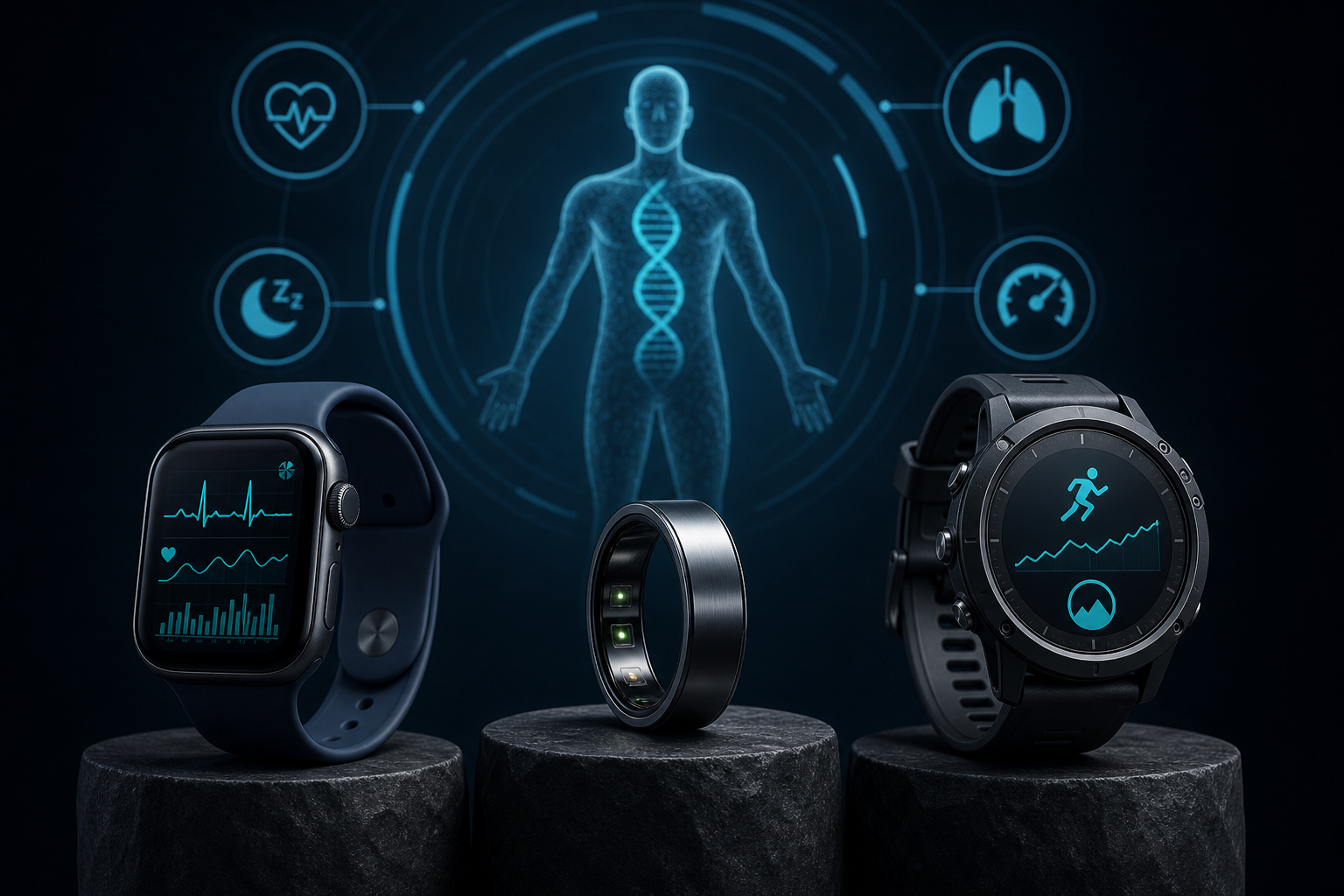
You've probably been wearing a health tracker for months, maybe years. The data keeps accumulating. But the question that actually matters — is your biological age moving in the right direction? — still doesn't have an answer. The data exists. It just isn't connected to anything useful.
This comparison breaks down how Apple Watch, Oura Ring, and Garmin stack up for longevity tracking in 2026: what each device measures, where each falls short, and how to get more signal out of whichever hardware you already own.
What "Longevity Data" Actually Means From a Wearable
Step counts and calorie burns are not longevity data. They're activity proxies. Longevity data is the set of biomarkers research links to biological aging: heart rate variability (HRV), resting heart rate, sleep architecture, respiratory rate, blood oxygen saturation, and VO2 max. Tracked consistently over time, these signals tell you something real about how your body is aging.
The distinction matters because most wearables collect longevity-relevant data without interpreting it through that lens. They show you the numbers. They don't tell you what those numbers add up to.
The Gap Between Data and Interpretation
HRV is a useful example. A single reading is almost meaningless. A 90-day trend, correlated with sleep quality and recovery interventions, starts to tell a story. Most wearable dashboards don't build that story. They surface the data point and move on.
The same is true for VO2 max. Apple Watch, Oura Ring, and Garmin all estimate it. None of them, natively, connect it to a biological age score or show you which habits are actually shifting it.
Apple Watch: The Broadest Longevity Data Platform in 2026
Apple Watch generates more longevity-relevant data points than any other consumer wearable. That's a function of sensor density and deep HealthKit integration — not a marketing claim.
What Apple Watch Measures for Longevity
- HRV (SDNN): Measured nightly and during guided breathing sessions. One of the strongest single-sensor proxies for autonomic nervous system health and biological aging.
- Resting heart rate: Tracked continuously. Longitudinal decline correlates with improved cardiovascular fitness.
- VO2 max: Estimated during outdoor walks and runs. VO2 max is one of the strongest predictors of all-cause mortality in the research literature.
- Sleep stages: Deep sleep, REM, and core sleep tracked natively since watchOS 9. Sleep architecture matters for cellular repair and cognitive aging.
- Blood oxygen (SpO2): Spot checks and background readings. Relevant for respiratory health and altitude adaptation.
- Cardio Fitness notifications: Alerts when VO2 max drops below age-adjusted thresholds.
- ECG: Single-lead electrocardiogram for atrial fibrillation detection.
Where Apple Watch Falls Short Natively
Apple Watch doesn't produce a biological age score. It doesn't tell you whether your HRV trend is aging you faster or slower. It doesn't connect sleep data to your VO2 max trajectory and give you a single number that summarizes the picture.
It also doesn't ingest blood test results. Your HbA1c, fasting glucose, and CRP readings from your last blood panel exist in a separate world from your wearable data — unless you use an app that bridges the two.
The hardware is excellent. The native interpretation layer for longevity is thin.
Oura Ring: The Sleep and Recovery Specialist
Oura Ring has earned its reputation as the most accurate consumer-grade sleep tracker. The form factor matters: a ring worn on the finger captures pulse waveforms closer to the arterial wall than a wrist device, which improves HRV and resting heart rate accuracy, particularly during sleep.
What Oura Ring Measures for Longevity
- HRV: Measured throughout the night, not at a single point. Oura's overnight HRV average is generally considered more reliable than Apple Watch's session-based measurement.
- Resting heart rate: Highly accurate overnight measurement, less affected by movement artifacts.
- Sleep architecture: Deep sleep, REM, and light sleep with granular timing data.
- Body temperature deviation: A sensitive early-warning signal for illness, hormonal shifts, and recovery status.
- Respiratory rate: Measured during sleep. Elevation can indicate stress, illness, or sleep-disordered breathing.
- Readiness Score: Oura's proprietary daily score that aggregates recovery signals.
Where Oura Ring Falls Short for Longevity
Oura's Readiness Score is useful, but it isn't a biological age score. It tells you how recovered you are today. It doesn't tell you how you're aging across months and years.
Oura has no VO2 max estimation. For longevity purposes, that's a real gap. VO2 max is one of the few wearable metrics with strong longitudinal data linking it to lifespan.
Like Apple Watch, Oura doesn't ingest blood biomarkers. Its native app also doesn't track specific recovery interventions — sauna, cold plunge, breathwork — in a way that connects back to your biological age trajectory.
Oura syncs to Apple HealthKit on iPhone, which means the data it collects can feed into apps that provide that interpretation layer.
Garmin: The Performance and VO2 Max Leader
Garmin's place in the longevity conversation is less obvious than Apple Watch or Oura, but it earns it through one feature: VO2 max estimation. Garmin's FirstBeat Analytics engine produces VO2 max estimates that are among the most validated in consumer wearables, particularly for runners and cyclists training with heart rate data.
What Garmin Measures for Longevity
- VO2 max: Estimated from outdoor runs and cycling sessions. Garmin's algorithm accounts for heat and altitude, which improves accuracy. The Garmin Connect app also provides a "Fitness Age" metric derived from VO2 max.
- HRV Status: Introduced in 2023, this feature tracks overnight HRV trends with a 5-day rolling window and flags when values drop outside your personal baseline.
- Sleep tracking: Improved significantly with recent firmware updates, though still generally considered less accurate than Oura for sleep stage detection.
- Body Battery: An energy reserve metric derived from HRV, stress, sleep, and activity. Useful for day-to-day recovery decisions.
- Stress tracking: Continuous stress score derived from HRV variability throughout the day.
- Pulse Ox (SpO2): Available on most mid-range and premium Garmin devices.
Where Garmin Falls Short for Longevity
Garmin's ecosystem is built for athletic performance, not biological aging. The Fitness Age feature is a starting point, but it's derived almost entirely from VO2 max and doesn't incorporate HRV trends, sleep quality, or blood biomarkers.
Garmin Connect is functional but not designed for longevity interpretation. Like Apple Watch and Oura, it doesn't produce a biological age score or connect wearable data to blood test results.
Garmin syncs to Apple HealthKit on iPhone, making its data available to third-party apps that provide deeper longevity analysis.
Head-to-Head: How the Three Wearables Compare for Longevity Data
| Feature | Apple Watch | Oura Ring | Garmin |
|---|---|---|---|
| HRV tracking | Nightly + sessions | Overnight (high accuracy) | Overnight (5-day trend) |
| VO2 max estimation | Yes | No | Yes (validated) |
| Sleep architecture | Yes (watchOS native) | Yes (most accurate) | Yes (improving) |
| Body temperature | No | Yes (deviation) | Yes (select models) |
| ECG | Yes | No | No |
| Blood oxygen | Yes | Yes | Yes |
| Native biological age score | No | No | No (Fitness Age only) |
| Blood biomarker integration | No | No | No |
| HealthKit sync (iPhone) | Native | Yes | Yes |
The honest summary: all three devices collect longevity-relevant data. None of them, on their own, tell you your biological age or give you a meaningful interpretation of how you're aging.
The Missing Layer: Connecting Wearable Data to Biological Age
This is the actual problem. You could own all three devices and still not know whether your biological age is 38 or 48. The raw data exists. The interpretation doesn't come with the hardware.
A biological age score requires combining multiple biomarkers over time and weighting them against aging research. HRV alone isn't enough. VO2 max alone isn't enough. Sleep quality alone isn't enough. And without blood test data, none of them give you the full picture.
HbA1c — glycated hemoglobin — reflects average blood glucose over 90 days, which means it captures metabolic patterns a single fasting reading misses. C-reactive protein (CRP) signals systemic inflammation. HDL cholesterol affects cardiovascular aging. None of these appear on any wearable screen, but they're part of what determines how fast you're aging at the cellular level.
How Nuvo Bridges the Gap
This is where an app like Nuvo Longevity becomes relevant. Nuvo pulls wearable data from Apple Watch, Oura Ring, and Garmin via Apple HealthKit, combines it with blood test results you enter manually — HbA1c, fasting glucose, HDL cholesterol, CRP, creatinine, and others — and calculates a single daily biological age score from 21 longevity biomarkers.
The score updates every day. You can log specific recovery interventions — sauna, cold plunge, breathwork, meditation, red light therapy, massage — and observe how they move the number. That's the feedback loop wearable hardware alone doesn't provide.
Nuvo Intelligence, the on-device AI coach, delivers personalized recommendations based on your specific biomarker profile. Everything runs locally on your iPhone. No account required, no data transmitted externally. If you're already paying for an Apple Watch and periodic blood panels, the missing piece is the interpretation layer — not more hardware.
For a broader look at how longevity apps use wearable data, the top longevity tracking apps for Apple Watch in 2026 covers the field in more detail.
Which Wearable Should You Prioritize for Longevity Tracking?
The answer depends on what you're trying to measure.
If VO2 max is your primary focus: Garmin produces the most validated estimates, particularly if you run or cycle regularly. VO2 max has the strongest research backing of any single wearable metric for predicting longevity outcomes.
If sleep and recovery are your primary focus: Oura Ring's overnight HRV and sleep architecture data is the most accurate of the three. The ring form factor reduces motion artifacts, and body temperature deviation gives you an early-warning signal no wrist device matches.
If you want the broadest longevity data platform: Apple Watch covers the most ground. ECG, VO2 max, HRV, sleep stages, and deep HealthKit integration make it the most versatile foundation for a longevity tracking stack.
If you want to connect wearable data to blood biomarkers: None of the three devices solve this natively. You need an app layer — one that reads from HealthKit, which all three devices support on iPhone.
The Case for Using More Than One Device
Many serious longevity trackers wear Apple Watch during the day for VO2 max, activity, and ECG, then switch to Oura Ring at night for sleep and HRV accuracy. Both sync to HealthKit. An app that reads from HealthKit gets the combined data stream from both.
This isn't about spending more money on hardware. Different sensors have different strengths, and HealthKit makes it possible to aggregate them without friction.
What Wearable Data Can't Tell You on Its Own
There's a ceiling on what wearable sensors can measure. They're excellent at capturing autonomic nervous system signals, movement, and sleep. They can't measure metabolic health directly.
Your fasting glucose trend, your HbA1c over time, your inflammatory markers — these require a blood draw. And they're not optional if you're serious about biological age. Metabolic dysfunction is one of the fastest drivers of accelerated aging, and it often shows up in blood tests before it registers in wearable data.
The health optimization apps that combine blood biomarkers with wearable data article covers this intersection in more depth.
Longevity Tracking in 2026: The Practical Stack
If you're building a longevity tracking setup from scratch — or tightening what you already have — here's how the pieces fit together.
Hardware layer: Apple Watch as the primary device, Oura Ring for sleep and HRV, or Garmin for VO2 max and endurance. All three sync to HealthKit on iPhone.
Blood testing layer: Annual or semi-annual panels covering HbA1c, fasting glucose, HDL, CRP, and creatinine at minimum. These don't require a specialist referral in most markets.
Interpretation layer: An app that reads from HealthKit, ingests your blood results, and produces a biological age score you can act on. This is the layer that turns raw data into something useful.
The hardware question matters less than most people think. Apple Watch, Oura Ring, and Garmin all produce good longevity data. What changes the outcome is whether you have a system that interprets that data against your biological age, tracks your interventions, and tells you what's actually moving the number.
Frequently Asked Questions
Which wearable is best for tracking biological age?
No wearable calculates biological age natively. Apple Watch, Oura Ring, and Garmin all collect relevant biomarkers — HRV, VO2 max, sleep — but biological age requires combining those signals with blood test data over time. You need an app layer on top of the hardware to produce an actual biological age score.
Can Oura Ring data be used for biological age tracking?
Yes, indirectly. Oura Ring syncs to Apple HealthKit on iPhone, which means apps that read from HealthKit can access Oura's HRV, sleep, and recovery data. Nuvo Longevity, for example, pulls Oura data via HealthKit and combines it with blood biomarkers to calculate a daily biological age score.
Is Garmin or Apple Watch better for VO2 max estimation?
Both estimate VO2 max, but Garmin's FirstBeat Analytics engine is generally considered more accurate for athletes training with consistent heart rate data. Apple Watch estimates are reliable for everyday users but can be less precise in high-intensity training contexts.
Do any wearables measure HbA1c or blood glucose directly?
No consumer wearable currently measures HbA1c. Continuous glucose monitors (CGMs) like Abbott's Libre track interstitial glucose in real time, but HbA1c — a 90-day average of blood glucose — still requires a blood draw. This is why apps that let you enter blood test results alongside wearable data provide a more complete picture of biological age.
What is HRV and why does it matter for longevity?
HRV, or heart rate variability, measures the variation in time between consecutive heartbeats. Higher HRV generally indicates better autonomic nervous system function and cardiovascular health. Longitudinal HRV decline is associated with accelerated aging and increased disease risk. It's one of the most actionable longevity biomarkers a wearable can track.
Can I use both Apple Watch and Oura Ring together for longevity tracking?
Yes. Both devices sync to Apple HealthKit on iPhone, so an app that reads from HealthKit can access data from both simultaneously. This combination gives you Apple Watch's VO2 max and ECG data alongside Oura's more accurate overnight HRV and sleep architecture.
Does Garmin work with longevity apps on iPhone?
Garmin devices sync to Apple HealthKit via the Garmin Connect app on iPhone. Apps that read from HealthKit — including Nuvo Longevity — can access Garmin data including VO2 max, HRV Status, and activity metrics. The integration runs through HealthKit rather than a direct Garmin API connection.
The Bottom Line
Apple Watch, Oura Ring, and Garmin each do something well. Apple Watch covers the most ground. Oura Ring leads on sleep and overnight HRV accuracy. Garmin produces the most validated VO2 max estimates. All three sync to Apple HealthKit.
What none of them do is tell you your biological age. That requires combining wearable data with blood biomarkers and running it through a model that weights the signals against aging research. The hardware is the foundation. The interpretation layer is what makes it something you can act on.
If you want to see how your wearable data connects to your biological age, nuvolongevity.com is worth a look.