Zone 2 Cardio for Longevity: How Low-Intensity Training Shows Up in Your Wearable Data
Zone 2 cardio is one of the highest-return longevity investments available. Here's what it does to your mitochondria, how it shows up in your HRV, resting heart rate, VO2 max, and sleep data, and what it means for your biological age.
Written by the Nuvo Longevity editorial team at Firefly Labs LLC.
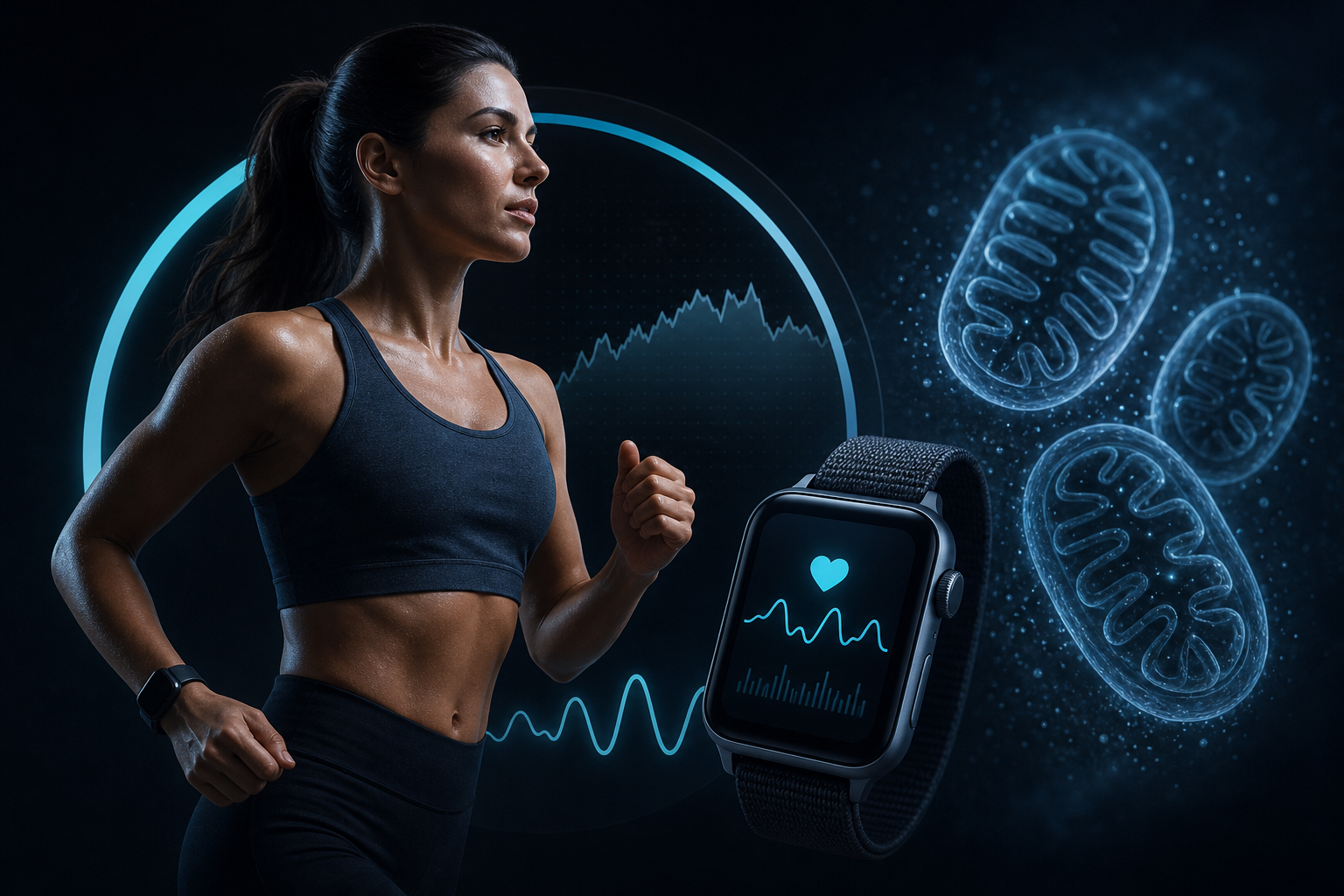
You've probably heard that Zone 2 cardio is one of the most important things you can do for long-term health. But if you're tracking workouts on an Apple Watch or Oura Ring, you might be staring at a pile of numbers — heart rate, HRV, VO2 max estimates — without a clear sense of whether your Zone 2 sessions are actually doing anything for your biological age.
This article covers what Zone 2 cardio is, why it matters specifically for longevity, and how to read the signals your wearable is already collecting to know whether it's working.
What Zone 2 Cardio Actually Means
Heart rate training zones divide exercise intensity into five bands. Zone 2 sits at roughly 60 to 70 percent of your maximum heart rate. At this intensity, you can hold a conversation but wouldn't want to sing. Breathing is elevated but controlled.
The defining characteristic of Zone 2 isn't the heart rate number, though. It's the metabolic substrate. At this intensity, your body primarily burns fat for fuel through the mitochondrial pathway. That distinction matters for aging in ways that higher-intensity training doesn't replicate.
Why Zone 2 Is Specifically a Longevity Tool
Mitochondria are the organelles that produce cellular energy. Their function declines with age, and that decline is implicated in nearly every major age-related disease. Zone 2 training is one of the most direct stimuli for mitochondrial biogenesis — the creation of new mitochondria — and for improving the efficiency of existing ones.
The mechanism runs through a protein called PGC-1 alpha, which acts as a master regulator of mitochondrial production. Sustained low-intensity aerobic work upregulates PGC-1 alpha more reliably than short high-intensity bursts. More mitochondria per cell means better energy production, less oxidative stress, and slower cellular aging.
VO2 max — your body's maximum rate of oxygen consumption — is one of the strongest predictors of all-cause mortality in the research literature. Zone 2 builds the aerobic base that supports VO2 max over time. Higher-intensity intervals can improve VO2 max acutely, but without that aerobic foundation, those gains plateau quickly.
Systemic inflammation is another lever. Chronic low-grade inflammation accelerates biological aging, and regular Zone 2 cardio is associated with reductions in inflammatory markers, including C-reactive protein (CRP). That's not a minor footnote — CRP is directly tied to biological age calculations.
How Zone 2 Shows Up in Your Wearable Data
This is where most people lose the thread. You finish a 45-minute easy run, your Apple Watch logs it, and then what? Here are the specific signals to watch.
Heart Rate Variability (HRV)
HRV measures the variation in time between consecutive heartbeats. Higher HRV generally indicates a well-regulated autonomic nervous system and better cardiovascular fitness — it's one of the clearest recovery and adaptation signals your wearable captures.
Consistent Zone 2 training improves resting HRV over weeks to months. The mechanism is direct: Zone 2 work strengthens parasympathetic nervous system tone, the branch of your autonomic nervous system responsible for rest and recovery. If your HRV trend is flat or declining despite regular cardio, your intensity is probably too high, your recovery is insufficient, or both.
Watch the trend, not the daily number. A single low HRV morning tells you little. A downward trend over three weeks tells you something is off.
Resting Heart Rate
Resting heart rate (RHR) drops as cardiovascular fitness improves. Zone 2 is particularly effective here because it directly strengthens the heart's stroke volume — the amount of blood pumped per beat. A stronger heart beats fewer times per minute to move the same volume of blood.
A well-trained aerobic system typically shows a resting heart rate in the low-to-mid 50s or below. If yours is sitting above 70 despite consistent Zone 2 work, either the volume isn't sufficient, intensity is drifting too high, or other factors — poor sleep, high stress, alcohol — are masking the adaptation.
VO2 Max Estimates
Apple Watch, Garmin, and Oura all estimate VO2 max using heart rate response to exercise. These estimates aren't lab-grade, but they're directionally useful as trend indicators.
Zone 2 training improves VO2 max by building the aerobic base on which higher-intensity work sits. If your wearable's VO2 max estimate hasn't moved in months despite consistent cardio, your Zone 2 intensity may be too low to drive adaptation — or you need more volume before adding intensity.
VO2 max is worth tracking deliberately. It's one of the 21 longevity biomarkers Nuvo incorporates into a daily biological age score, alongside blood markers like CRP and HbA1c. Watching your VO2 max estimate move within the context of your full biomarker picture is more meaningful than tracking it in isolation.
Sleep Quality Metrics
Zone 2 cardio improves sleep architecture, particularly slow-wave sleep — the most restorative phase. Over time, your wearable's sleep tracking should reflect this as deeper sleep stages and improved sleep efficiency.
Poor sleep accelerates biological aging through multiple pathways: cortisol dysregulation, impaired cellular repair, elevated inflammatory markers. If your Zone 2 training is working as a longevity intervention, improved sleep quality is often one of the first places it shows up in your data.
Finding Your Zone 2 Heart Rate
The standard formula — 60 to 70 percent of max heart rate — is a starting point, not a precise target. Maximum heart rate estimates from formulas like 220 minus age carry meaningful individual error.
A more reliable field test: during Zone 2 work, you should be able to speak in full sentences without gasping. If you can only manage a few words, you've drifted into Zone 3. If you could easily sing, you're probably in Zone 1.
For wearable users, the talk test combined with your heart rate at that intensity gives you a personalized Zone 2 ceiling. As fitness improves, you'll sustain a faster pace at the same heart rate. That's the adaptation you're looking for.
How Much Zone 2 Is Enough
The research-informed consensus among longevity-focused practitioners points to 150 to 200 minutes of Zone 2 per week as a meaningful dose — three to four sessions of 45 to 60 minutes each.
Below 90 minutes per week, the mitochondrial adaptation signal is weak. Above 200 minutes, marginal benefit flattens for most people and recovery demands start competing with other training.
Consistency over months matters more than any single week's volume. Your wearable's trend data over 8 to 12 weeks will tell you more about whether Zone 2 is working than any individual session.
What Zone 2 Doesn't Do
Zone 2 is not a complete longevity training protocol on its own. It builds aerobic base and mitochondrial density, but it doesn't maintain muscle mass or bone density. Strength training is the other non-negotiable for aging well — and the two modalities work best when programmed together, not traded off against each other.
Your wearable data will reflect this gap. Muscle mass and strength don't show up directly in heart rate or HRV signals. Blood biomarkers — creatinine as a rough proxy for muscle mass, fasting glucose for metabolic health — capture dimensions of health that wearables miss entirely. Combining wearable data with periodic blood panels gives you a more complete picture than either source alone.
If you want to see how Zone 2 training interacts with your full biomarker profile, the lower biological age with Apple Watch guide covers the broader set of wearable-driven interventions and how they connect to biological age movement.
Connecting Zone 2 Data to Biological Age
Here's the gap most people hit: they're doing Zone 2 consistently, HRV is trending up, resting heart rate is dropping — but there's no way to know whether any of it is actually moving their biological age.
Wearable data captures the inputs. Biological age captures the output. Bridging those two requires a system that reads both.
Nuvo's daily biological age score pulls from 21 longevity biomarkers — wearable-derived metrics like VO2 max, HRV, and resting heart rate alongside blood markers like CRP and HbA1c. When you log Zone 2 sessions consistently and your CRP drops or your VO2 max estimate improves, those changes register in the score. The feedback loop is direct rather than inferred.
For a broader look at how different apps handle this kind of tracking, the top longevity tracking apps for Apple Watch in 2026 piece covers the current field.
The Practical Takeaway
Zone 2 cardio is one of the highest-return longevity investments you can make with your time. The evidence for its effects on mitochondrial health, VO2 max, cardiovascular function, and systemic inflammation is strong and consistent.
Your wearable is already collecting the signals that show whether it's working. HRV trend, resting heart rate, VO2 max estimate, and sleep quality are the four metrics to watch. Track them over 8 to 12 weeks, not day to day.
The missing piece for most people isn't the data. It's the context that turns individual metrics into a single picture of how you're actually aging. That's what combining wearable data with blood biomarkers in one place gives you.
You can explore how Nuvo connects those signals at nuvolongevity.com.
Frequently Asked Questions
What heart rate should I target for Zone 2 cardio?
Zone 2 generally falls between 60 and 70 percent of your maximum heart rate, but individual variation is significant. A reliable field test: you should be able to speak in full sentences comfortably. If you're gasping after a few words, you've moved into Zone 3. Use your wearable's heart rate reading at the point where the talk test passes to establish your personal Zone 2 ceiling.
How long does it take to see Zone 2 benefits in wearable data?
Meaningful changes in resting heart rate and HRV typically appear after 6 to 10 weeks of consistent Zone 2 training at adequate volume — roughly 150 minutes per week. VO2 max estimates often take longer to shift, typically 10 to 16 weeks. Day-to-day variation is noise; look at 4-week rolling averages in your wearable data.
Can I do Zone 2 cardio every day?
Most people can handle daily Zone 2 without significant recovery cost, since the intensity is low enough that muscle damage and central nervous system fatigue are minimal. The practical limit is time and total weekly volume. If your HRV is trending down or your resting heart rate is creeping up despite what feels like easy training, reduce frequency before reducing duration.
Does Zone 2 cardio directly lower biological age?
Zone 2 training influences several biomarkers associated with biological age — VO2 max, resting heart rate, HRV, and inflammatory markers like CRP. Whether and how quickly those changes register in a biological age score depends on the scoring methodology and which biomarkers it weights. The effect is real but operates over months, not days.
Is Zone 2 better than high-intensity interval training (HIIT) for longevity?
They serve different functions. Zone 2 builds mitochondrial density, aerobic base, and cardiovascular efficiency. HIIT drives acute VO2 max improvements and metabolic adaptations that Zone 2 alone doesn't produce. Most longevity-focused protocols combine both: a large proportion of weekly training volume in Zone 2 with one or two higher-intensity sessions per week. Neither replaces the other.
Which wearable metrics best reflect Zone 2 adaptation over time?
Resting heart rate and HRV trend are the most reliable signals from consumer wearables. VO2 max estimates are directionally useful but carry more measurement error. Sleep quality metrics — particularly deep sleep percentage and sleep efficiency — also reflect Zone 2 adaptation as the aerobic system strengthens.
How does Zone 2 cardio interact with blood biomarkers?
Consistent Zone 2 training is associated with reductions in CRP, improvements in fasting glucose and insulin sensitivity, and favorable changes in HDL cholesterol over time. These blood biomarkers capture dimensions of health that wearables can't measure directly — which is why combining periodic blood panels with wearable data gives a more complete picture of whether your training is actually working at the cellular level.