CGM for Longevity: Do You Need a Continuous Glucose Monitor to Track Biological Age?
CGMs have moved into the longevity toolbox — but do you actually need one to track biological age? Here's what a CGM measures, where it adds value, and where your blood panel already tells the story.
Written by the Nuvo Longevity editorial team at Firefly Labs LLC.
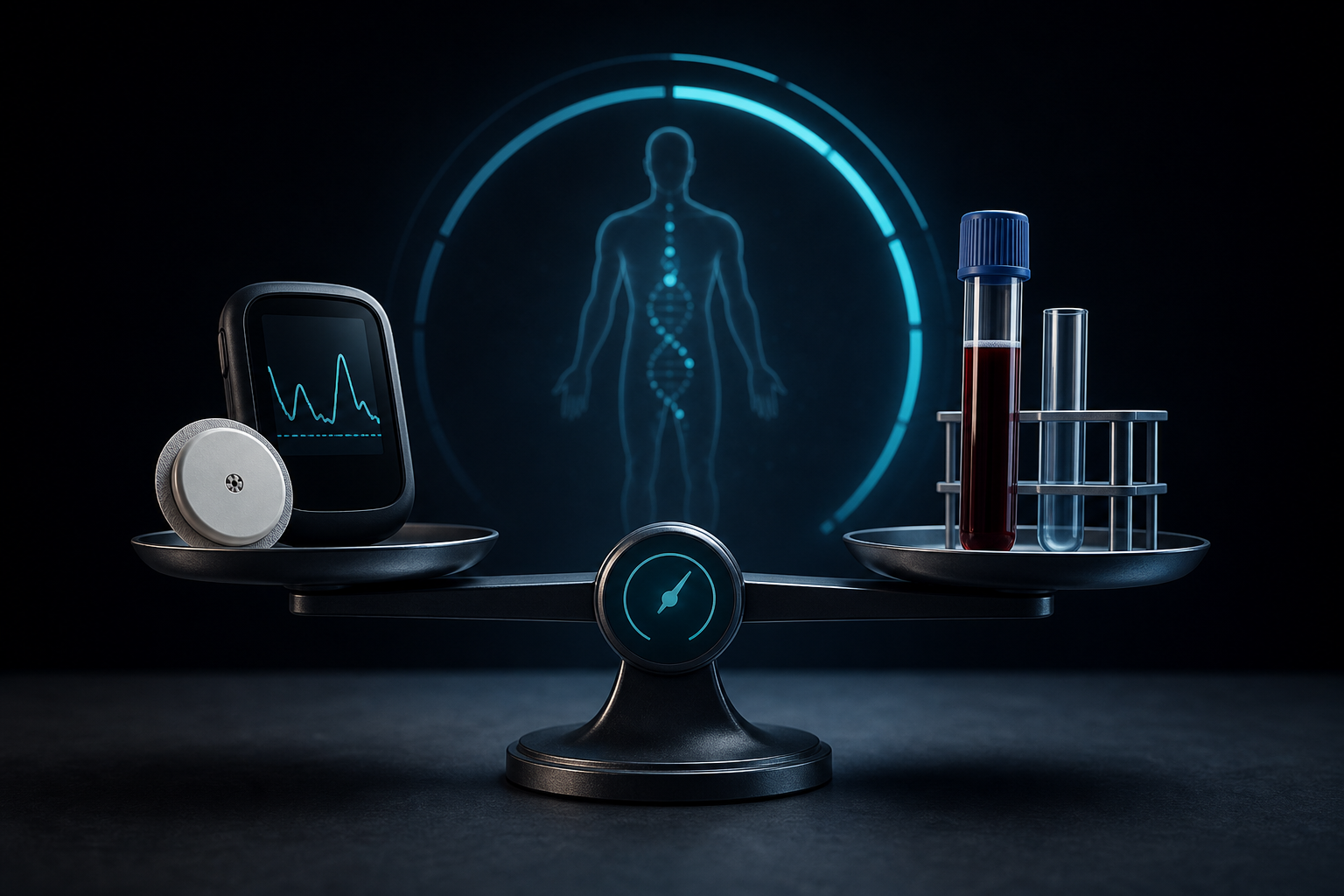
Continuous glucose monitors have moved fast from diabetes clinics into the longevity toolbox. If you follow any biohacking podcast or longevity newsletter, you've seen someone wearing a CGM patch on their upper arm while talking about metabolic health and biological age in the same breath.
The question worth asking is whether you actually need one — or whether the data you can already get from a standard blood panel and your existing wearable is enough to track what matters.
Here's what a CGM actually measures, where it adds genuine value for longevity tracking, and where it creates noise without improving your biological age picture.
What a CGM Actually Measures
A continuous glucose monitor is a small sensor worn on the skin — typically the upper arm or abdomen — that reads interstitial glucose levels every few minutes, day and night. Unlike a single fasting glucose reading from a lab draw, a CGM shows the full shape of your glucose response: how high it spikes after a meal, how quickly it returns to baseline, whether it dips overnight.
That continuous picture is genuinely useful for people managing type 1 or type 2 diabetes. For healthy, non-diabetic longevity trackers, the question is whether that granularity translates into actionable biological age insight — or whether it's expensive precision on a metric you could approximate more cheaply.
Why Glucose Matters for Biological Age
Glucose dysregulation is one of the cleaner predictors of accelerated aging. Chronically elevated blood glucose drives glycation — the binding of glucose molecules to proteins and DNA — which damages tissue, accelerates cellular aging, and contributes to systemic inflammation. HbA1c, or glycated hemoglobin, is the standard clinical measure of this: it reflects your average blood glucose over roughly 90 days, not just the moment of the blood draw.
The normal range for HbA1c sits below 5.7%. The prediabetes range runs from 5.7% to 6.4%. Every point above optimal is associated with measurable increases in biological age markers across multiple longitudinal studies.
Fasting glucose tells a similar story on a shorter timescale. A reading above 100 mg/dL signals impaired glucose regulation even before HbA1c climbs into the prediabetes range. Both numbers matter. Both come from a standard blood panel — no wearable required.
That's the first thing to understand about CGMs and longevity: the biomarkers most predictive of metabolic aging are already captured by a periodic blood test. A CGM adds resolution to the glucose picture. It doesn't add new categories of information.
Where a CGM Adds Value
That said, there are specific situations where continuous glucose data earns its cost.
Identifying Post-Meal Spikes You'd Otherwise Miss
Fasting glucose and HbA1c tell you your baseline and your 90-day average. They don't tell you that your blood glucose spikes to 180 mg/dL after white rice and returns to baseline in 90 minutes, or climbs to 160 mg/dL after oats and stays elevated for three hours. That post-meal response pattern — glycemic variability — has independent associations with cardiovascular risk and inflammatory markers beyond what HbA1c captures.
If you're trying to optimize your diet for metabolic health, a two-week CGM trial can reveal which specific foods drive your largest responses. That's actionable in a way a quarterly HbA1c is not.
Connecting Sleep and Stress to Glucose
One of the more surprising findings for people who try CGMs is how clearly poor sleep and psychological stress show up in glucose readings. A night of five hours of sleep can push fasting glucose 10 to 20 mg/dL higher the following morning. Cortisol-driven glucose elevation from a stressful afternoon shows up as a visible rise on the CGM graph — no food involved.
This is where CGM wearable data starts to intersect meaningfully with what your other wearables are already building: HRV from Apple Watch or Oura Ring, sleep stages, recovery score.
Validating Dietary Changes Before the Next Blood Panel
HbA1c is a 90-day average. Change your diet in January and you won't see the full effect until April. A CGM compresses that feedback loop. You can observe within days whether a dietary change is improving your post-meal glucose response, rather than waiting three months for confirmation.
Where a CGM Doesn't Add Much
For most people tracking biological age with already-clean metabolic markers, a CGM adds cost and complexity without proportionally improving the signal.
If your fasting glucose is consistently below 90 mg/dL and your HbA1c is below 5.4%, your glucose picture is already clean. A CGM will surface small fluctuations that are physiologically normal and clinically irrelevant. The risk is spending attention on noise — optimizing a metric that isn't meaningfully limiting your biological age — while the biomarkers that actually are go unaddressed.
There's also the cost. Consumer CGM programs marketed to healthy adults typically run $100 to $200 per month for sensors and the associated app subscription. That's a significant spend for two weeks of data you'd then need to interpret without clinical context.
What You Actually Need to Track Glucose for Biological Age
The most practical approach for most longevity trackers looks like this.
Get a blood panel that includes HbA1c and fasting glucose at least twice a year. These two numbers give you the 90-day average and the baseline that matter most for biological age calculations. If either is trending upward, that's the signal to act on.
Use a CGM for a two-week trial if you want dietary specificity. If your HbA1c sits in the 5.5% to 5.9% range and you want to understand which foods are driving it, a short CGM trial is worth the investment. Treat it as a diagnostic tool, not a permanent fixture.
Connect your glucose data to your other biomarkers. A single glucose reading in isolation tells you less than glucose alongside HRV, sleep quality, CRP, and HDL cholesterol. The pattern across multiple biomarkers is what actually predicts biological age movement.
That last point is where most glucose-tracking setups fall short. A CGM app shows you glucose. It doesn't show you what that glucose trend, combined with your HRV trend and your CRP from last month's blood panel, adds up to in terms of how you're actually aging.
Integrating Glucose Into a Biological Age Score
This is the gap that matters. You can have excellent glucose data and still have no idea whether your biological age is improving, because glucose is one input among many.
HbA1c and fasting glucose are two of the 21 longevity biomarkers that Nuvo uses to calculate a daily biological age score. The app takes those blood test results alongside wearable data from Apple Watch, Oura Ring, or Garmin — HRV, sleep, VO2 max, resting heart rate — and combines them into a single number that updates as your habits and biomarkers change.
A blood panel you already run twice a year becomes part of a continuous biological age picture, rather than a standalone number you're not sure what to do with. You don't need a CGM to feed that picture. You need your HbA1c and fasting glucose results entered once, and the app does the rest.
For context on how different apps handle this kind of multi-biomarker tracking, the best apps to track biological age in 2026 comparison covers the field in detail.
The Honest Answer on CGMs for Longevity
A CGM is a useful diagnostic tool. It's not a prerequisite for tracking biological age, and for most people with clean metabolic markers, it's not the highest-leverage investment in their longevity stack.
The biomarkers that matter most — HbA1c, fasting glucose, HDL cholesterol, CRP, creatinine — come from a standard blood panel. The wearable data that matters — HRV, sleep, VO2 max — is already sitting on your Apple Watch or Oura Ring.
What most people are missing isn't more data. It's a way to see what all that data adds up to. That's a different problem than a CGM solves.
If you're curious how HbA1c and fasting glucose fit into a real biological age calculation alongside wearable metrics, the before and after biomarker story covering HbA1c, CRP, and VO2 max shows exactly how those numbers move together over time.
Frequently Asked Questions
Do I need a CGM to calculate my biological age?
No. The glucose biomarkers most relevant to biological age — HbA1c and fasting glucose — come from a standard blood panel. A CGM adds granularity to your glucose picture but isn't required to track biological age effectively.
What glucose biomarkers matter most for biological age?
HbA1c and fasting glucose are the two primary markers. HbA1c reflects your 90-day average blood glucose and is one of the cleaner predictors of metabolic aging. Fasting glucose captures your baseline regulation. Both are available from routine lab work.
When does a CGM actually make sense for longevity tracking?
A CGM is most useful as a short-term diagnostic tool — typically a two-week trial — if your HbA1c is trending upward and you want to identify which specific foods or lifestyle factors are driving it. It's less useful as a permanent fixture if your metabolic markers are already in a healthy range.
How does glucose data connect to a biological age score?
Glucose is one input among many. Biological age calculations that combine HbA1c and fasting glucose with HRV, sleep, VO2 max, HDL cholesterol, CRP, and other biomarkers give a more complete picture than glucose alone. Nuvo integrates blood panel results alongside wearable data to produce a single daily score.
Can my Apple Watch replace a CGM for glucose tracking?
No. Apple Watch doesn't currently measure blood glucose directly. It captures HRV, heart rate, sleep, and activity data that contribute to biological age alongside glucose biomarkers from blood tests. The two data types are complementary, not interchangeable.
How often should I get blood panels to track glucose for biological age?
Twice a year is a reasonable baseline for HbA1c and fasting glucose if your numbers are stable and healthy. If you're actively working to improve a borderline result, quarterly testing gives you faster feedback on whether your interventions are working.
Is glycemic variability more important than HbA1c for longevity?
HbA1c remains the more established predictor of long-term metabolic aging risk. Glycemic variability — the pattern of glucose spikes and dips throughout the day — is an emerging marker with growing research support, but it's most relevant for people whose HbA1c is already elevated or trending in the wrong direction.
The glucose picture matters for biological age. The question is how much resolution you actually need — and whether a CGM is the right tool to get it, or whether your existing blood panel and wearable data already tell the story. For most people, they already do. The missing piece is seeing it all in one place.