Health Optimization in 2026: How Biometric Data Is Replacing Annual Physicals
Health optimization in 2026 goes beyond annual physicals. See which biomarkers actually predict aging and how real-time data changes your decisions.
Written by the Nuvo Longevity editorial team at Firefly Labs LLC.
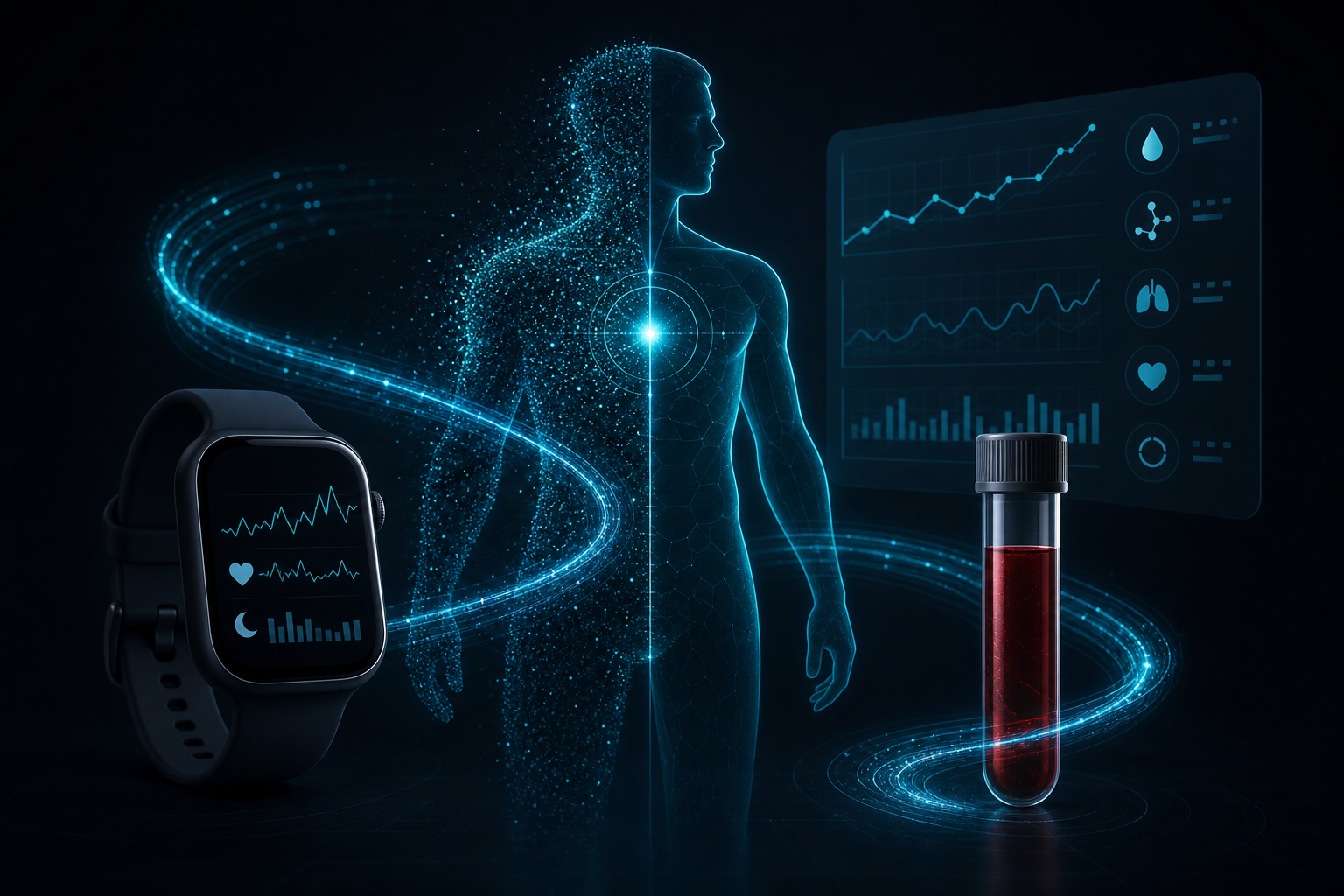
The annual physical used to be the whole picture. You showed up once a year, gave blood, waited a week for results, and got a verdict. That model made sense when data was scarce. In 2026, it doesn't. Biometric data from wearables and blood panels now flows continuously, and the people paying attention are making decisions their doctor won't see until next year's appointment.
This article covers what that shift looks like in practice: which biomarkers actually matter, how wearable and blood data work together, and what a real-time health optimization system looks like compared to the once-a-year snapshot most people still rely on.
Why the Annual Physical Is No Longer Enough
The standard annual physical captures a moment. Your fasting glucose on a Tuesday morning after a stressful week. Your blood pressure taken in a clinical waiting room. Your cholesterol after two months of eating better because you knew the appointment was coming.
None of that is wrong. It's just thin. A single data point tells you where you were, not where you're trending.
The deeper problem is that the annual model was designed around what was measurable at the time, not what's meaningful for long-term health. Most of the biomarkers that predict how quickly you're aging — HRV, VO2 max, fasting insulin, C-reactive protein — either weren't routinely tested or weren't connected to anything actionable.
That gap is closing fast.
The Biomarkers That Actually Predict How You're Aging
Not all health metrics are equal. Step count tells you something. Resting heart rate tells you more. But a handful of biomarkers, tracked together, give you a genuinely predictive picture of biological aging.
HbA1c and Fasting Glucose
HbA1c — glycated hemoglobin — reflects your average blood glucose over roughly three months. A single fasting glucose reading captures one moment. HbA1c captures a pattern. That difference matters because chronic glucose dysregulation is one of the cleaner predictors of accelerated aging, cardiovascular risk, and cognitive decline. The standard prediabetes range runs from 5.7% to 6.4%; longevity-focused practitioners often target below 5.4%.
Fasting glucose adds resolution. If your HbA1c is creeping up, fasting glucose tells you whether the problem is consistent or episodic.
CRP and Systemic Inflammation
C-reactive protein is a marker of systemic inflammation — the chronic, low-grade kind that drives arterial stiffness, neurodegeneration, and a wide range of age-related conditions. A high-sensitivity CRP test (hs-CRP) below 1.0 mg/L is generally associated with lower cardiovascular risk; above 3.0 mg/L signals meaningful systemic inflammation.
The catch is that CRP fluctuates. A single reading after a hard workout or a bad night of sleep will look elevated. Longitudinal tracking — watching the trend over months rather than reacting to a single number — is where CRP becomes useful.
VO2 Max
VO2 max is the maximum rate at which your body can use oxygen during intense exercise. It's one of the strongest predictors of all-cause mortality in the research literature. A declining VO2 max over time reliably signals deteriorating cardiorespiratory fitness. The good news is that it's highly trainable, and modern wearables estimate it with reasonable accuracy from heart rate data during workouts.
HRV and Resting Heart Rate
Heart rate variability (HRV) measures the variation in time between consecutive heartbeats. Higher HRV generally reflects better autonomic nervous system function and recovery capacity. It's sensitive to sleep quality, alcohol, stress, and training load — which makes it a useful daily signal rather than a quarterly one.
Resting heart rate trends in the opposite direction. Lower is generally better, and a sustained increase over weeks often precedes illness or overtraining.
HDL Cholesterol and Creatinine
HDL cholesterol plays a role in reverse cholesterol transport and carries anti-inflammatory properties. Creatinine reflects kidney filtration efficiency. Neither is a headline biomarker, but both contribute to a complete picture of metabolic and organ function that the annual physical tends to gloss over.
For a deeper look at how these biomarkers are trending in 2026 and what the research says about their predictive value, the biomarker trends overview covering HbA1c, CRP, VO2 max, and telomeres is worth reading alongside this article.
What Wearables Add That Blood Tests Can't
Blood panels are snapshots. Wearables are time-lapse photography.
Your Apple Watch, Oura Ring, or Garmin records HRV, resting heart rate, sleep stages, respiratory rate, and activity data every single day. That continuous stream catches things a quarterly blood draw misses entirely — the two-week stretch where your HRV tanks after a stressful project, the gradual improvement in sleep efficiency after you cut alcohol, the VO2 max trajectory over six months of zone 2 training.
The limitation of wearables alone is that they can't see inside your metabolism. They don't know your HbA1c is creeping toward prediabetic range while your step count looks fine. They don't know your CRP is elevated from chronic inflammation rather than a recent workout. Wearable data without blood data is half the picture.
The combination is where health optimization becomes genuinely predictive rather than reactive.
From Data to Decisions: The Missing Layer
Here's the real problem with health data in 2026: most people have more of it than ever, and less clarity about what to do with it.
Your Apple Watch generates thousands of data points per week. Your annual blood panel generates another 20 to 30 numbers. They live in separate places, in separate formats, with no unified interpretation.
The result is a frustration familiar to anyone who takes their health seriously: abundant data, no actionable signal. You know your HRV was low this week. You know your HbA1c came back at 5.8%. You don't know whether those two facts are related, whether your sauna sessions are helping, or whether your biological age is moving in the right direction.
That's the gap modern health optimization tools are trying to close.
How Biological Age Scores Change the Equation
Biological age is a composite estimate of how old your body functions relative to your chronological age. A 42-year-old with excellent VO2 max, low CRP, stable HRV, and well-controlled glucose might have a biological age of 35. The same person with poor sleep, elevated HbA1c, and declining cardiorespiratory fitness might score closer to 50.
The value of a biological age score isn't the number itself. It's the feedback loop. When a single score synthesizes multiple biomarkers into one daily signal, you can actually observe whether specific interventions are working — not in theory, but in your own data.
Did three weeks of consistent cold plunge sessions move your recovery score? Did adding creatine affect your HRV trend? Did cutting processed carbohydrates shift your fasting glucose enough to affect your biological age? These are questions you can't answer with an annual physical. You can answer them with daily biometric tracking tied to a unified score.
Nuvo Longevity takes this approach directly: a daily biological age score derived from 21 longevity biomarkers, combining wearable data from Apple Watch, Oura Ring, or Garmin with user-entered blood test results including HbA1c, fasting glucose, HDL cholesterol, CRP, and creatinine. The score updates daily, and logged interventions — sauna, cold plunge, breathwork, meditation, red light therapy, massage — are tied to biological age movement so you can see what's actually working.
The Intervention Tracking Problem
Most health apps track habits. Very few connect habits to outcomes.
You can log a sauna session in a dozen different apps. Almost none of them will tell you whether that session, repeated consistently over six weeks, is moving a meaningful health marker. The feedback loop is broken. You're tracking behavior without knowing the biological consequence.
This is where health optimization in 2026 diverges sharply from the wellness-app model of the previous decade. The question isn't "did I do the habit?" It's "is the habit working?"
For context on which habits the research supports most strongly for biological age reduction, the trending healthy habits guide for 2026 covers the evidence behind interventions like strength training, zone 2 cardio, and cold exposure in practical terms.
Privacy Is Now a Health Optimization Variable
There's a dimension of health optimization that doesn't get enough attention: what happens to your data.
Your HbA1c, HRV trends, sleep patterns, and recovery scores are among the most sensitive personal data you generate. Most health platforms require an account and upload this data to cloud servers, where it's processed, stored, and in many cases used to train models or shared with third parties.
For a growing segment of health-conscious users, that's a dealbreaker. The privacy architecture of a health app isn't a secondary feature — it's a fundamental question about who controls your most personal information.
On-device processing, where all computation happens locally on your device with encryption and no account required, is a meaningful alternative. The case for privacy-first biological age tracking explains why this architecture matters and what it means in practice for your data.
What the Annual Physical Still Does Well
This isn't an argument for abandoning your doctor. The annual physical catches things that wearables and apps can't — physical examination findings, imaging, cancer screenings, and clinical judgment that no algorithm replaces.
The point is that the annual physical was never designed to be your primary health optimization tool. It was designed to catch serious problems at a point in time. Using it as your only health feedback mechanism is like checking your bank balance once a year and hoping nothing went wrong in between.
The two approaches are complementary. Your doctor sees the clinical picture. Your daily biometric data shows you the trend between appointments — and gives you something concrete to bring to the conversation when you get there.
What a Modern Health Optimization Stack Looks Like in 2026
For someone who wants to move beyond the annual physical model, the practical setup looks something like this:
Wearable data, continuously. Apple Watch, Oura Ring, or Garmin for daily HRV, resting heart rate, sleep quality, and VO2 max estimates. The device you already own is sufficient.
Blood panels, periodically. A comprehensive metabolic panel every three to six months, including HbA1c, fasting glucose, HDL cholesterol, CRP, and creatinine. These don't require a doctor's order in most US states — direct-to-consumer lab services make it straightforward.
A unified interpretation layer. Something that takes both data streams and produces an actionable signal rather than leaving you to reconcile 30 numbers from separate sources. This is where biological age scoring earns its place.
Intervention tracking with feedback. Logging recovery practices and seeing their effect on the score — not just tracking them for their own sake.
Privacy-conscious architecture. Choosing tools that process your health data on-device rather than uploading it to servers you don't control.
The cost of this stack has dropped significantly. Running Nuvo on an Apple Watch you already own costs $2.08 per month at the annual rate. That's a fraction of what platforms like InsideTracker ($489 or more in year one) or Function Health ($499 per year) charge — and those platforms don't offer daily wearable-integrated feedback.
The Shift That's Already Happening
The annual physical isn't disappearing. But its role is changing. It's becoming one data point in a larger, continuous picture rather than the whole picture itself.
The people getting the most out of health optimization in 2026 aren't the ones with the most data. They're the ones who've built a system that turns data into a daily signal they can act on. That means connecting blood and wearable data, tracking specific interventions, and watching biological age move in response to choices they're making right now — not waiting to find out next year.
For a comparison of how different wearable platforms handle biological age tracking, the Nuvo vs WHOOP comparison for 2026 breaks down the differences in approach, data integration, and cost in practical terms.
If you're ready to move past the annual snapshot model, nuvolongevity.com is a good place to start.
Frequently Asked Questions
What is health optimization and how is it different from standard healthcare?
Health optimization focuses on improving how your body functions day to day, using continuous data from wearables and blood biomarkers to track trends and guide interventions. Standard healthcare — including the annual physical — is designed to detect and treat disease. The two are complementary. Health optimization gives you the ongoing feedback that clinical appointments don't provide.
Which biomarkers are most important for tracking biological age?
The most predictive biomarkers for biological aging include HbA1c, fasting glucose, CRP, HDL cholesterol, creatinine, HRV, resting heart rate, and VO2 max. No single marker tells the full story. The value comes from tracking them together over time and watching how they respond to specific interventions.
Can a wearable like Apple Watch replace blood tests for health optimization?
No. Wearables capture continuous physiological data — HRV, sleep, heart rate, activity — but they can't measure metabolic markers like HbA1c or CRP that require a blood draw. The most complete picture of biological age combines both data streams. Wearables show you daily trends; blood panels show you what's happening inside your metabolism.
How often should you get blood tests for health optimization purposes?
Most longevity-focused practitioners recommend a comprehensive panel every three to six months rather than annually. That frequency gives you enough data points to observe trends and see whether interventions are moving key markers like HbA1c and CRP in the right direction.
What is a biological age score and how is it calculated?
A biological age score estimates how old your body functions relative to your chronological age, based on a set of biomarkers. Different platforms use different models and different numbers of biomarkers. Nuvo's daily score uses 21 longevity biomarkers drawn from both wearable data and user-entered blood test results, updated daily rather than at discrete lab intervals.
Are health optimization apps safe to use without medical supervision?
Health optimization apps provide data and personalized recommendations based on your biomarkers, but they don't replace clinical diagnosis or medical advice. They're most useful for understanding your own trends and having more informed conversations with your doctor — not as a substitute for clinical care.
What's the difference between tracking habits and tracking biological age?
Habit tracking tells you whether you did something. Biological age tracking tells you whether it's working. Logging a cold plunge session is useful. Seeing that consistent cold exposure over six weeks correlates with improved HRV and a lower biological age score is something you can act on. The feedback loop is what separates health optimization from wellness journaling.