How to Test Your Biological Age at Home Without a Lab Visit
You don't need a $500 lab package to test your biological age. Here's which biomarkers actually matter and how to combine wearable data with blood results.
Written by the Nuvo Longevity editorial team at Firefly Labs LLC.
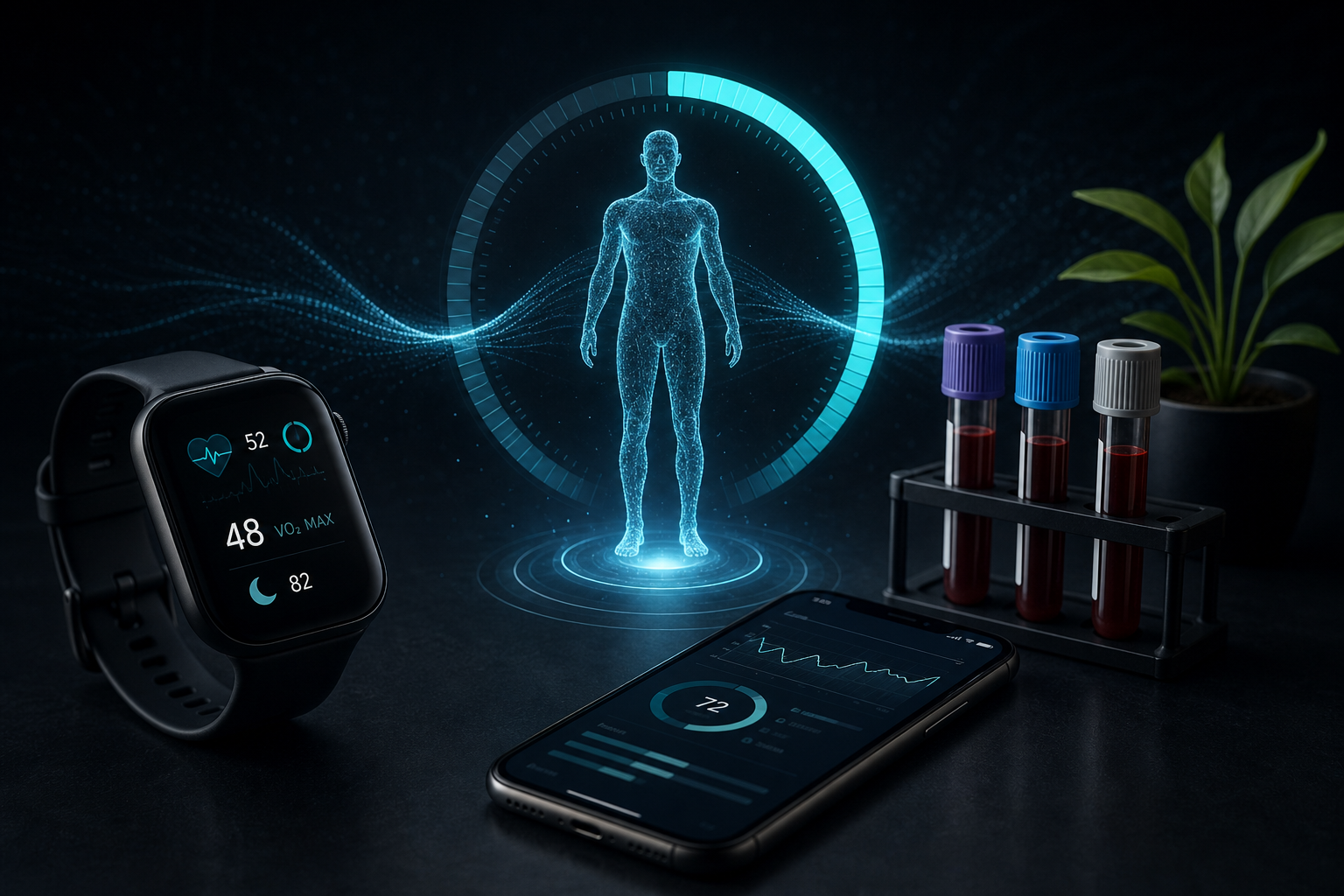
You get your annual bloodwork back. The numbers are technically "normal." But something feels off, and the report gives you nothing to act on. Meanwhile, your Apple Watch has been collecting HRV, sleep, and resting heart rate data for months — data that also says something about how you're aging, if you knew how to read it.
Testing your biological age doesn't require a $500 lab package or a clinic appointment. Here's what actually works at home, what the data means, and how to turn it into a number you can track over time.
What Biological Age Actually Measures
Biological age reflects how your body is functioning relative to your chronological age. Two people who are both 42 can have biological ages of 35 and 51 — the difference comes down to biomarkers that reflect cellular health, metabolic function, inflammation, and cardiovascular fitness.
For a deeper look at that distinction, biological age vs chronological age is worth reading before you start collecting data.
The key point: biological age isn't fixed. It responds to what you do. That's what makes testing it useful.
The Two Data Sources That Actually Matter
Most people treat this as an either/or choice — get a blood panel or use a wearable. Neither source alone gives you the full picture.
Blood biomarkers capture metabolic and inflammatory state. Wearable data captures cardiovascular and recovery function in real time. Biological age lives at the intersection of both.
Blood Biomarkers You Can Test at Home or Through a Standard Panel
You don't need a specialty lab to get the markers that matter most. Most of these appear on a standard metabolic panel or can be ordered through your GP.
HbA1c (glycated hemoglobin) reflects your average blood glucose over roughly 90 days. A reading between 5.7% and 6.4% signals pre-diabetic glucose metabolism, which accelerates cellular aging. Below 5.4% is associated with lower biological age.
Fasting glucose captures a single snapshot of blood sugar regulation. Paired with HbA1c, it tells you whether glucose dysregulation is a pattern or an outlier.
HDL cholesterol is the fraction most directly tied to cardiovascular longevity. Low HDL is a stronger predictor of early mortality than high LDL in most population studies.
CRP (C-reactive protein) is the primary marker for systemic inflammation — chronic low-grade inflammation being one of the most consistent predictors of accelerated aging across multiple organ systems.
Creatinine reflects kidney filtration efficiency. Declining kidney function is both a consequence and a driver of biological aging.
All five markers are available through most standard blood panels. At-home finger-prick kits can now return HbA1c and lipid results within a few days, no clinic visit required.
Wearable Data That Feeds Into Biological Age
Your Apple Watch, Oura Ring, or Garmin already captures several biomarkers relevant to aging. The ones that carry the most signal:
VO2 max is the single strongest wearable-derived predictor of longevity. It measures your cardiovascular system's capacity to deliver and use oxygen. Apple Watch estimates VO2 max from outdoor walks and runs. A 45-year-old with a VO2 max above 45 ml/kg/min is functioning significantly younger than their chronological age.
Resting heart rate reflects autonomic nervous system efficiency. Chronically elevated resting heart rate is associated with higher all-cause mortality risk.
HRV (heart rate variability) measures the variation between heartbeats. Higher HRV generally indicates better recovery capacity and lower physiological stress. It declines with age but responds meaningfully to training, sleep, and recovery interventions.
Sleep architecture — specifically deep sleep and REM percentages — reflects the quality of cellular repair that happens overnight. Poor sleep is one of the fastest routes to accelerated biological aging.
Resting respiratory rate is a sensitive early indicator of cardiovascular and metabolic stress, often shifting before other markers do.
How to Combine These Into a Biological Age Estimate
This is where most DIY approaches fall apart. You can collect all of this data and still have no idea what it adds up to. A good HRV number alongside a poor HbA1c — what does that actually mean for your biological age? The math isn't intuitive.
One approach is a scoring framework that weights each biomarker against age-adjusted reference ranges and combines them into a single number. That's what Nuvo does: it pulls wearable data from Apple Watch, Oura Ring, or Garmin via HealthKit, combines it with blood biomarkers you enter manually, and calculates a daily biological age score from 21 longevity biomarkers — on-device, no account required, no data sent to a server.
The practical advantage is continuity. A single blood panel gives you a snapshot. A daily score built from wearable data, updated each time you enter a new blood result, gives you a trend. Trends are what tell you whether what you're doing is actually working.
What to Do With Your Results
A biological age number is only useful if you can act on it.
If Your Blood Biomarkers Are Out of Range
Elevated HbA1c or fasting glucose points toward carbohydrate metabolism and insulin sensitivity. The interventions with the strongest evidence: time-restricted eating, resistance training, and reducing refined carbohydrate intake.
Elevated CRP points toward inflammation. Common drivers include poor sleep, excess body fat, sedentary behavior, and diets high in processed foods. Omega-3 fatty acids, consistent aerobic exercise, and sleep quality improvements are the most evidence-backed responses.
Low HDL typically responds to aerobic exercise volume and dietary fat quality. Replacing refined carbohydrates with unsaturated fats tends to raise HDL more reliably than most supplements.
If Your Wearable Metrics Are Lagging
Low VO2 max is the highest-leverage target. Zone 2 cardio — sustained aerobic effort at a conversational pace, three to four sessions per week — produces measurable VO2 max improvements within 8 to 12 weeks in most people.
Low HRV often reflects accumulated stress, poor sleep, or insufficient recovery between hard training sessions. Breathwork, cold exposure, and consistent sleep timing all show measurable HRV effects within days to weeks.
For a detailed breakdown of what actually moves these numbers, how to lower biological age naturally covers the intervention evidence in depth.
Tracking Interventions Against Your Score
Most biological age testing approaches share the same blind spot: they give you a number but no feedback loop. You make changes, wait 90 days for another blood panel, and hope something shifted.
A more useful approach is logging specific interventions and watching how your daily score responds. Sauna sessions, cold plunge, breathwork, meditation, red light therapy, and resistance training all have documented effects on HRV, resting heart rate, and inflammatory markers. If you're tracking biological age daily, you can observe whether a week of consistent sauna use moves your recovery metrics before your next blood draw — rather than waiting to find out.
This is what makes the combination of wearable data and blood biomarkers more useful than either alone. Wearable metrics update daily. Blood markers update every 90 days. Together, they give you short-term feedback and long-term confirmation.
For a concrete example of what this looks like with real data, this before-and-after biomarker story covering HbA1c, CRP, VO2 max, and biological age is worth reading.
The Limits of At-Home Testing
At-home biological age testing is genuinely useful. It also has limits worth naming.
Finger-prick HbA1c kits vary in accuracy. Venous blood drawn at a lab is more reliable. If you're making significant dietary or supplement changes based on an at-home HbA1c result, confirm it with a standard lab draw at least once.
Wearable VO2 max estimates are estimates. Apple Watch's algorithm is reasonably accurate for most users, but it can underestimate in people with unusual gait patterns or poor GPS conditions. The trend matters more than the absolute number.
Biological age scores from apps are not clinical diagnostics. They're decision-support tools. A score trending in the right direction is a useful signal — not a substitute for working with a physician on any specific medical concern.
Choosing an App to Track It All
If you want a single place to combine blood biomarkers and wearable data into a biological age score, the best apps to track biological age in 2026 covers the main options and their tradeoffs.
The short version: most apps are either blood-focused (InsideTracker, Function Health) or wearable-focused (WHOOP, Humanity, SuperAge) — not both. Nuvo is built specifically to fuse both data types into a daily score on your Apple Watch, with all processing done on-device and no account required. At $2.08 per month billed annually, it's the lowest-cost option that handles both data sources.
Frequently Asked Questions
Can I test my biological age without a blood test?
Yes, partially. Wearable data from an Apple Watch, Oura Ring, or Garmin captures several biomarkers relevant to biological age — including VO2 max, HRV, resting heart rate, and sleep architecture. These alone can produce a meaningful estimate. Adding blood biomarkers like HbA1c and CRP makes the score significantly more accurate, because it captures metabolic and inflammatory state that wearables can't directly measure.
How often should I test my biological age?
With wearable data, you can track a daily score. Blood biomarkers like HbA1c reflect a 90-day average, so retesting every three months is the practical minimum for seeing meaningful change. The most useful approach is continuous wearable tracking with quarterly blood panel updates.
What is the most important biomarker for biological age?
VO2 max has the strongest single-marker association with longevity in population research. Among blood biomarkers, HbA1c and CRP are the most predictive of accelerated aging in otherwise healthy people. None of these should be read in isolation — what matters is the pattern across multiple biomarkers.
Are at-home HbA1c tests accurate enough to use?
They're useful for trend tracking but have more variability than venous blood draws. If your at-home result lands in the pre-diabetic range (5.7% to 6.4%), confirm it with a standard lab panel before making major dietary changes. For ongoing monitoring once you've established a baseline, at-home kits are a reasonable tool.
How long does it take to see biological age improve?
HRV and resting heart rate can shift within one to two weeks of consistent sleep improvement or aerobic training. VO2 max typically shows measurable change after six to eight weeks of structured cardio. HbA1c reflects a 90-day average, so dietary changes take at least three months to show up in that number. CRP can respond faster — sometimes within four to six weeks of reducing the main inflammation drivers.
Do I need an Apple Watch to test biological age at home?
No. Oura Ring and Garmin devices also capture the wearable metrics relevant to biological age and sync via HealthKit. Without any wearable, blood biomarkers alone can still produce a partial biological age estimate — you just lose the cardiovascular and recovery layer that wearable data adds.
Is biological age testing worth it if I feel fine?
The most useful time to track biological age is before something feels wrong. Many of the biomarkers that predict accelerated aging — elevated CRP, declining VO2 max, rising HbA1c — move in the wrong direction for years before producing symptoms. Testing gives you the information to intervene while the changes are still reversible.
The data you need to estimate your biological age is mostly already available to you. Your wearable collects it daily. A standard blood panel fills in what wearables can't see. The gap has always been a tool that combines both into something you can actually act on.
That's the problem worth solving. Start with what you have.