VO2 Max and Longevity: Why Cardiorespiratory Fitness Is a Leading Predictor of Biological Age
VO2 max longevity research is unusually strong — discover why cardiorespiratory fitness predicts biological age and how to improve your score.
Written by the Nuvo Longevity editorial team at Firefly Labs LLC.
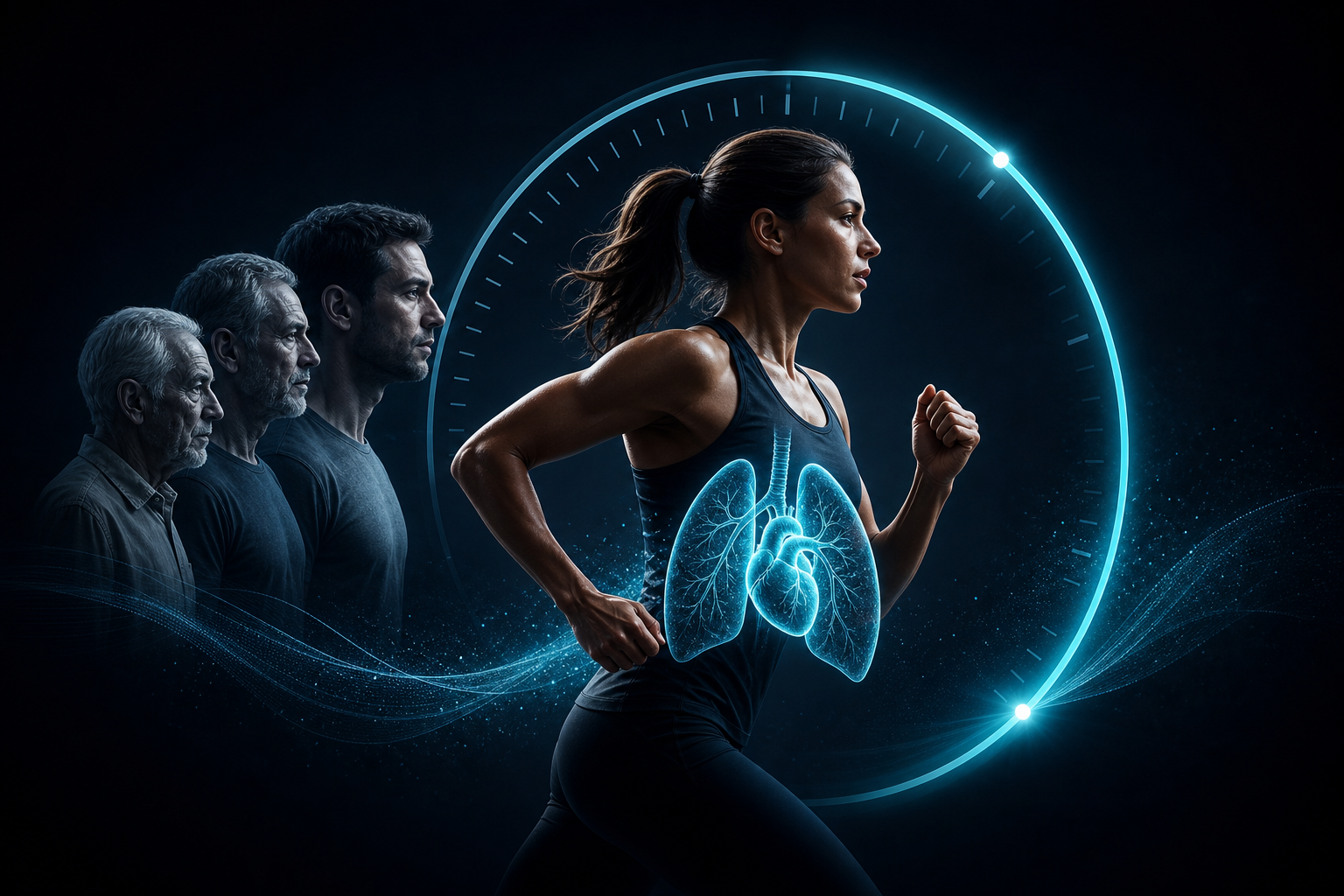
Your Apple Watch estimates it. Your doctor rarely brings it up. Yet VO2 max consistently ranks among the strongest predictors of how fast you're actually aging — not how old your birth certificate says you are, but how old your body is functioning.
This article covers what VO2 max measures, why it belongs in biological age calculations, what the research says about its relationship to lifespan and healthspan, and what actually moves the number.
What VO2 Max Actually Measures
VO2 max is the maximum rate at which your body can consume oxygen during intense exercise. The "V" stands for volume, "O2" for oxygen. It's expressed in milliliters of oxygen per kilogram of body weight per minute (mL/kg/min).
The number reflects how efficiently your cardiovascular system delivers oxygen to working muscles — and how well those muscles extract and use it. A higher VO2 max means your heart, lungs, and mitochondria are working as a coordinated system. A lower one signals a bottleneck somewhere in that chain.
This isn't just an athletic metric. Cardiologists, epidemiologists, and longevity researchers treat VO2 max as a window into systemic physiological capacity — the kind that determines whether your body ages at the rate your calendar suggests, or faster.
The Longevity Evidence Is Unusually Strong
Most single biomarkers correlate modestly with mortality risk. VO2 max is different. The evidence base is large, longitudinal, and consistent across populations.
A landmark study published in JAMA Network Open followed over 122,000 patients across a median of 8.4 years. Patients with elite cardiorespiratory fitness had a 5-fold lower all-cause mortality risk compared to those classified as low fitness. More striking: the survival benefit of moving from low to below-average fitness was larger than the benefit of eliminating hypertension or smoking.
That finding has real implications. Improving VO2 max from poor to merely average may do more for your lifespan than treating a diagnosed condition.
The relationship holds across age groups. In adults over 70, higher VO2 max predicts not just longer survival but longer healthspan — more years without functional decline, cognitive impairment, or cardiovascular disease. The fitness-mortality gradient doesn't flatten with age. It steepens.
Why VO2 Max Is a Biological Age Biomarker
Chronological age counts the years that have passed. Biological age measures how much physiological wear has accumulated. The gap between the two is what longevity science is trying to quantify and close.
VO2 max earns its place in biological age calculations because it declines predictably with age in sedentary individuals — roughly 10 percent per decade after 30 — but that decline isn't fixed. Active individuals preserve cardiorespiratory fitness well into their 60s and 70s. The divergence between sedentary and active aging trajectories is measurable, and VO2 max captures it directly.
This is why VO2 max functions as a biological age signal rather than just a fitness metric. A 50-year-old with a VO2 max of 48 mL/kg/min has the cardiorespiratory profile of someone 15 to 20 years younger. That gap is real, physiologically meaningful, and it shows up in downstream health outcomes.
Epigenetic clocks — methylation-based biological age estimates — correlate with VO2 max across multiple studies. Higher fitness consistently associates with younger epigenetic age, independent of body weight and other confounders. The mechanism isn't fully established, but the signal is consistent: cardiorespiratory fitness slows the molecular markers of aging.
What Counts as a Good VO2 Max Score
Reference ranges vary by age and sex. Here's a practical framework for adults in their 30s:
Men aged 30 to 39:
- Low: below 38 mL/kg/min
- Average: 38 to 43
- Good: 44 to 51
- Excellent: above 51
Women aged 30 to 39:
- Low: below 29 mL/kg/min
- Average: 29 to 34
- Good: 35 to 43
- Excellent: above 43
These thresholds shift downward with age, but the relative benefit of sitting in the upper quartile stays consistent. The longevity research doesn't reward perfection — it rewards not being in the bottom 20 percent.
If your Apple Watch puts your VO2 max in the low or below-average range, that's not just a fitness problem. It's a biological age signal worth taking seriously.
How VO2 Max Connects to Other Longevity Biomarkers
VO2 max doesn't age in isolation. It sits inside a web of interacting biomarkers, and understanding those connections tells you more than the number alone.
HRV and Autonomic Function
Heart rate variability (HRV) reflects the balance between sympathetic and parasympathetic nervous system activity — essentially, how well your body regulates stress and recovery. High HRV indicates strong autonomic function. Low HRV associates with accelerated aging, higher cardiovascular risk, and reduced exercise capacity.
VO2 max and HRV are correlated but measure different things. HRV captures how well you recover and adapt. VO2 max captures peak aerobic capacity. Together, they describe both your ceiling and your floor.
Inflammation and CRP
Systemic inflammation, measured by C-reactive protein (CRP), accelerates biological aging through multiple pathways: it damages endothelial cells, impairs mitochondrial function, and disrupts metabolic signaling. High CRP associates with lower VO2 max and faster cardiorespiratory decline.
The relationship runs both ways. Higher fitness suppresses inflammatory markers. Reducing CRP through exercise and dietary changes often coincides with measurable VO2 max improvements. When you track both, you can see the feedback loop in action.
Fasting Glucose and Metabolic Health
Chronically elevated fasting glucose impairs mitochondrial efficiency — the same mitochondria that determine how much oxygen your muscles can extract during exercise. Metabolic dysfunction and low VO2 max tend to cluster together, and they compound each other's aging effects.
HbA1c, the 90-day average of blood glucose, is a more reliable signal than any single fasting reading. A person with HbA1c trending toward the pre-diabetic range (5.7 to 6.4 percent) will typically show VO2 max decline before any clinical diagnosis appears. These biomarkers are early warning systems, not just confirmations of existing disease.
This is why a biological age score that fuses VO2 max with blood markers like CRP, HbA1c, and fasting glucose gives you something a single metric cannot: you can see what's driving the aging signal and where to intervene first.
What Actually Moves VO2 Max
VO2 max is one of the most trainable longevity biomarkers. The mechanisms are well-understood and the timelines are concrete.
Zone 2 Training
Zone 2 cardio — sustained aerobic effort at roughly 60 to 70 percent of maximum heart rate, where you can hold a conversation but feel the work — builds mitochondrial density and improves fat oxidation. It's the foundation of cardiorespiratory fitness.
Most people who exercise regularly spend too much time in moderate-intensity zones and not enough in Zone 2. Three to four sessions per week of 30 to 45 minutes each, sustained over 8 to 12 weeks, produces measurable VO2 max gains in previously sedentary adults.
High-Intensity Interval Training
Short bursts of near-maximal effort followed by recovery periods drive different adaptations than Zone 2 work: they increase cardiac stroke volume and push the ceiling of oxygen delivery. One to two HIIT sessions per week, layered on top of a Zone 2 base, produces faster VO2 max gains than either approach alone.
Zone 2 builds the aerobic floor. HIIT raises the ceiling. The combination is what matters.
Sleep and Recovery
VO2 max gains happen during recovery, not during training. Inadequate sleep suppresses the hormonal environment needed for cardiovascular adaptation — specifically growth hormone and testosterone, which peak during deep sleep stages.
Poor sleep also elevates cortisol, which raises fasting glucose and CRP. The biomarkers connect. A week of disrupted sleep shows up in your HRV, your resting heart rate, and eventually your VO2 max estimate. Recovery isn't passive.
Interventions That Support the Process
Regular sauna use has a documented effect on cardiovascular adaptation — it increases plasma volume and improves endothelial function through some of the same mechanisms as aerobic training. Cold plunge protocols activate the autonomic nervous system and improve vagal tone, which shows up in HRV.
These aren't replacements for training. They're recovery accelerants that support the adaptations you're already building. The ability to log these interventions and observe how they interact with your biological age score over time is what separates tracking from understanding.
Tracking VO2 Max as Part of Biological Age
A VO2 max number on its own is useful. In context — alongside HRV, sleep quality, HbA1c, CRP, and fasting glucose — it becomes actionable.
The real-world biomarker changes that move biological age scores don't happen in isolation. VO2 max improvements tend to coincide with CRP reduction, better fasting glucose control, and improved HRV. When you can see those connections in a single daily score, you stop optimizing individual metrics and start optimizing the system.
That's the logic behind Nuvo. The app pulls VO2 max from your Apple Watch alongside wearable data from Oura Ring or Garmin, combines it with blood biomarkers you enter from your own lab results, and runs the full picture through 21 longevity biomarkers to produce a daily biological age score. Nuvo Intelligence, the on-device AI coach, identifies which biomarkers are pulling your score in the wrong direction and what to do about it — whether that's adjusting training load, addressing a blood marker, or logging a recovery intervention.
Everything runs on-device. No account required. No data leaves your phone.
If you're already tracking VO2 max on your wearable and want to understand what it adds up to, nuvolongevity.com is where to start.
The Pace of Aging Matters More Than a Single Score
One VO2 max reading tells you where you are. The trajectory tells you where you're going.
A 45-year-old with a VO2 max of 42 mL/kg/min who has been declining 2 mL/kg/min per year is in a fundamentally different position than someone at the same number who has held steady for five years. The rate of change — what researchers call the pace of aging — carries as much predictive information as the absolute score.
This is why longitudinal tracking matters more than a one-time assessment. The goal isn't to hit a number. It's to slow the rate at which the number declines — or reverse it entirely.
VO2 Max and Biological Age: The Practical Summary
Cardiorespiratory fitness is not a niche athletic concern. It's one of the most powerful levers available for slowing biological aging, and VO2 max is its most measurable expression.
The research is consistent: higher VO2 max associates with younger biological age, lower all-cause mortality, longer healthspan, and better epigenetic profiles. The training adaptations that raise VO2 max — Zone 2 work, HIIT, quality sleep, and recovery practices — also improve the other biomarkers that drive biological age.
The number your Apple Watch shows you is a starting point. What matters is what you do with it, and whether you can see it in the context of everything else your body is telling you.
Frequently Asked Questions
What is a good VO2 max for longevity?
Research consistently shows that sitting in the top two fitness quintiles for your age and sex associates with substantially lower all-cause mortality. For men aged 30 to 39, a VO2 max above 44 mL/kg/min puts you in the good range; above 51 is excellent. For women in the same age group, good starts at 35 and excellent above 43. The longevity benefit is largest when moving out of the bottom quintile — the gain from low to average fitness is greater than the gain from good to elite.
Does VO2 max predict lifespan?
The evidence is strong that it predicts mortality risk. A large-scale study of over 122,000 patients found that low cardiorespiratory fitness carried a mortality risk comparable to or greater than traditional risk factors like hypertension and smoking. VO2 max doesn't guarantee outcomes, but it's one of the most robust single predictors of longevity available from non-invasive measurement.
How fast can you improve VO2 max?
Measurable improvements typically appear within 8 to 12 weeks of consistent training in previously sedentary adults. Combining Zone 2 base training with one to two HIIT sessions per week produces faster gains than either approach alone. Highly trained individuals see slower absolute gains because they're starting from a higher base.
How does VO2 max relate to biological age?
VO2 max declines roughly 10 percent per decade in sedentary individuals after age 30, but this decline isn't fixed. Active individuals preserve cardiorespiratory fitness significantly longer, creating a measurable gap between their VO2 max profile and their chronological age. A higher VO2 max relative to your age group is a signal of slower physiological aging — which is exactly what biological age calculations are designed to capture.
Can wearables accurately measure VO2 max?
Consumer wearables like Apple Watch, Garmin, and Oura Ring estimate VO2 max using heart rate data and movement patterns rather than direct gas exchange measurement. These estimates are less precise than lab-based testing but are validated against gold-standard measurements with reasonable accuracy for population-level trends. For tracking change over time — which is what matters for longevity — wearable estimates are practically useful.
Which biomarkers work alongside VO2 max for biological age?
VO2 max is most informative when paired with HRV (autonomic recovery), CRP (systemic inflammation), HbA1c (long-term glucose regulation), fasting glucose (metabolic function), and HDL cholesterol (cardiovascular health). These markers interact — improving VO2 max through training typically improves CRP and fasting glucose simultaneously. Tracking them together reveals the system, not just individual data points.
What's the difference between VO2 max and cardiorespiratory fitness?
Cardiorespiratory fitness (CRF) is the broader concept: the ability of the cardiovascular and respiratory systems to supply oxygen to working muscles during sustained exercise. VO2 max is the most precise quantitative measure of CRF. In research and clinical contexts the terms are often used interchangeably, though CRF can also be estimated from submaximal tests, resting heart rate, and activity questionnaires when direct measurement isn't available.