Nuvo vs Lifeforce: Daily Biological Age or a Longevity Membership?
Pick Lifeforce for quarterly at-home blood draws, 50+ biomarkers, Lifescore, and a clinician plan. Pick Nuvo for a daily 21-biomarker biological age on iPhone at $24.99/yr.
Written by the Nuvo Longevity editorial team at Firefly Labs LLC.
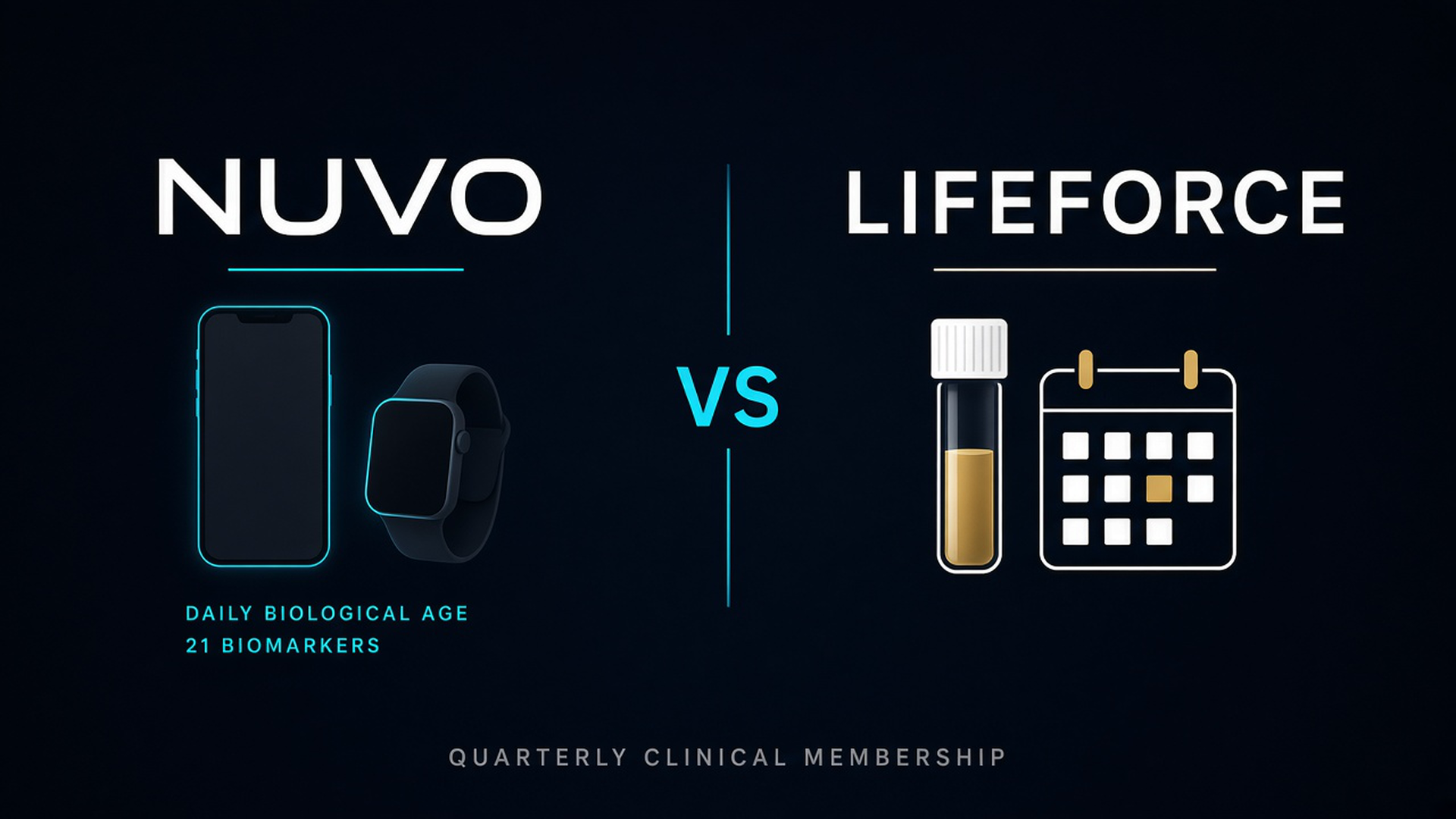
Choose Lifeforce if you want quarterly clinical longevity medicine: a licensed phlebotomist at home, 50+ blood biomarkers, a Lifescore plus biological age, clinicians and coaches, and a plan that can include pharmaceuticals, hormones, and supplements. Choose Nuvo if you want a daily biological age on the iPhone and Apple Watch you already own, from 21 biomarkers — HealthKit wearables plus an optional lab PDF — with on-device AI, no account, and $24.99/year after a 7-day trial. They do adjacent jobs. Lifeforce orders the draw and writes the clinical plan. Nuvo is the daily private score that can use a lab PDF you already paid for. They can stack: a Lifeforce draw can go into Nuvo as a PDF so the daily trend keeps moving between quarters.
Written by the Nuvo Longevity editorial team at Firefly Labs LLC, the developer of Nuvo. Lifeforce details below are taken from public pages on mylifeforce.com — the homepage, membership, Lifescore, start-now, one-time diagnostic, maintenance, deal, and advanced-panel landers, the biomarkers guide, the 2024 member-results journal article, the Lifescore help article, the website privacy policy (effective 20 July 2022), and the medical notice of privacy practices (last updated 26 October 2023) — checked 1 October 2026. Prices differ by URL on that date; we cite each page and do not collapse them into one invented annual total. This page is educational and is not medical advice. Lifeforce’s Lifescore and biological age are their scores from membership labs and questionnaires. Nuvo’s daily score is not a substitute for a clinician, a phlebotomy panel, or a prescription.
What each product actually sells
Lifeforce: a clinical longevity membership
Lifeforce (Lifeforce Digital) describes itself on the homepage as a longevity medicine program that combines diagnostics, doctors, coaches, and therapies. The public job is a membership, not a daily iPhone biological-age app. The homepage flow, checked 1 October 2026, is:
- At-home blood draw. A licensed phlebotomist comes to you and measures 50+ biomarkers. You complete an onboarding questionnaire (history, lifestyle, goals) and integrate wearables you use.
- Lifescore. A proprietary, evidence-based algorithm produces Lifescore, which the homepage calls a single metric for the overall state of your health. The same step says Lifeforce also measures quality of life, risk of dying early, and speed of aging. A clinician then sets priorities.
- 45-minute telehealth consult with a board-certified clinician. The homepage says the plan can include supplements, hormones, peptides, pharmaceuticals, and lifestyle strategies. You are then matched with a health coach.
- Retest. Every three months, another at-home blood draw and telehealth consult.
The membership lander lists the same quarterly shape: at-home phlebotomy every 3 months covering 50+ biomarkers, a 45-minute 1:1 clinician session every 3 months, unlimited health coaching, 30% off supplement subscriptions, members-only hormone optimization, and a dashboard that includes Lifescore + biological age. That page names the wearables it integrates: Oura, Whoop, Withings, and Fitbit. The homepage says members integrate wearables they use. We did not see Apple Watch named on those two pages.
The Lifescore lander defines the score as one number from more than 50 biomarkers, health history, and clinical data, on a 0–100 scale. It splits the idea into three parts: Quality of Life (energy, focus, libido, mood, body composition), Longevity Risk (cognitive decline, heart health, diabetes, osteoporosis, and cancer), and Biological Age (how slowly or rapidly the body is aging). A clinician reviews the algorithm output. Lifeforce’s 2024 journal article describes Lifescore as a number between 1 and 100. The lander says 0–100 and the journal says 1–100. We cite both.
Biological age, on that journal page, is a separate algorithm. Lifeforce writes that it was developed by scientists from Yale, UCLA, and the NIH and that it examines 9 specific biomarkers, including albumin, creatinine, glucose, and hsCRP. The journal does not name the other five markers and does not call the score a daily wearable clock. The Lifescore help article (updated 28 June 2024) attributes the Lifescore algorithm to researchers at UCLA, Stanford, and the NIH in 2018 — a different institutional list than the journal’s biological-age line. We are not collapsing those into one paper. The help article also says Lifescore updates with each retest, using new labs and an updated questionnaire, and that a clinician explains it on the telehealth visit. Results themselves are viewed in the member portal after an email login, not in a daily Apple Watch complication.
A marker-level tour is the biomarkers guide: hormone balance, metabolic condition, cardiovascular risk, nutrients, and organ health, with examples such as ApoB, hs-CRP, lipoprotein(a), and creatinine. The one-time Diagnostic page sells a single at-home 50+ draw, a dashboard with ideal ranges plus Lifescore and biological age, a 45-minute clinician consult, and a personalized program, and it recommends retesting at least every six months and ideally every three months. The start-now lander also says plans include access to prescription medications. The homepage comparison table lists FDA-approved pharmaceuticals, clinical-grade supplements, and hormone therapies as part of what Lifeforce offers. Add-on panels (Heavy Metals, Metabolic Health, Cardiovascular Health) are listed at $200 each on the advanced panels lander.
Lifeforce publishes its own member-improvement figures, and those figures differ by page. The homepage says 80% of members improve their Lifescore within 12 months. The membership lander says 65% improved in the first 3 months. The 2024 journal says 59% improved Lifescore, with an average improvement of 11%, and that 38% lowered biological age, with members’ biological ages on average 7 years younger than chronological age. Those are Lifeforce’s numbers about Lifeforce members. We cite them. We do not treat them as an independent trial.
If the job is “send a phlebotomist, read 50+ markers with a clinician, and build a plan that can include prescriptions, hormones, and supplements,” that is Lifeforce.
Nuvo: a daily 21-biomarker score
Nuvo Longevity (App Store: Nuvo: Longevity Coach, id 6762535065) is an iPhone and Apple Watch app. It calculates a daily biological age from 21 biomarkers: Apple Health / HealthKit data from Apple Watch, Oura, or Garmin, plus optional lab PDF upload so conventional results you already paid for (HbA1c, fasting glucose, HDL, CRP, creatinine, and more) sit in the same score.
Coaching runs as on-device private AI (Nuvo Intelligence). There is no account. Apple’s privacy nutrition label for Nuvo is Data Not Collected. Health data stays on the phone, is not sent to Nuvo servers, and is not sold. Price is $4.99/month or $24.99/year after a 7-day trial — $24.99/year is $2.08/month billed annually. Nuvo does not schedule a blood draw, employ a clinician, or ship a prescription.
Nuvo is not Lifescore, not a 50+ biomarker panel, and not a telehealth practice. If the job is “one daily biological age from 21 biomarkers, including optional labs, privately, on the phone you already carry,” that is Nuvo. Download app. For the wider field, see our 2026 biological age app comparison. For a twice-yearly 160+ lab membership rather than a clinician-and-Rx program, see Nuvo vs Function Health. For prescriptions without Lifeforce’s quarterly draw, see Nuvo vs AgelessRx.
Comparison table
| Lifeforce | Nuvo Longevity | |
|---|---|---|
| Job to be done | Quarterly clinical longevity medicine: at-home phlebotomy, 50+ biomarkers, Lifescore, clinicians, coaches, and a plan that can include pharmaceuticals, hormones, and supplements. | One daily biological age from 21 biomarkers on the iPhone and Apple Watch you already own, with optional labs you already paid for. |
| Labs and cadence | 50+ blood biomarkers. Homepage and membership lander: at-home draw and clinician visit every 3 months. Start-now monthly plan: 4×/year. Core annual and maintenance: 2 draws/year. One-time Diagnostic is a single draw and recommends retesting later. | Optional lab PDF into the same daily 21-biomarker score. Nuvo does not schedule draws and does not sell a panel. |
| Score | Lifescore (0–100 on the lander; 1–100 in the 2024 journal) from 50+ biomarkers, history, and clinical data, reviewed by a clinician and updated at retest. Biological age is their separate algorithm (journal: 9 biomarkers, including albumin, creatinine, glucose, and hsCRP). Not a daily wearable score. | Yes. Recalculated daily from 21 biomarkers so sleep, HRV, training, and optional labs can sit in one number. |
| Clinicians, Rx, supplements | 45-minute clinician visits, health coaches, and public offers of pharmaceuticals, hormones, peptides, and supplements, including member discounts. Drug prices are not printed on the membership landers we checked. | On-device coaching (Nuvo Intelligence). No clinician visit and no prescription in the app. |
| Wearables | Homepage: integrate wearables you use. Membership lander names Oura, Whoop, Withings, and Fitbit for clinicians to read next to labs. Apple Watch is not named on those pages. | HealthKit from Apple Watch, Garmin, or Oura. The daily score is built on that stream plus optional labs. |
| Privacy / account | Member portal with email and password. Website privacy policy (effective 20 July 2022) collects account and contact data you provide, plus cookies, analytics, and advertising tags. Medical notice (26 October 2023) is a HIPAA notice for PHI used in treatment, payment, and operations. Not an on-device “no collection” app. | No account. On-device private AI. Apple privacy label: Data Not Collected. Data stays on the phone, is not sent to Nuvo servers, and is not sold. See on-device AI and privacy. |
| Price (US public, 1 Oct 2026) | Not one number. Diagnostic and Core annual modules print $599. Maintenance prints $499/year. Several membership modules print an intro price plus $149/month. Add-on panels $200 each. Cite the URL at checkout. Details below. | $4.99/month or $24.99/year ($2.08/month billed annually) after a 7-day trial. No kit and no lab draw is bundled. |
| Platform | At-home or lab draw, telehealth, and a web member portal. Not sold on the pages above as an iPhone + Apple Watch daily age app. | iPhone + Apple Watch app. Not Android. |
| Best for | People who want a clinician-led longevity membership with phlebotomy, a 50+ panel, and a plan that can include prescriptions and supplements. | People who want one daily 21-biomarker biological age on the iPhone they already own, optional labs they already paid for, no account, at $24.99/year. |
What each “age” actually measures
Lifeforce sells two related numbers, and they are not Nuvo’s daily score. Lifescore is the composite. The lander builds it from 50+ blood biomarkers, a health questionnaire, and clinical review, then splits quality of life, longevity risk, and biological age. The help center says the Lifescore algorithm came from UCLA, Stanford, and NIH researchers in 2018 and that it updates when you retest. Biological age, in the 2024 journal, is the 9-marker algorithm Lifeforce attributes to Yale, UCLA, and NIH scientists, with albumin, creatinine, glucose, and hsCRP named. That number moves when new labs (and the program around them) move those markers. It does not move because last night’s sleep or today’s Apple Watch workout landed in HealthKit.
Nuvo’s 21 biomarkers are wearable plus optional conventional labs — HRV, sleep, fitness, and chemistry such as HbA1c or CRP — recalculated daily on the phone. A Lifescore from a quarterly draw and a Nuvo biological age on the same calendar day are not interchangeable. Lifeforce’s own help article says comparing Lifescore with other companies’ scores may not be meaningful, because the algorithms differ. We agree with that caution. Nuvo does not implement Lifescore. Lifeforce does not implement Nuvo’s 21-biomarker daily biological age.
Can they stack?
Yes. That is the honest adjacent-jobs answer. Use Lifeforce for the phlebotomist, the 50+ panel, the clinician, the coach, and any prescription or supplement plan they actually write for you. Use Nuvo for the daily 21-biomarker trend on HealthKit in the months between draws. A Lifeforce lab PDF can sit in Nuvo’s score next to Apple Watch, Oura, or Garmin data. The PDF does not become Lifescore, and Nuvo’s daily number does not replace the clinician visit.
If you only want the clinical membership, stop at Lifeforce. If you only want the daily biological age, stop at Nuvo. If you already pay for Lifeforce and still want to see whether sleep, training, or the latest panel showed up in a daily private number on the phone you already own, stack them.
Privacy
These products do not share a privacy architecture. Lifeforce is an account-based clinical service. The website privacy policy (effective 20 July 2022) says Lifeforce Digital collects personal data you choose to provide — name, email, address, phone — to create accounts, arrange services, and take payment. It also describes cookies, web beacons, Google Analytics advertising features, and Facebook advertising remarketing, and it says the site does not respond to browser Do Not Track signals. The medical notice of privacy practices (last updated 26 October 2023) covers protected health information held by Lifeforce Medical practices. It describes uses for treatment, payment, and healthcare operations, a patient account on the Lifeforce platform, and email, text, or chat that may not be a secure channel. Selling PHI requires written authorization under that notice. That is the privacy story of a clinic and a membership portal.
Nuvo is the other story: no account, on-device Nuvo Intelligence, Apple’s Data Not Collected label, health data staying on the phone. We do not apply “Data Not Collected” to Lifeforce. Their public policies describe collection, accounts, analytics, advertising tags, and a medical record. If you will not put labs and a care plan on a membership account, Nuvo is the product built for that constraint. It also will not send a phlebotomist. Architecture notes: health app privacy and on-device AI.
Where Lifeforce wins
Lifeforce wins when the job is quarterly clinical longevity medicine. A licensed blood draw at home, 50+ biomarkers, a clinician who spends 45 minutes on the results, a coach, and a plan that can include hormones, peptides, pharmaceuticals, and supplements are the product. Nuvo does not claim to beat that. Nuvo does not order ApoB, does not prescribe, and does not staff a telehealth visit.
Lifeforce also wins if you want someone else to schedule the retest. The membership pitch is continuous retesting — every three months on the homepage and membership lander — with the score and the plan updated when the new labs land. Nuvo will not remind a phlebotomist to come back. The one-time Diagnostic ($599 on that page) is the narrower version of the same clinical job: one draw, one consult, then a recommendation to retest later.
If you do not own an iPhone and Apple Watch, Lifeforce is the option that does not depend on that hardware. Nuvo does.
Where Nuvo wins
Nuvo wins on the daily biological-age job. Lifescore and Lifeforce’s 9-marker biological age update when new labs and questionnaires land — quarterly on the full membership, twice a year on Core annual and Maintenance. Sleep last night, a training block, or a week of poor recovery will not move those numbers until the next draw. Nuvo recalculates a daily biological age from 21 biomarkers so sleep, HRV, training, and optional labs can sit in one number on the phone.
Nuvo wins on cost if you already have the labs. A Lifeforce membership is a clinical service priced in the hundreds of dollars (see the next section). Nuvo is $24.99/year after a 7-day trial. Stacking a Lifeforce plan plus Nuvo is a different decision from replacing Lifeforce. The fit is: keep the draws and the clinician, upload the PDF, and use the daily score between visits. You do not need a Lifeforce membership to use Nuvo, and Nuvo does not replace the 50+ panel.
Nuvo also wins on Apple Watch as the clock. Lifeforce’s named wearable list on the membership lander is Oura, Whoop, Withings, and Fitbit, read by clinicians next to blood. Nuvo’s daily score is built from HealthKit, including Apple Watch. And Nuvo wins on the privacy constraint above: no account, on-device, Data Not Collected.
Who wins for which user
Buy Lifeforce if you want at-home phlebotomy, 50+ biomarkers, Lifescore, a clinician, a coach, and access to a clinical plan that can include prescriptions and supplements. Buy Nuvo if you want a daily 21-biomarker biological age on iPhone and Apple Watch, privately, at $24.99/year, with optional labs. Buy both if you already pay for Lifeforce and still want a daily age number from HealthKit plus the PDF from the draw you already did. They do not cancel each other. One is a clinical membership. The other is a daily readout.
If the only job is “a longevity doctor, a quarterly panel, and a plan,” stop at Lifeforce. If the only job is “daily biological age from 21 biomarkers, privately, on iPhone,” stop at Nuvo. Download app.
Habits that actually move aging markers — sleep, aerobic fitness, glucose, inflammation — are covered in How to reduce biological age. This page is only about which product to buy for which job.
Pricing math without invented discounts
Lifeforce’s homepage, checked 1 October 2026, does not print a dollar price. The landers do, and they do not match. Cite the URL you are buying from.
- One-time Diagnostic: $599. At-home 50+ biomarker draw, dashboard with Lifescore and biological age, 45-minute clinician consult, personalized program. The page recommends later retesting. That later draw is not inside the $599 line we read.
- Start-now says all plans are HSA/FSA eligible. Monthly Membership: $199 today (compare-at $349), then $149/month, cancel anytime — 4×/year at-home 50+ draw, 4×/year clinical consults, access to prescription medications, unlimited health coaching, 30% off supplements, and access to advanced panels and select peptides. Core Annual: $599 one-time (compare-at $699) — 2×/year draws of 50+ biomarkers, 1×/year clinical consult, access to prescription medications, a personalized program, and 30% off supplements. The Core bullets on that module do not repeat “at-home.” The same page’s how-it-works copy says blood is drawn at home or at a lab every 3–6 months.
- Maintenance Membership: $499 annually, which that page frames as “Only $41 a month (billed annually).” Two at-home draws a year, dashboard with Lifescore and biological age, 30% off supplements. This is a tracking plan, not the quarterly clinician program.
- Membership lander: the purchase module shows $149 beside a struck-through $599, and the sentence under it is “Ongoing monthly fee $149 (cancel anytime).” The bullets are the quarterly program (at-home draw and 45-minute clinician every 3 months, unlimited coaching, 30% off supplement subscriptions, members-only hormone optimization, Lifescore + biological age).
- Deal page: the module shows $249 beside a struck-through $599, then the same “Ongoing monthly fee $149 (cancel anytime)” and the same quarterly bullets. A banner on that page still read “Save $450 Now Through 7/31” on 1 October 2026. We do not treat a past banner date as the price checkout will charge.
- Advanced panels: Heavy Metals, Metabolic Health, and Cardiovascular Health at $200 each after checkout when you schedule the next diagnostic. The membership module on that same URL showed $349 beside a struck-through $549, then $149/month.
Twelve times the published $149 monthly fee is $1,788. Lifeforce does not print $1,788 as an annual price. Intro charges on the landers above ($199, $249, $149, $349) change the first year, so we do not publish one first-year total. Pharmaceuticals, hormones, peptides, and supplements are described as access, member programs, discounts, and deliveries. These pages do not print a drug menu with prices. We do not invent one.
Nuvo: $4.99/month or $24.99/year ($2.08/month billed annually) after a 7-day trial. No mailed sample and no clinician visit are bundled.
Those dollars buy different things. Comparing $24.99 to $599, $499, or $149/month as if they bought the same object is a category error. One buys phlebotomy, a 50+ panel, and a clinical plan on whatever cadence that URL actually includes. The other buys a daily 21-biomarker score on iPhone and Apple Watch.
Frequently Asked Questions
Should I pick Nuvo or Lifeforce?
Pick Lifeforce if you want quarterly clinical longevity medicine: at-home blood draws, 50+ biomarkers, Lifescore, clinicians and coaches, and a plan that can include prescriptions and supplements. Pick Nuvo if you want a daily biological age from 21 biomarkers on iPhone and Apple Watch, optional lab PDF in that same score, on-device AI, no account, and $24.99/year after a 7-day trial. If you already use Lifeforce, you can stack: Lifeforce for the draw and the clinician, Nuvo for the daily 21-biomarker trend.
Is Lifeforce a daily biological age app?
No. Lifeforce is a longevity membership. Lifescore and biological age update when new labs and questionnaires come in — every three months on the homepage and membership lander, less often on Core annual and Maintenance. The membership lander can sync named wearables (Oura, Whoop, Withings, Fitbit) for clinicians to read next to blood. That is not a daily Apple Watch biological age. Nuvo is the daily 21-biomarker score on iPhone and Apple Watch.
What is Lifescore versus Lifeforce biological age?
Lifescore is the composite number. The Lifescore lander says 0–100 from 50+ biomarkers, health history, and clinical data, covering quality of life, longevity risk, and biological age, then reviewed by a clinician. The 2024 journal says Lifescore runs from 1 to 100. Biological age, on that journal page, is a separate algorithm Lifeforce attributes to Yale, UCLA, and NIH scientists, using 9 biomarkers including albumin, creatinine, glucose, and hsCRP. The Lifescore help article attributes the Lifescore algorithm to UCLA, Stanford, and the NIH in 2018. Those are Lifeforce’s descriptions of two scores. Neither is Nuvo’s daily 21-biomarker biological age.
Can I upload Lifeforce labs into Nuvo?
Yes. Nuvo does not replace Lifeforce’s panel or clinician. You can add a lab PDF you already have, including results from a Lifeforce draw, into Nuvo’s 21-biomarker daily score alongside HealthKit data from Apple Watch, Oura, or Garmin. Nuvo does not ingest Lifescore as a named input.
How much do Lifeforce and Nuvo cost?
On 1 October 2026 Lifeforce did not publish one price. The one-time Diagnostic and the Core annual module on start-now both print $599. Maintenance prints $499/year. Monthly plans on several landers print $149/month after an intro price that changes by URL ($199, $249, $149, or $349 on the pages cited above). Advanced panels are $200 each. Nuvo is $4.99/month or $24.99/year ($2.08/month billed annually) after a 7-day trial. Confirm Lifeforce at the URL you check out from. Drug and supplement charges are extra relative to the membership lines we could read.
Are medications included in the Lifeforce membership price?
The pages we checked advertise access, not a bundled drug price. Start-now lists “access to prescription medications.” The homepage says a plan can include supplements, hormones, peptides, and pharmaceuticals. The membership lander lists members-only hormone optimization and a discount on supplement subscriptions. None of those modules printed a price for a specific prescription. We do not invent one. Nuvo does not sell medications.
Does Nuvo require an account?
No. Nuvo uses on-device private AI and no account. Apple’s privacy label is Data Not Collected; data stays on the phone. Lifeforce uses a member portal (email and password) and publishes both a website privacy policy and a medical notice of privacy practices for clinical records. Privacy is a real difference. The product difference is a 21-biomarker daily score versus a 50+ biomarker clinical membership.
How many biomarkers does Nuvo use?
21 longevity biomarkers. They combine HealthKit wearable inputs with optional labs such as HbA1c, fasting glucose, HDL, CRP, creatinine, and more. Lifeforce’s public pages say 50+ blood biomarkers on the membership panel. Those counts are not the same test.
Is this medical advice?
No. This comparison is educational and is not medical advice. Neither Lifeforce nor Nuvo replaces care, diagnosis, or treatment from a licensed clinician you choose. Lifescore, biological age, wearable scores, and lab results should be reviewed with a qualified professional. Prescriptions require a licensed prescriber.
If the job is a daily biological age from 21 biomarkers on the iPhone and Apple Watch you already own, Download app.