Nuvo vs Fitbit: Daily Biological Age or Wellness Scores?
Pick Fitbit (Google Health) for readiness, sleep, and Premium coaching. Pick Nuvo for a daily 21-biomarker bio age on iPhone, on-device, no account.
Written by the Nuvo Longevity editorial team at Firefly Labs LLC.
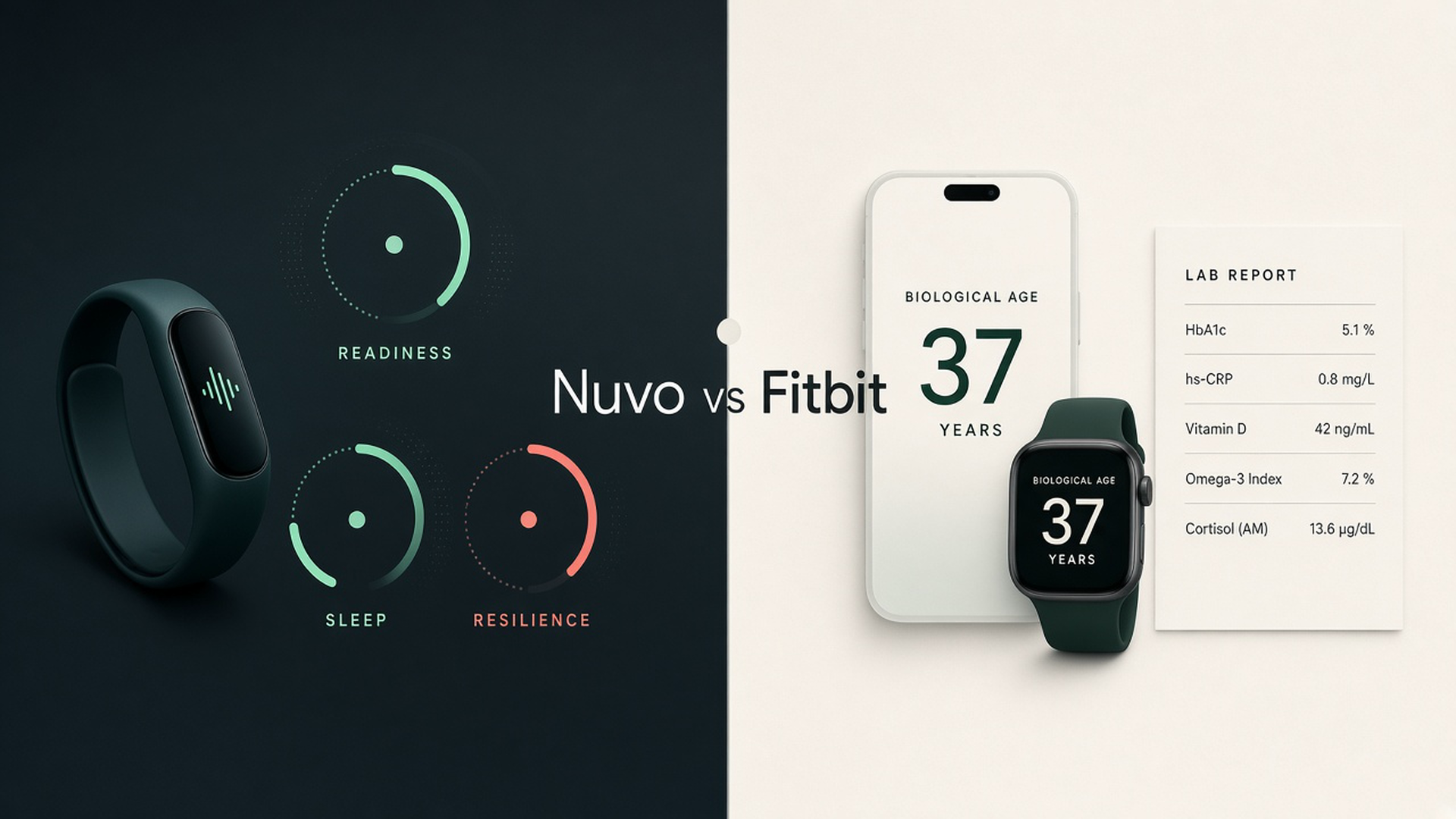
Choose Fitbit — now the Google Health app — if you want a wearable wellness dashboard: a daily readiness score, a sleep score, resilience, cardio load, and VO2 max, plus Google Health Premium coaching on a Fitbit or Pixel Watch. Choose Nuvo if you want a daily biological age on iPhone and Apple Watch from 21 biomarkers — HealthKit wearables plus optional lab PDF — with on-device AI, no account, and $24.99/year after a 7-day trial. They can both talk about recovery. They do different jobs. Fitbit scores how ready, rested, and trained you are today. Nuvo tracks longevity / biological age with optional labs. Many Fitbit users still want that daily 21-biomarker number; they can stack.
Written by the Nuvo Longevity editorial team at Firefly Labs LLC, the developer of Nuvo. Fitbit / Google Health details below are taken from Google’s redesign help article, the Google Health Premium store page, the Premium subscription help article, and the readiness, sleep score, resilience, cardio load, and VO2 max help articles, plus the US App Store listing (id 462638897, Google Health (Fitbit)) and an iTunes lookup, checked 12 October 2026. Where those pages disagree, we quote the page and do not invent a single number. This page is educational and is not medical advice. Readiness, sleep, resilience, cardio load, and an estimated VO2 max are not a clinical biological-age assay, and Nuvo’s daily score is not a substitute for a clinician.
What each product actually sells
Fitbit: Google Health wellness scores and Premium coaching
The US listing is Google Health (Fitbit) (id 462638897), developed by Google, seller Google LLC, bundle id com.fitbit.FitbitMobile. The listing we opened on 12 October 2026 says the Fitbit app is now Google Health. iTunes lookup the same day: version 5.10, current version released 9 October 2026, free to download, minimum iOS 16.4. The store page prints Age Rating 9+. The description says some features require a Google Health Premium subscription, the Google Health app, Wi-Fi, and an internet connection, and that the product is not intended for medical purposes.
Google’s redesign article says that starting 19 May 2026 the Fitbit app becomes the Google Health app. With a Fitbit or Pixel Watch connected, the app uses four tabs: Today, Fitness, Sleep, and Health. The same article says Fitbit Premium becomes Google Health Premium, and subscribers in supported countries get Google Health Coach, built with Gemini. A Google account is required to log in. The Google Store Premium page (checked 12 October 2026) confirms the rename, prints “From $9.99,” and says “Get 3 months of personalized health coaching.” Its FAQ says Google Health runs on Android 11.0 or newer and Apple iOS 16.4 or newer.
What the help articles actually define as scores — not a 21-biomarker biological age:
- Readiness — a daily recovery snapshot from heart-rate variability, recent sleep, and resting heart rate. The readiness article says the score runs from 0 (low) to 100 (high), then later prints categories from 1 to 100: Low 1–29, Moderate 30–64, High 65–100 (the earlier paragraph says Low is 29 or below and High is 65 or above). The first score needs 7 nights of wear. The article says the activity component was removed and replaced with resting heart rate. Premium users get a coach that adjusts training from the score. The article does not call this Nuvo’s biological age.
- Sleep Score — one number for how you slept. The sleep-score article says most users average between 72 and 83, and prints bands: Excellent 90–100, Good 80–89, Fair 60–79, Poor less than 60. Inputs include sleep duration, time to sound sleep, sound sleep, restlessness, interruptions longer than five minutes, and awake time. Extra coach chat about sleep is a Premium purchase on that page. The device has to track sleep stages.
- Resilience — the redesign article says Resilience replaces Stress score in Mental Wellbeing, described as Optimal, Balanced, or Low instead of a number. The stress article still also documents a 1–100 stress management score for the Fitbit app (heart rate, sleep, and activity). We cite both and do not collapse them into one scale.
- Cardio load and target load — weekly cardiovascular strain from heart rate, based on the TRIMP model (heart rate during activity, plus age, resting heart rate, and sex), on the cardio-load article. The same page says a first target can appear after 7 consecutive days and nights, that a personalized target follows about two weeks of wear, and that without Premium the weekly target follows the average cardio load of the previous 4 weeks. Premium coaching on that page can set Recovery, Maintain, or Build targets, and that Premium section says it requires a compatible Android device. Apple Watch and Garmin can sync in for cardio load when connected.
- VO2 max — the redesign article says cardio fitness score is now called VO2 max, calculated during GPS runs, and that the score will no longer be calculated from demographics such as height and weight. The VO2 max article says Google Health estimates it only on outdoor GPS runs (a 10-minute run, or up to three runs in 30 days), from running efficiency versus resting heart rate, then compares that estimate with age, sex, and weight for a fitness level from poor to excellent. Those two pages do not say the same thing about weight. We quote both. It is an estimate, not a mask-on lab test. The VO2 article calls VO2 max a strong predictor of endurance, cardio health, and longevity. That sentence is not a daily biological-age product.
The store page also says Google Health can bring health metrics, vitals, and medical records — lab results, allergies, and medications — into one place, and that you can log meals with a photo. That is a records and coaching view. Public pages we checked do not sell a daily biological age from 21 biomarkers, and they do not describe an optional lab PDF as an input to that kind of clock.
US App Store in-app purchases on 12 October 2026 list Fitbit Premium Monthly $9.99 and Fitbit Premium Annual $79.99 (those two prices repeat on the list). The listing still uses the Fitbit Premium name on those rows. The Google Store page prints “From $9.99” and does not, on the page we fetched, print one annual checkout total. The subscription help article says that as of 19 May 2026 a new or returning Google Account user is offered a 3-month trial after updating, that Google Health Premium is included at no extra cost on Google AI Pro and Google AI Ultra if a Fitbit or Pixel Watch is paired, and that device bundles can activate a 1-month trial instead of 3 months. Coach features on that article require age 18 or older, a Fitbit or Pixel Watch, and a supported country (the United States is on the list). Cite checkout. Tax and which SKU your Apple ID sees can differ.
Privacy is not the Nuvo story. The US listing’s privacy section says data may be collected and linked to you, including Health & Fitness. That is Apple’s “Data Linked to You” label, not “Data Not Collected.” A Google account is required.
Nuvo: a daily 21-biomarker score
Nuvo Longevity (App Store: Nuvo: Longevity Coach, id 6762535065) is an iPhone and Apple Watch app. It calculates a daily biological age from 21 biomarkers: Apple Health / HealthKit data from Apple Watch, Oura, or Garmin, plus optional lab PDF upload so conventional results you already paid for (HbA1c, fasting glucose, HDL, CRP, creatinine, and more) sit in the same score.
Coaching runs as on-device private AI (Nuvo Intelligence). There is no account. Apple’s privacy nutrition label for Nuvo is Data Not Collected. Health data stays on the phone, is not sent to Nuvo servers, and is not sold. Price is $4.99/month or $24.99/year after a 7-day trial — $24.99/year is $2.08/month billed annually. Nuvo is not Android, does not sell a Fitbit or Pixel Watch, and does not replace readiness, sleep staging, or a Gemini coach in the cloud.
Nuvo is not readiness, Sleep Score, resilience, cardio load, or VO2 max. If the job is “one daily biological age from 21 biomarkers, including optional labs, privately, on the phone you already carry,” that is Nuvo. Download app. For the wider field, see our 2026 biological age app comparison. For another wrist-worn recovery contrast, see Nuvo vs WHOOP. For an Apple Watch training coach rather than a Fitbit band, see Nuvo vs Athlytic. For a sleep ring, see Nuvo vs Oura. Apple Watch longevity apps more broadly: best longevity tracking apps for Apple Watch.
Comparison table
| Fitbit (Google Health) | Nuvo Longevity | |
|---|---|---|
| Job to be done | Wearable wellness scores (readiness, sleep, resilience, cardio load, VO2 max) plus optional Google Health Premium coaching on a Fitbit or Pixel Watch. | One daily biological age from 21 biomarkers on the iPhone and Apple Watch you already own, with optional labs you already paid for. |
| Metrics / daily score | Readiness (about 0–100 from HRV, sleep, resting heart rate), Sleep Score (bands from Poor under 60 to Excellent 90–100), Resilience (Optimal / Balanced / Low; a 1–100 stress score is still documented), weekly cardio load, VO2 max from outdoor GPS runs. Not Nuvo’s 21-biomarker biological age. | Yes. Recalculated daily from 21 biomarkers so sleep, HRV, training, and optional labs can sit in one number. |
| Labs | Medical records, including lab results, can sit in the Google Health app. That is not a lab-PDF input to a daily 21-biomarker biological age on the pages we checked. | Optional lab PDF into the same daily 21-biomarker score (HbA1c, fasting glucose, HDL, CRP, creatinine, and more). Not a lab membership. Does not schedule draws. |
| Privacy / account | Google account required. US App Store privacy label: data linked to you, including Health & Fitness. Premium coach needs an internet connection. You can delete or export Google Health data from the app or Google Account (redesign article). | No account. On-device private AI (Nuvo Intelligence). Apple privacy label: Data Not Collected. Data stays on the phone, is not sent to Nuvo servers, and is not sold. See on-device AI and privacy. |
| Price (US public, 12 Oct 2026) | Free download. US App Store in-app list: Fitbit Premium $9.99/month or $79.99/year. Google Store page: “From $9.99” and a 3-month coaching offer; no single annual total on that page. Help center: 3-month trial for new or returning Google Account users after the update; also included on Google AI Pro / Ultra with a paired Fitbit or Pixel Watch. Cite checkout. | $4.99/month or $24.99/year ($2.08/month billed annually) after a 7-day trial. No kit and no wearable is bundled. |
| Platform | iPhone (iOS 16.4+) and Android (11.0+). Scores such as readiness need a compatible Fitbit or Pixel Watch worn overnight. Not a phone-only biological-age app. | iPhone + Apple Watch app. HealthKit from Apple Watch, Garmin, or Oura. Not Android. Does not require a Fitbit band. |
| Best for | People who already wear a Fitbit or Pixel Watch and want readiness, sleep, training load, and optional Gemini coaching. | People who want one daily 21-biomarker biological age on the iPhone they already own, optional labs they already paid for, no account, at $24.99/year. |
| App Store ratings | iTunes lookup on 12 October 2026: 4.47 from 704,923 US ratings for “Google Health (Fitbit).” The listing prints 4.5 and 705K Ratings. Cite the listing; we do not publish a schema.org rating object on this page. | Honestly thin: 5.0 from 4 US ratings (iTunes lookup, 12 October 2026). Do not treat that as a large review corpus. |
What each score actually measures
People searching “Fitbit biological age” usually want one number that says whether the body is younger than the birthday. Google’s public pages we checked do not sell that product. They sell several wellness scores. Readiness is overnight recovery versus your own baseline. Sleep Score is last night’s sleep quality, with age and gender used as targets on the sleep article. Resilience (and the older stress management score) is how the body is handling strain. Cardio load is weekly training impulse. VO2 max is an outdoor-run estimate of oxygen use, which Google’s own article ties to endurance and longevity without turning it into a daily multi-biomarker age.
Nuvo’s 21 biomarkers are wearable plus optional conventional labs — HRV, sleep, fitness, and chemistry such as HbA1c or CRP — recalculated daily on device. A morning readiness of 70 and a Nuvo biological age on the same calendar day are not interchangeable. A Sleep Score moving from Fair to Good is not the same event as HbA1c or CRP moving inside Nuvo’s score. Google’s line that VO2 max predicts longevity is a fitness statement. It is not Nuvo’s clock.
Nuvo does not implement readiness, Sleep Score, resilience, cardio load, or Google’s VO2 max formula as named clocks. Google Health does not implement Nuvo’s 21-biomarker daily biological age.
Can they stack?
Yes — with a narrow pipe, not a shared score. The cardio-load article says an Apple Watch or Garmin can sync into Google Health so those activities count toward cardio load. App Store version history for 5.05 (still on the listing we opened 12 October 2026) says Google Health can share exercise records, sleep, vitals, steps, and more to Apple Health. Nuvo reads HealthKit from Apple Watch, Oura, or Garmin, plus an optional lab PDF. If a type Google Health actually writes into Apple Health is a type Nuvo already reads, it can sit in Nuvo’s inputs. Nuvo does not ingest readiness, Sleep Score, resilience, or Fitbit’s VO2 max as named fields. A lab PDF can go into Nuvo’s 21-biomarker score. A lab result stored as a Google Health medical record does not become that score.
If you only want the band, the sleep stages, and the Premium coach, stop at Fitbit. If you only want the daily biological age, stop at Nuvo. If you already pay for Google Health Premium and still want to see whether sleep, training, or labs showed up in a daily longevity number, stack them.
Privacy
On privacy architecture these two are far apart. Google Health requires a Google account. The US App Store privacy label we read is data linked to you, including health and fitness, and Premium coaching needs an internet connection. Google’s redesign article says you can delete or export health data and can delete the Google Health service, with a 30-day window to change your mind. Nuvo is no account, on-device Nuvo Intelligence, Data Not Collected, data not sent to Nuvo servers, not sold. If the constraint is “no health account and no Nuvo server,” that is Nuvo’s public privacy story, not Fitbit’s. Architecture notes: health app privacy and on-device AI.
Where Fitbit wins
Fitbit wins if the job is wrist-worn wellness scores and a cloud coach. Readiness, sleep stages, Sleep Score, resilience, cardio load, on-device tiles, and Google Health Coach (Gemini, Premium, 18+, Fitbit or Pixel Watch, supported countries) are the product. Nuvo does not claim to beat Fitbit at overnight sleep staging, a 100-point readiness tile on a Charge or Pixel Watch, or a workout-video library. Android is a Fitbit win. Nuvo is iPhone and Apple Watch only. If that dashboard is the product you came to buy, buy Fitbit.
Fitbit also wins on review volume. iTunes lookup on 12 October 2026: 4.47 from 704,923 US ratings. Nuvo’s App Store presence is early: 4 ratings. We are not going to inflate four ratings into social proof, and we do not publish a schema.org rating object for Nuvo.
Where Nuvo wins
Nuvo wins on the daily biological-age job. Fitbit’s headline scores are readiness, sleep, resilience, cardio load, and an estimated VO2 max. Those update from the band. They do not fuse optional HbA1c, CRP, or HDL into a 21-biomarker clock. Nuvo recalculates a daily biological age from 21 biomarkers so sleep, HRV, training, and optional labs can sit in one number.
Nuvo wins on optional labs in the same score. Google Health can store medical records, including lab results. Public pages we checked do not turn that record into Nuvo’s daily score. If you already paid for a conventional panel, Nuvo is the one that can put that PDF next to wearable data.
Nuvo wins on no account and on-device coaching. Fitbit’s coach is Gemini in Google Health Premium, with a Google account and an internet connection. Nuvo Intelligence runs on the phone. That is a product difference, not a slogan.
Price is a different object, not a small gap on the same SKU. The US App Store list shows Fitbit Premium at $79.99/year or $9.99/month. Dividing that listed annual price by 12 is about $6.67 a month. Nuvo is $24.99/year (or $4.99/month) after a 7-day trial. Some people pay neither: Google’s help article includes Premium on Google AI Pro and Ultra when a watch is paired, and describes a 3-month trial. The category difference remains training-and-recovery scores versus a longevity score. You do not need a Fitbit band for Nuvo if you already have an Apple Watch.
Who wins for which user
Buy Fitbit if you want Google Health readiness, sleep, resilience, cardio load, and optional Premium coaching on a Fitbit or Pixel Watch, including on Android. Buy Nuvo if you want a daily 21-biomarker biological age on iPhone and Apple Watch, privately, at $24.99/year, with optional labs. Buy both if you already wear a Fitbit and still want a daily age number from HealthKit plus any conventional lab PDF you have. They do not cancel each other; one is a wellness-score platform, the other is a daily age readout.
If the only job is “readiness, sleep score, and a Fitbit coach,” stop at Fitbit. If the only job is “daily biological age from 21 biomarkers, privately, on iPhone,” stop at Nuvo. Download app.
Habits that actually move aging markers — sleep, aerobic fitness, glucose, inflammation — are covered in How to reduce biological age. This page is only about which product to buy for which job. For SuperAge’s Watch bio-age app, see SuperAge vs Nuvo.
Pricing math without invented discounts
Fitbit / Google Health prices we verified (12 October 2026): the US App Store listing shows in-app purchases named Fitbit Premium Monthly $9.99 and Fitbit Premium Annual $79.99. The Google Store Premium page prints “From $9.99” and a 3-month coaching line, and does not print a single annual figure we could quote. The subscription article describes a 3-month trial for new or returning Google Account users, device trials that can be 1 month instead, and inclusion on Google AI Pro and Google AI Ultra with a paired Fitbit or Pixel Watch. We are not going to invent a $79.99 checkout that ignores those paths, and we are not going to invent an annual price the store page did not print.
Nuvo: $4.99/month or $24.99/year ($2.08/month billed annually) after a 7-day trial. No mailed sample and no band is bundled.
Those dollars buy different things. Comparing $79.99/year Fitbit Premium to $24.99/year Nuvo as if they bought the same object is a category error. Many people already own the band. The remaining question is whether they also want a daily 21-biomarker biological age. That is the Nuvo add, not a rip-and-replace.
Frequently Asked Questions
Should I pick Nuvo or Fitbit?
Pick Fitbit (the Google Health app) if you want readiness, a sleep score, resilience, cardio load, and optional Google Health Premium coaching on a Fitbit or Pixel Watch. The US App Store list we checked 12 October 2026 shows Fitbit Premium at $9.99/month or $79.99/year, with a 3-month trial described on Google’s help and store pages rather than on those in-app rows. Pick Nuvo if you want a daily biological age from 21 biomarkers on iPhone and Apple Watch, optional conventional lab PDF in that same score, on-device AI, no account, and $24.99/year after a 7-day trial. If you already use Fitbit, you can stack: Fitbit for the band scores, Nuvo for the daily 21-biomarker trend.
Is Fitbit a biological age app?
Not in Nuvo’s sense. Google Health (formerly the Fitbit app) is a wearable wellness product: readiness, Sleep Score, resilience, cardio load, and an estimated VO2 max, plus Premium coaching. Public pages we checked on 12 October 2026 do not describe a daily biological age from 21 biomarkers. Google’s VO2 max article calls that estimate a predictor of longevity. That is a fitness metric, not Nuvo’s clock.
What happened to Fitbit Premium?
Google’s redesign article says that as of 19 May 2026 Fitbit Premium is renamed Google Health Premium, with Google Health Coach built with Gemini for subscribers in supported countries. The US App Store listing we opened 12 October 2026 still labels in-app purchases “Fitbit Premium Monthly” ($9.99) and “Fitbit Premium Annual” ($79.99). The Google Store page says the Fitbit app is now the Google Health app and prints “From $9.99.”
What do Fitbit readiness, sleep, and resilience scores measure?
Readiness is a daily recovery score from HRV, recent sleep, and resting heart rate, on a roughly 0–100 scale (the help article also prints 1–100 bands: Low 1–29, Moderate 30–64, High 65–100). Sleep Score summarizes last night, with printed bands of Excellent 90–100, Good 80–89, Fair 60–79, and Poor under 60. Resilience replaces the old stress score as Optimal, Balanced, or Low; the same stress article still documents a 1–100 stress management score. None of those is a 21-biomarker biological age.
Can I use Nuvo with Fitbit?
Yes, as adjacent products. Google Health can take Apple Watch or Garmin activity for cardio load, and version notes on the listing say Google Health can share exercise, sleep, vitals, and steps to Apple Health. Nuvo reads HealthKit plus optional lab PDFs. Nuvo does not ingest Fitbit readiness or Sleep Score as a named input. You do not have to pick only one product. Nuvo does not run on Android, so a Fitbit user on Android still needs an iPhone for Nuvo.
How much do Fitbit Premium and Nuvo cost?
On 12 October 2026 the US App Store listing showed Fitbit Premium at $9.99/month or $79.99/year. The Google Store page showed “From $9.99” and a 3-month offer, without one annual total. Google’s help article also includes Premium on Google AI Pro and Ultra when a Fitbit or Pixel Watch is paired. Nuvo is $4.99/month or $24.99/year ($2.08/month billed annually) after a 7-day trial. Different jobs.
Does Fitbit include blood labs in a biological age?
The Google Store page says medical records such as lab results can be brought into Google Health. That is not, on the pages we checked, a daily biological age computed from an optional lab PDF plus 21 biomarkers. Nuvo can take that PDF into the same daily score. Nuvo does not schedule a blood draw.
Does Nuvo require an account?
No. Nuvo uses on-device private AI and no account. Apple’s privacy label is Data Not Collected; data stays on the phone. Google Health requires a Google account, and the US listing’s privacy label is data linked to you, including Health & Fitness. Privacy is a difference. The product difference is 21 longevity biomarkers (HealthKit plus optional labs) versus Fitbit’s readiness, sleep, resilience, and Premium coach.
Is this medical advice?
No. This comparison is educational and is not medical advice. Google’s listing says Google Health is not intended for medical purposes. Nuvo’s listing says it is not a medical device. Neither product replaces care, diagnosis, or treatment from a licensed clinician. Readiness, sleep scores, estimated VO2 max, wearable biological age, and lab results should be reviewed with a qualified professional.
If the job is a daily biological age from 21 biomarkers on the iPhone and Apple Watch you already own, Download app.